Gulchekhra Makhamadalievа1, Khamid Karimov2
1Hematopoietic Stem Cell Treatment Unit, Republican Specialized Scientific-Practical Medical Center of Hematology MoH RUz, Tashkent, Uzbekistan
2Department of Molecular Medicine and Cellular Technologies, Republican Specialized Scientific-Practical Medical Center of Hematology MoH RUz, Tashkent, Uzbekistan
Correspondence to: Gulchekhra Makhamadalievа, Hematopoietic Stem Cell Treatment Unit, Republican Specialized Scientific-Practical Medical Center of Hematology MoH RUz, Tashkent, Uzbekistan.
| Email: |  |
Copyright © 2024 The Author(s). Published by Scientific & Academic Publishing.
This work is licensed under the Creative Commons Attribution International License (CC BY).
http://creativecommons.org/licenses/by/4.0/

Abstract
To determine the role of single nucleotide gene polymorphism in multiple myeloma with nephropathy. Molecular analysis of the IL10 gene (C-819T) was performed in the Laboratory of Molecular Genetics, Cytogenetics and FISH at RSNPMChematology. We examined 101 patients with reliably diagnosed multiple myeloma aged 34 to 72 years. Analysis of functional significance of IL10 gene polymorphism (C-819T) in patients with uncomplicated course of the disease in comparison with the group of patients with myeloma nephropathy the frequency of allele C was significantly higher in 2.2 times, which proves the reliable connection between the major allele C and a significant reduction in the risk of nephropathy in MM among patients with uncomplicated course of the disease. The C allele of the IL10 polymorphic gene (C-819T) is a protective marker against the development of nephropathy in MM with plasmacytoma.
Keywords:
Multiple myeloma (ММ), Molecular genetics, Polymorphism, IL10
Cite this paper: Gulchekhra Makhamadalievа, Khamid Karimov, Polymorphism (C-819T) of IL10 Gene - Role in Myeloma Nephropathy Development, American Journal of Medicine and Medical Sciences, Vol. 14 No. 12, 2024, pp. 3343-3346. doi: 10.5923/j.ajmms.20241412.56.
1. Introduction
One of the important diagnostic criteria of myeloma, which can determine the prognosis of the course and complications of the disease, is the detection of high levels of inflammatory interleukins (ILs) in the serum [1,2]. Experts believe interleukins play an important role in myeloma progression [3,6]. This is due to genetic changes occurring in the cells of the microenvironment. Depending on the interleukin composition, the rate of relapse-free and overall survival can be evaluated in conjunction with a number of other prognostic indicators in patients with myeloma. Many experimental data have now revealed a specific correlation between the risk of metastasis and interleukin activation in this disease [2,5].The diagnosis and prognosis of complications of multiple myeloma have been studied in recent years [4]. According to multicenter studies, due to conditions leading to hypoxia, inflammation and immune alterations, serious research is underway to better understand the underlying mechanisms of cancer cell growth and the development of resistance to chemotherapeutic drugs. Therefore, studying their effects on proliferation and stimulation of new angiogenesis is currently one of the priority areas of myeloma diagnosis, prognosis and treatment.
2. Main Body
2.1. The Purpose of Our Research
To determine the roles of single nucleotide polymorphism (SNP) of IL10 gene (C-819T) in multiple myeloma.
2.2. Material and Methods of Study
Molecular genetic analysis of IL10 gene (C-819T) was performed in the Laboratory of Molecular Genetics, Cytogenetics and FISH at RSSPMC of Hematology MoH RUz. We examined 101 patients in disease stages “IIIA” and “B” aged 28 to 76 years (mean age of patients was 55.3 ± 2.3 years) in the period from 2021 to 2024. IL10 polymorphism (C-819T) was genotyped by real-time PCR using primers from Litech (Russia) using Applied Biosystems (USA) thermocycler.Patients were divided into the following groups:1) I group – Main (MM) (n=101)2) Ia group – MM without complications, (n=32)3) Ib group – MM with plasmacytoma, (n=37)4) Ic group – MM with plasmacytoma + nephropathy (n=32)5) II group Control group, (n=95)Statistical analysis of genetic results of IL2 (T-330G) polymorphism was performed with IBM software using the package “OpenEpi 2009, Version 9.2”. The frequencies of genotypes and alleles of IL10 (C-819T) polymorphism were compared between the group of patients with MM and healthy control group with determination of the degree of significance of differences in the frequencies of the loci of the studied gene by RXB matching, Pearson test (χ2), odds ratio (OR) and confidence intervals (95% Cl) at P≤0.05.
2.3. Results of the Study
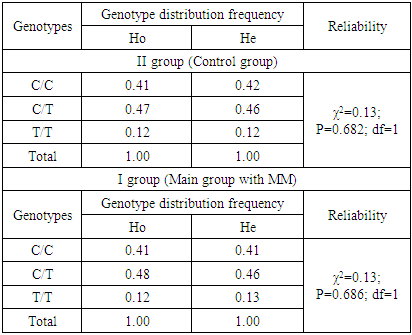
The observed (No) and expected (No) genotypic loci for the IL10 gene (C-819T) in the control and main groups with MM were distributed with no statistically significant differences and followed the Hardy-Weinberg law (HWE) (Table 1).Table 1. Correspondence of genotypic loci of IL10 gene SNP(C-819T) distribution at RXB in II goup (control group) and I group (main with MM groups) (M ± m)
 |
| |
|
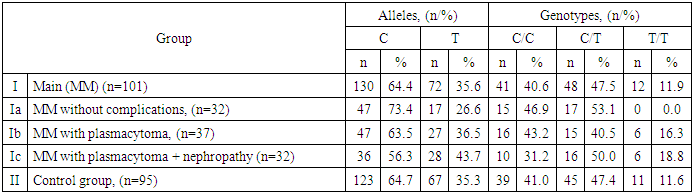
A slight excess in the distribution of heterozygotes for the IL10 gene (C-819T) in the control (Ho=0.47 and He=0.46) and in the group with MM (Ho=0.48 and He=0.46) led to an insignificant increase in the heterozygosity index in the control (Dcontrol=0.04) and main (Dmain MM=0.04) groups.At the same time, the structure of the polymorphic marker IL10 (C-819T) was characterized by a higher frequency of the main allele C and a lower frequency of the weakened variant T in the control group and among patients with MM.All three genotype variants were recorded in all studied groups except for patients with MM without complications.Along with this, if the main loci of the studied marker were found most often in the Ia group, then weakened loci were found in the Ic group of MM complicated by plasmacytoma + nephropathy, which is possibly associated with the participation of these loci in the mechanism of MM (see Table 2).Table 2. Distribution of IL10 gene SNP (C-819T) in groups of patients with MM and controls
 |
| |
|
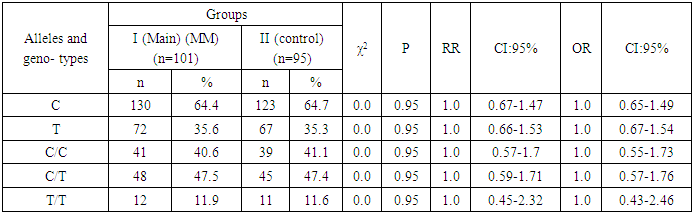
The almost identical distribution of IL10 gene loci (C-819T) in the I group (main) and II group (control) was accompanied by a pattern of no statistically significant differences between the impaired T loci (35.6% vs. 35.3%; χ2<3.84; P=0.95; OR=1.0; CI: 0.67-1.54), C/T (47.5% vs. 47.4%; χ2<3.84; P=0.99; OR=1.0; CI:0.57-1.76) and T/T (11.9% vs. 11.6%; χ2<3.84; P=0.95; OR=1.0; CI:0.43-2.46). In turn, differences that did not reach a significant level in the distribution of IL10 gene loci (C-819T) served as evidence of no association between them and increased MM risk (χ2<3.84; P>0.05) (Table 3).Table 3. Evaluation of the prognostic significance of the IL10 gene SNP (C-819T) in group I (the main group of patients with MM) in comparison with group II (control)
 |
| |
|
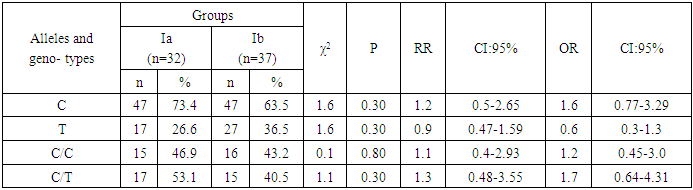
Comparing the differences between the loci of IL10 polymorphic gene (C-819T) in Ia group (MM without complications) in relation to the II group (control) we found differences in the frequencies of the major loci C and C/C exceeding the similar ones in the control insignificantly in 1.5-fold (73.4% vs. 64.7%; χ2=1.6; P=0.3; OR=1.5; CI: 0.8-2.82) and 1.3-fold (46.9% vs. 41.1%; χ2=0.3; P=0.6; OR=1.3; CI:0.57-2.83). Moreover, despite the higher frequency and heterozygous C/T locus in group 2 by 1.3-fold (53.1% vs. 47.4%; χ2=0.3; P=0.6; OR=1.3; CI: 0.56-2.81) the differences between groups were not significant.Comparing the distribution of IL10 polymorphic gene loci (C-819T) in Ib group (MM with plasmacytoma) and II group (control group) s statistically significant differences in the frequencies of attenuated T variants (36. 5% vs. 35.3%; χ2<3.84; P=0.9; OR=1.1; CI:0.6-1.84), C/T (40.5% vs. 47.4%; χ2=0.5; P=0.5; OR=0.8; CI:0.35-1.63), and T/T (16.2% vs. 11.6%; χ2=0.5; P=0.5; OR=1.5; CI:0.51-4.32) were also not established. In regularity with this, statistically insignificant differences in IL10 (C-819T) gene loci (χ2<3.84; P>0.05) between groups 3 and 5 prove that the studied marker cannot serve as a predictor increasing the risk of plasmacytoma development in MM.According to IL10 gene polymorphism (C-819T) loci variants between groups in the Ia and Ib groups were distributed with frequencies without significant differences in C (73.4% vs. 63.5%; χ2=1.6; P=0.3; OR=1.6; CI: 0.77 - 3.29) and T (26. 6% vs. 36.5%; χ2=1.6; P=0.3; OR=0.6; CI: 0. 3 - 1. 3), and in C/C genotypes (46.9% vs. 43.2%; χ2=0.1; P=0.8; OR=1.2; CI: 0. 45 - 3.0) and C/T (53.1% vs. 40.5%; χ2=1.1; P=0.3; OR=1.7; CI: 0.64 - 4.31) were not detected (see Table 4).Table 4. Structural differences of of the IL10 gene SNP (C-819T) in the Ia and Ib groups of of MM patients
 |
| |
|
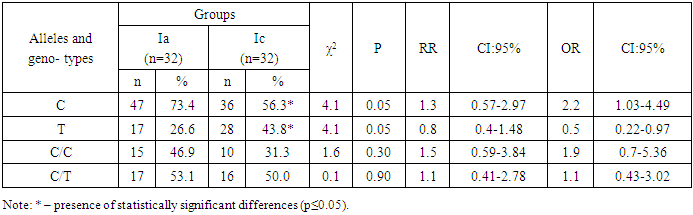
The results confirm that there is no significant risk of plasmacytoma in MM compared to MM patients without complications.At the same time, for the IL10 gene polymorphism (C-819T), the frequency of the C allele was significantly higher 2.2-fold in group Ia (MM without complications) compared to group Ic (MM with plasmacytoma + nephropathy) (73.4% vs. 56.3%; χ2=4.1; P=0.05; OR=2.2; CI:1.03-4.49), whereas the frequency of the T allele decreased statistically significantly (26.6% vs. 43.8%; χ2=4.1; P=0.05; CI:0.22-0.97). However, no significant differences were found in the frequencies of C/C (46.9% vs. 31.3%; χ2=1.6; P=0.3; OR=1.9; CI:0.7-5.36) and C/T (53.1% vs. 50.0%; χ2=0.1; P=0.9; OR=1.1; CI:0.43-3.02) genotypes (see Table 5).Table 5. Structural differences of IL10 gene SNP(C-819T) in groups 2 and 4 of MM patients
 |
| |
|
Thus, the obtained data prove a significant association between the major allele C and a significant reduction in the risk of plasmacytoma + nephropathy in MM among patients with uncomplicated course of the disease.Thus, the absence of statistically significant differences in the distribution of loci of the polymorphic marker IL10 (C-819T) between the groups of patients with MM (I group) and controls (II group) proves the absence of a significant association of the studied genetic marker with the risk of developing MM and its complications (χ2<3.84; P>0.05).In turn, the differences that did not reach a reliable level in the distribution of the IL10 gene loci (C-819T) served as evidence of the absence of an increase in the risk of MM between them. In turn, the absence of significant differences in the IL10 gene loci (C-819T) (χ2<3.84; P>0.05).However, by polymorphism of IL10 gene (C-819T) in group Ia in comparison with group Ic with MM it was found that the frequency of allele C was significantly higher (χ2=4.1; P=0.05), and the frequency of allele T was significantly lower (26.6% vs. 43.8%; χ2=4.1; P=0.05; CI:0.22 - 0.97). These results prove a significant association between the major allele C and a significant 2.2-fold reduction in the risk of plasmacytoma + nephropathy in MM among patients with uncomplicated course of the disease. In accordance with this, allele C of polymorphic gene IL10 (C-819T) is a protective marker in relation to the development of nephropathy in MM with plasmacytoma.
3. Conclusions
Thus, analyzing the peculiarities of distribution and functional significance of loci of polymorphic marker IL10 (C-819T) it is established the presence of a significant association of the studied genetic marker with 2.2-fold reduction in the risk of plasmacytoma + nephropathy in MM among patients with uncomplicated course of the disease.The C allele of the IL10 polymorphic gene (C-819T) is a protective marker against the development of nephropathy in MM with plasmacytoma.
References
| [1] | Abdallah N, Bohra A, Mammadzadeh A, Buadi FK, Kapoor P, Dispenzieri A, Gertz MA, Hayman SR, ElHaj M, Dingli D, Cook J, Binder M, Lin Y, Kourelis TV, Warsame R, Thompson CA, Menser T, Rajkumar SV, Kumar SK. Prognostic Impact of Patient-Reported Symptoms in Multiple Myeloma. Blood Adv. 2024 Dec 5: bloodadvances. 2024014232. doi: 10.1182/bloodadvances.2024014232. Epub ahead of print. PMID: 39637309. |
| [2] | Allegra A, Innao V, Allegra AG, Pugliese M, Di Salvo E, Ventura-Spagnolo E, Musolino C, Gangemi S. Lymphocyte Subsets and Inflammatory Cytokines of Monoclonal Gammopathy of Undetermined Significance and Multiple Myeloma. Int J Mol Sci. 2019 Jun 10; 20(11): 2822. doi: 10.3390/ijms20112822. PMID: 31185596; PMCID: PMC6600674. |
| [3] | Wallington-Beddoe C. T., Mynott R. L. Prognostic and predictive biomarker developments in multiple myeloma // Journal of hematology & oncology. – 2021. – Т. 14. – С. 1-15. |
| [4] | Pavlova AA, Bubnova LN, Bessmeltsev S. S., Pavlova I. E. Polymorphism of Interleukin-4, Interleukin-6 and Tumor Necrosis Factor-α genes in patients with multiple myeloma. Bulletin of Hematology, Vol. XII, No. 2, 2016. pp. 45-46. |
| [5] | Nazarova E.L., Demyanova V.T., Shardakov V.I., Zotina E.N., Dokshina I.A. Association of polymorphisms of some genes of innate immunity with the risk of chronic lymphoproliferative diseases. Hematology and Transfusiology. 2016; 61(4): 183-189. |
| [6] | Shahzad MN, Ijaz I, Naqvi SSZH, Yan C, Lin F, Li S, Huang C. Association between interleukin gene polymorphisms and multiple myeloma susceptibility. Mol Clin Oncol. 2020 Mar; 12(3): 212-224. doi: 10.3892/mco.2020.1979. Epub 2020 Jan 16. PMID: 32064097; PMCID: PMC7016519. |


 Abstract
 Reference
 Full-Text PDF
 Full-text HTML