
-
Paper Information
- Next Paper
- Previous Paper
- Paper Submission
-
Journal Information
- About This Journal
- Editorial Board
- Current Issue
- Archive
- Author Guidelines
- Contact Us
American Journal of Medicine and Medical Sciences
p-ISSN: 2165-901X e-ISSN: 2165-9036
2024; 14(12): 3339-3342
doi:10.5923/j.ajmms.20241412.55
Received: Nov. 23, 2024; Accepted: Dec. 17, 2024; Published: Dec. 28, 2024

Effect of Neurotrophic Therapy in the Treatment of Neurological Disorders in Chronic Kidney Disease
 Abstract
 Reference
 Full-Text PDF
 Full-text HTML
Rakhmatova Dilbar Ismatilloevna
PhD Associate Professor, Department of Neurology Bukhara State Medical Institute, Uzbekistan
Correspondence to: Rakhmatova Dilbar Ismatilloevna, PhD Associate Professor, Department of Neurology Bukhara State Medical Institute, Uzbekistan.
| Email: |  |
Copyright © 2024 The Author(s). Published by Scientific & Academic Publishing.
This work is licensed under the Creative Commons Attribution International License (CC BY).
http://creativecommons.org/licenses/by/4.0/

Introduction. The problem of neurological disorders chronic kidney disease is currently the subject of research by many scientists, since it is relevant for almost all countries of the world. Neurological complications in chronic kidney disease are currently leading among the most common diseases. Purpose of the study. To analyze the therapeutic effect of neurotrophic therapy (Gliatilin), depending on its dose, in motor and cognitive disorders in patients with neurological disorders in chronic kidney disease. Research materials and methods. Neuropsychological studies assessing attention, memory, mental performance, and fluency were used to assess cognitive functions. For this, the MMSE test and special tests were used, such as the visual memory test, the Bourdon test, the speech activity test, the clock drawing test. Monitoring of the bioelectrical activity of the brain in all patients was carried out using a 16-channel computer electroencephalograph. Research results. Most often, patients of the main and control groups complained of headache, dizziness, memory loss, increased fatigue, irritability, and emotional lability. Most patients of the main group had cognitive impairments of varying severity, 55% of patients had ataxia, hypokinesia was observed in 23% of patients, non-severe pyramidal disorders in 51%, pseudobulbar disorders were observed in 22% of patients. Conclusions. Indicators of bioelectrical activity of the brain according to EEG during Gliatilin therapy indicate a decrease in diffuse cerebral disorders. Sol.Gliatilini in doses of 1000 mg has a pronounced multimodal property, has a rapidly developing neuroprotective effect, which allows us to recommend its use for the therapeutic correction of both neuropsychological and motor disorders in patients with encephalopathy in chronic kidney disease.
Keywords: Encephalopathy, Chronic kidney disease, Gliatilin, EEG, Neuroprotection, Neuropsychologic examination
Cite this paper: Rakhmatova Dilbar Ismatilloevna, Effect of Neurotrophic Therapy in the Treatment of Neurological Disorders in Chronic Kidney Disease, American Journal of Medicine and Medical Sciences, Vol. 14 No. 12, 2024, pp. 3339-3342. doi: 10.5923/j.ajmms.20241412.55.
1. Introduction
- The problem of neurological disorders chronic kidney disease is currently the subject of research by many scientists, since it is relevant for almost all countries of the world. Neurological complications in chronic kidney disease (CKD) are currently leading among the most common diseases. Among patients with pre-dialysis CKD, the risk of developing both ischemic and hemorrhagic stroke is significantly higher, but ischemic stroke still prevails in incidence compared to hemorrhagic stroke. Encephalopathy is a cerebral dysfunction caused by the accumulation of toxins due to acute or chronic renal failure. This condition typically develops in patients with acute or chronic renal failure whose estimated glomerular filtration rate is below 65 ml/min [1,2,7,8].The clinical presentation varies widely, from subtle to florid, and the clinical course invariably progresses if left untreated. The syndrome likely results from alterations in hormonal metabolism, retention of uremic solutes, changes in electrolyte and acid-base homeostasis, blood-brain barrier transport, vascular reactivity issues, and inflammation [3,5,9,11]. Urea is the most commonly measured indicator of uremic toxins, but many other substances are being studied as contributors to uremia. Diagnosis of uremic encephalopathy is challenging because there are no specific clinical, laboratory, or imaging findings. Early recognition and treatment are crucial, as uremic encephalopathy is an absolute indication for initiating renal replacement therapy. Qualitative diagnostics of cognitive disorders should include neuropsychological research, since the first manifestations of this disease are psycho-emotional disorders and the most disabling consequences are associated with higher mental disorders. And therefore, in the therapeutic correction of encephalopathy, neuroprotective drugs are of great importance for patients with chronic kidney disease [4,6,10]. Purpose of the study. To analyze the therapeutic effect of neurotrophic therapy (Gliatilin), depending on its dose, in motor and cognitive disorders in patients with neurological disorders in chronic kidney disease.
2. Research Materials and Methods
- Neuropsychological studies assessing attention, memory, mental performance, and fluency were used to assess cognitive functions. For this, the MMSE test and special tests were used, such as the visual memory test, the Bourdon test, the speech activity test, the clock drawing test. Monitoring of the bioelectrical activity of the brain in all patients was carried out using a 16-channel computer electroencephalograph.The study was conducted in a multidisciplinary Bukhara regional hospital in the department of neurology for 6 months. All patients underwent a comprehensive clinical and instrumental examination. The main group consisted of 54 patients with encephalopathyin chronic kidney disease, aged 45-70 years (mean age 61 years).Of these, 28 patients received Gliatilin at the dose of 1000 mg use of Gliatilin in the form of injections per 150.0 ml of saline solution for 10 days and 26 patients received Gliatilin 400 mg in the form of tablets 2 times a day for 2 weeks, but the dynamics of the disease was observed within 2 months. The control group consisted of 45 patients with encephalopathyin chronic kidney disease of the same age who received standard therapy.
3. Research Results
- Most often, patients of the main and control groups complained of headache, dizziness, memory loss, increased fatigue, irritability, and emotional lability. Most patients of the main group had cognitive impairments of varying severity, 55% of patients had ataxia, hypokinesia was observed in 23% of patients, non-severe pyramidal disorders in 51%, pseudobulbar disorders were observed in 22% of patients.Objective criteria for evaluating the effect of Gliatilin on cerebral cognitive functions were the data of neuropsychological control studies indicating an increase in the activity of mental processes in patients after treatment with Gliatilin. A mini-study of the mental state using the MMSE test, which makes it possible to judge such cognitive functions as perception, orientation, attention, counting, memory, speech, reading and writing, revealed an initially low level of preservation of cognitive functions before treatment. The average score equal to 19 before treatment increased to 27, approaching the maximum (30 points) in the treatment with Gliatilin at doses of 1000 mg. When treated with Gliatilin at a dose of 400 mg of tablets, the test results increased to 24 points. The indicators of the control group have an average score of 20 (Pic. 1).
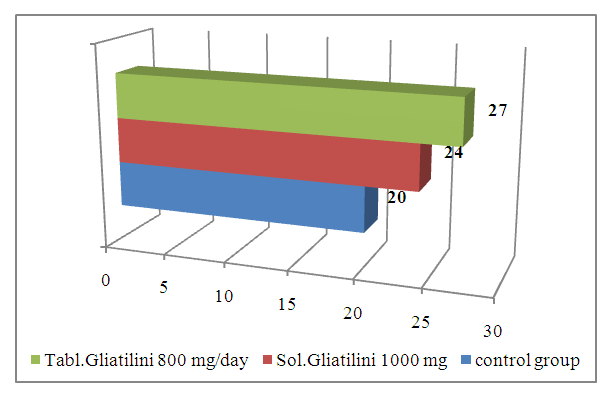 | Picture 1. The results of the MMSE test of the subjects within two months, depending on the dose of Gliatilin, compared with the control group |
|
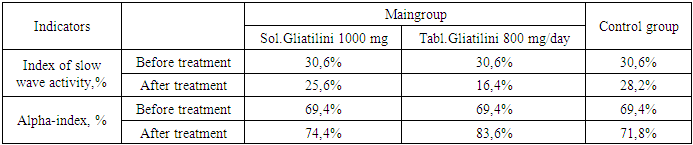
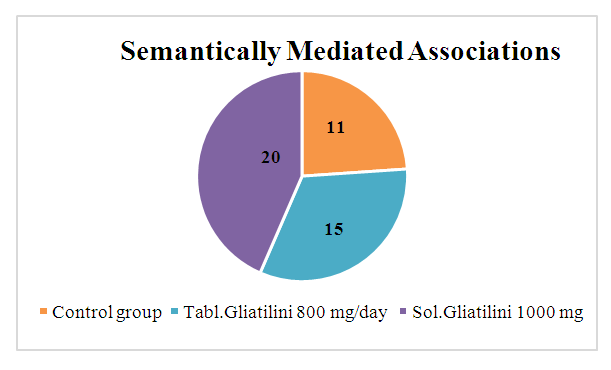 | Picture 2. Results of the test for speech activity after treatment with Gliatilin at different doses |
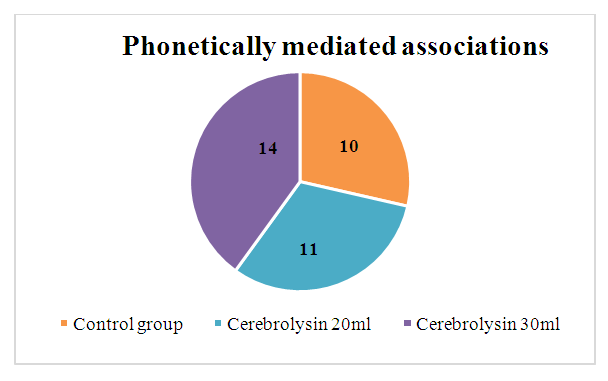 | Picture 3. Results of the test for speech activity after treatment with Gliatilin at different doses |
4. Conclusions
- 1. The use of Gliatilin in patients with encephalopathy in chronic kidney disease is pathogenetically justified and is expressed as a dynamic effect in the shortest possible time of treatment. These changes are especially visible when using Sol.Gliatilini in doses of 1000 mg.2. Sol.Gliatilini at doses of 1000 mg has a positive effect on intellectual-mnestic disorders, significantly affects the dynamic indicators of the cognitive sphere (memory, perception, mental performance, etc.).3. Indicators of bioelectrical activity of the brain according to EEG during Gliatilin therapy indicate a decrease in diffuse cerebral disorders. Sol.Gliatilini in doses of 1000 mg has a pronounced multimodal property, has a rapidly developing neuroprotective effect, which allows us to recommend its use for the therapeutic correction of both neuropsychological and motor disorders in patients with encephalopathy in chronic kidney disease.Information about the source of support in the form of grants, equipment, and drugs. The authors did not receive financial support from manufacturers of medicines and medical equipment.Conflicts of interest. The authors have no conflicts of interest.