Abdirimova Gulrukh Ibadullaevna
Independent Researcher, Tashkent State Dental Institute, Tashkent, Uzbekistan
Correspondence to: Abdirimova Gulrukh Ibadullaevna, Independent Researcher, Tashkent State Dental Institute, Tashkent, Uzbekistan.
Copyright © 2024 The Author(s). Published by Scientific & Academic Publishing.
This work is licensed under the Creative Commons Attribution International License (CC BY).
http://creativecommons.org/licenses/by/4.0/

Abstract
In addition to the main clinical and laboratory research methods, the prevalence, intensity and acceleration of enamel hypoplasia in 132 children born under the influence of hormonal drugs in congenital pregnancy were studied. In these children, as well as the state of oral hygiene, as well as the knowledge of sick children and their parents, teachers on the method of proper oral hygiene was determined. Extensive preparatory work and appropriate organizational measures provided the opportunity to accurately conduct dental examinations in minimal time. The data of public dental examinations were entered in the individual card. Examination of oral cavity organs in children was carried out according to generally accepted clinical methods. The position of the existing teeth in the oral cavity of children was studied, starting from the upper jaw from right to left, then from left to right in the lower jaw.
Keywords:
Enamel hypoplasia, Milk tooth, OHI-S (Oral Hygiene Indices-Simplified), EO'D intensity
Cite this paper: Abdirimova Gulrukh Ibadullaevna, Follow-Up Results of Enamel Hypoplasia and Enamel Hypoplasia in Dairy Teeth under the Influence of Hormonal Drugs Used in Pregnancy, American Journal of Medicine and Medical Sciences, Vol. 14 No. 11, 2024, pp. 3045-3050. doi: 10.5923/j.ajmms.20241411.81.
Article Outline
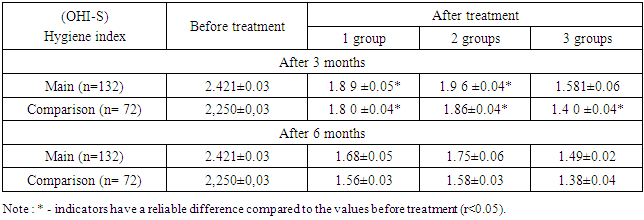
Children with enamel hypoplasia in milk teeth under the influence of hormonal drugs used during pregnancy were divided into the main (132) and comparison (72) groups. For all patients of the study, the treatment of enamel hypoplasia in milk teeth began with a dental examination, teaching the rules of individual oral hygiene and monitoring the implementation of these rules. Professional oral hygiene was carried out: soft caries were removed, caries and its complications were treated [2].The main group of 132 patients, taking into account the effect of hormonal drugs used during pregnancy, in order to perform immunomodulatory treatment along with traditional therapy due to the decrease of the immune system, we (Immudon tab. No. 40) 2 tablets 3 times a day for 10 days and 10 more after 10 days 2 tablets are prescribed 3 times a day. The main group of children was prescribed treatment 2 times a year, 1 time every 6 months. A comparison group of children who received traditional medical therapy was given treatment twice a year.The following treatment scheme was introduced in the main group of patient children.It was studied in 3 large groups.In group 1, 45 patients were treated with zirconium-based dental coverings as the main form of treatment for 15 days. Immudon in order to increase the local immunity of the body 2 tablets were prescribed 3 times a day for 20 days;2 groups, 36 patients were treated with fluoride toothpastes as the main treatment method for 15 days. Immudon in order to increase the local immunity of the body 2 tablets were prescribed 3 times a day for 20 days;3 groups, 51 patients were treated for 10 days with the basic treatment method, a complex of both zirconium-based dental coating and fluoride-preserving toothpaste. Immudon in order to increase the local immunity of the body 2 tablets were prescribed 3 times a day for 20 days;A comparison was made regarding the traditional treatment scheme in the children of the group [3].The patients of the comparison group were children who were born free of the effects of hormonal drugs during pregnancy, and children with enamel hypoplasia were considered, and we divided them into 3 large groups depending on the method of treatment.1 group of 24 children patients were treated with zirconium-based dental veneers along with the above treatments.2 groups of 21 patients and children were treated with fluoride-containing toothpastes along with the above treatments.3 groups of 27 children were treated with complex zirconium-based dental veneers and fluoride-containing toothpastes.The following criteria: index assessment of periodontal condition, OHI-S (Oral Hygiene Indices-Simplified), R MA, histo-morphological, immunological. The effectiveness of treatment was studied 3 months and 6 months after the start of treatment (survey, clinical-laboratory studies).Analysis of the effectiveness of complex treatment of patients with enamel hypoplasia in milk teeth under the influence of hormonal drugs used during pregnancyPositive dynamics of clinical indicators were obtained 3 days after the start of complex treatment of enamel hypoplasia in milk teeth under the influence of hormonal drugs used during pregnancy with both zirconium-based dental coating and fluoride-retaining toothpaste [6].72 patients of Taqqo Slash group, a positive dynamics of clinical indicators was obtained against the background of the complex treatment course of enamel hypoplasia in the traditional way.In the main group of our research groups, when the oral hygiene indices were compared, OHI-S hygiene after 2 months was 1.89, 1.96 to 1.581 after 2 months in milk teeth, enamel hypoplasia in the main group of enamel hypoplasia under the influence of hormonal drugs used in pregnancy, that is, 81.7%, after 6 months this indicator approached a relatively satisfactory level (Table 1). In our main group of patients, the result was satisfactory in 1st group of patients, and satisfactory in 2nd group of patients. In our 3 groups of patients, a significant improvement of results was observed on the basis of complex treatment [5].Table 1. Results of OHI-S (Oral Hygiene Indices-Simplified) index of oral hygiene in the background of treatment
 |
| |
|
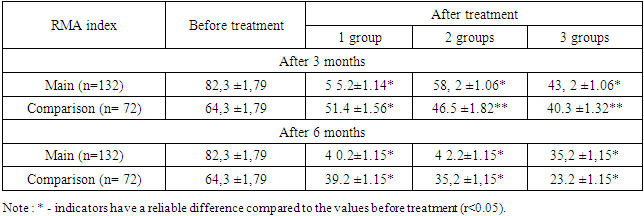
In the study groups, we witnessed an improvement in the outcome in the main and comparison groups against the background of complex treatment (both zirconium-based dental veneers and fluoride-retaining toothpastes). After 3 months, a positive significant level was observed in both groups. After 6 months, there was a significant improvement in these results.Oral hygiene scores improved relatively in the comparison group. Everyone in our research group was given professional hygiene measures, in addition, hygienic classes and interviews were conducted to their parents, help was given to choose personal hygiene products, controlled tooth brushing was carried out, mistakes and deficiencies were corrected, and we were satisfied with their oral hygiene (1.56- 1.58) and poor (1.38) to satisfactory and even improved.During the study allowed to note that this indicator was the highest in the main group of children with enamel hypoplasia (n= 132) in milk teeth under the influence of hormonal drugs used during pregnancy, and the value of the PMA index was 78.3 %. After treatment, these indicators decreased by 23% after 3 months in 3 groups compared to other groups (n=51), and after 6 months, this indicator decreased again by 11.2% and a good result was achieved (r<0.05). In the comparison group, in 3 groups of patients with enamel hypoplasia, the results after 6 months showed that the PMA index was 75.6%, which is higher (Table 2).Table 2. The RMA index of oral hygiene in the examined children against the background of treatment
 |
| |
|
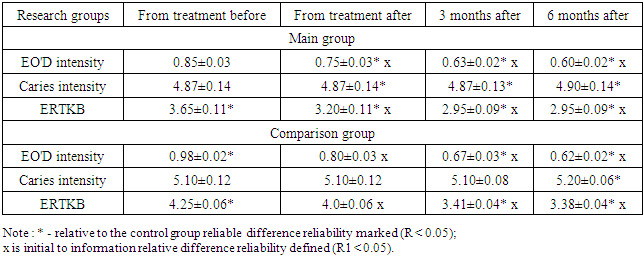
The results of the RMA index on the background of treatment in the study group showed an improvement in the result in the background of complex treatment (complex both zirconium-based dental veneers and fluoride-retaining toothpastes) in the main and comparison groups. After 3 months, a positive significant level was observed in both groups. It was found that in the background of the complex treatment of children of the comparison group, it decreased from 78.3% to 35%, respectively, in 3 groups (n= 27), and to 28% after 6 months. %, after 6 months it was found to be 34%. After 6 months, there was a significant improvement in these results [8].Children born under the influence of hormonal drugs during pregnancy, children without hypoplasia of milk teeth, improvement of general periodontal condition, regression of clinical signs and general evaluation of changes in the results of special research methods made it possible to determine the highest therapeutic effect observed in the complex use of drugs.The method of special treatment of enamel hypoplasia of milk teeth in children born under the influence of hormonal drugs during pregnancy is a complex complex, local treatment with both zirconium-based tooth coating and fluoride-containing toothpaste, the result of special treatment was tested in practice. The complex exhibits anti-process activity similar to that of zirconium-based dental veneers and fluoride-sparing toothpastes, as well as high esthetic activity.In conclusion, in our opinion, positive dynamics were observed in all groups after treatment. The results of the collected statistical data on children's complaints after treatment in the background of complex treatment and in the background of individual treatment decreased significantly [9].Pregnancy have a high rate and spread of hypoplasia of milk teeth, the speed of remineralization of teeth is sharply reduced, especially during the advanced stage of the disease. Based on this, we suggested to use the remineralizing gel after cleaning the teeth in the morning and in the evening by rubbing for 2-3 minutes without spitting as long as possible. The treatment course lasted 14 days in the comparison group and 20 days in the main group. In the course of treatment, fluoride-preserving toothpastes saturate the teeth with calcium and phosphorus, then have an active fluoridating component, which strengthens the enamel of the teeth with calcium and phosphorus, restores the mineral structure of the enamel, the high absorbency of this paste ensures long-term and reliable protection of the enamel of the teeth [10].Table 3 shows the results obtained after caries prevention according to the studied indicators.Table 3. Patient E O'D intensity in children indicators change
 |
| |
|
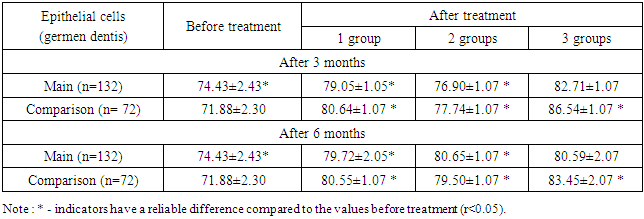
EO'D is a study of the intensity of the initial stage of caries in the main group dental prophylaxis of the complex effect under the following change character manifested, treatment from the course after its decrease is more than 1.1 times, in the comparison group - 1.2 times observed. From 3 months after treatment after this indicator in the main group initial with compared with 1.35 times, in the comparison group - 1.46 times decreased (0.98 vs. 0.67, P<0.05).6 months then E O'D is decreasing continue did, but significant not, 1.42 times in the main group (corresponding 0.85 vs. 0.6 respectively, P<0.05), but was reliably lower than the initial values. EO'D indicators in the comparison group of treatment effect decreases to a greater value under and from 6 months followed by a 1.58-fold decrease (0.98 vs. 0.62, P<0.05) and initial from the data reliable low maintenance was observed. Standard dental in treatment has been Children in the observation group Children born under the influence of hormonal drugs during pregnancy have hypoplasia of milk teeth A significant amount of E O'D level decrease was observed, while the intensity of EO'D in the comparison group indicators growth observed and from 3 and 6 months after this indicator was reliably higher compared to the initial values [11].Results of post-treatment histomorphological examination in children with enamel hypoplasia of milk teeth caused by hormonal drugs during pregnancyof children with enamel hypoplasia in milk teeth caused by hormonal drugs during pregnancy was also confirmed by histo-morphological studies. In the main group of patients, the amount of epithelial cells increased after the course of treatment, approaching the physiological value of indicators, which was especially expressed by the number of (germen dentis) cells reaching the value of physiological indicators 3 and 6 months after treatment. Papilla dentis also increased under the influence of the course of treatment and at the end of the follow-up, by the 6th month, it was reliably higher than the initial data. Significant and reliable reductions were also observed in the study of enameloblast cells. If these indicators reliably increased in the patient's children, then after treatment (after 1 month) a decrease in these indicators, but a sharp expression of the character, was observed. Thus, if Cuticula enamel cells were reliably decreased after treatment compared to baseline in both subgroups and at 3 and 6 month follow-up, this decrease was not only maintained, but continued to decrease and reached physiological levels after 6 months [1].Sacculus dentis cells also had a similar decreasing character. The next parameters studied, Dentin histogenesis, decreased reliably after cell treatment, continued to decrease after 3 and 6 months of follow-up, but did not reach physiological values, but came close to these values (Tables 4-5-6). The amount of odontoblast cells of all types in children with enamel hypoplasia in milk teeth caused by hormonal drugs during pregnancy decreased reliably, approaching physiological values after a course of treatment with both zirconium-based tooth coating and fluoride-containing toothpaste. Thus, Predentin was mostly maintained at the achieved positive level at 3 and 6 months of follow-up, these indicators were reliably lower than the initial data and close to the physiological norm. The dynamics of the positive change of cementoblasts showed that these indicators approach the physiological norm immediately after the treatment (especially in the comparison group) and after 3 and 6 months of follow-up, the comparison group is kept at a positive level, below the initial data. In the main group, this indicator reaches physiological values after treatment and remains at this level until the end of the follow-up. It should be mentioned that in the main group, according to all the studied histo-morphological indicators, the restoration of the composition of the dental hard tissue was expressed both after the treatment and in the long periods of observation (after 3 and 6 months).Table 4. Epithelial cells (germen dentis) multiply after treatment
 |
| |
|
Table 5. Post-treatment concentration multiplier of enameloblast index
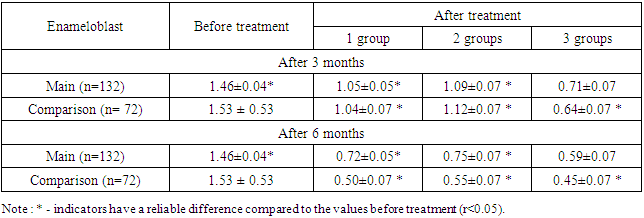 |
| |
|
Table 6. Post-treatment concentration multiplier of odontoblast index
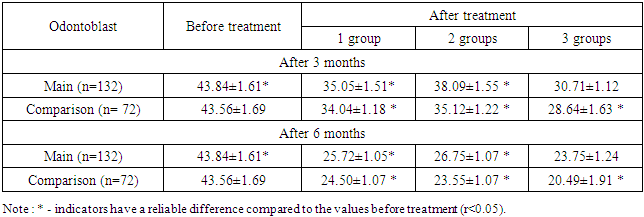 |
| |
|
Hypoplasia of milk teeth, children born under the influence of hormonal drugs during pregnancy, was a reliable reduction in the number of cellular elements with histopathological phenomena. Positive dynamics of histo-morphological changes are also observed in the group of children undergoing standard dental treatment, but the obtained data are significantly lower than during the course of treatment and the difference is not reliable [12].A study in the main group of children born under the influence of hormonal drugs during pregnancy with hypoplasia of milk teeth and enamel showed that the amount of Germen dentis cells in the histograms after a course of treatment with both zirconium-based dental veneers and fluoride-containing toothpastes was significantly higher compared to the pre-examination state and 3 months after treatment. revealed that the indicator is close to the physiological value. In this case, the nucleated cells of the spinous layer approached the physiological norm after treatment and increased to the physiological norm after 3 months in the main and comparison groups. At the same time, in both large groups of children born under the influence of hormonal drugs during pregnancy, the number of Germen dentis cells in children with hypoplasia of milk teeth reached physiological values after treatment and remained at the level reached until the end of the observation (3 and 6 months after treatment).With both zirconium-based dental veneers and fluoride-containing toothpastes is the decrease in the number of cellular elements with histopathological events, which reliably decreased after the treatment complex compared to the initial data and remained at the achieved level until the end of the follow-up. Among the cells with histopathological symptoms, Enameloblast cells reliably decrease compared to the initial data after the course of treatment, approach physiological values and reach the physiological norm only by the 6th month. The number of enameloblast cells after a course of treatment with both zirconium-based dental veneers and fluoride-containing toothpastes decreased significantly and approached the physiological norm and remained at this level until the end of the follow-up [16]. The number of Cuticula enamel cells and the number of Sacculus dentis cells with microorganisms had a positive decreasing dynamics, as well as the number of Dentin histogenesis cells after the course of treatment with both zirconium-based dental veneers and fluoride-retaining toothpastes.The study of connective tissue cells - the amount of odontoblast basic cell elements in children with enamel hypoplasia in the comparison group. Children born under the influence of hormonal drugs during pregnancy were significantly higher compared to children with enamel hypoplasia of primary teeth. a sufficiently significant reliable decrease is observed and continues to decrease throughout the observation period, reaching a value close to the physiological norm by the 6th month [17].The amount of cementoblast is decreasing like Predentin. The complex reliably decreases more than 1.5 times compared to the baseline value in the main group and 2 times compared to the comparison group after a course of treatment with both zirconium-based dental veneers and fluoride-containing toothpastes, and in both large groups, it approaches physiological values and continues to decrease until the end of the follow-up. [19]. The amount of cementoblast has a similar decreasing character. In this group, as well as in the main group, the pathological, histo-morphological changes detected in the patients with the comparison group were deeply and vividly expressed, and as a result of the complex treatment with both zirconium-based dental coating and fluoride-containing toothpaste, the observation on all histo-morphological indicators was mainly studied. expressed with very long-lasting results in all periods. Complex treatment with both zirconium-based dental veneers and fluoride-containing toothpastes is effective in the treatment of enamel hypoplasia in children, which was confirmed by clinical and histo-morphological methods. In general, the use of the histo-morphological method made it possible to classify the composition of healthy tooth hard tissue, to identify histo-morphological changes in tooth hard tissue damage in children with enamel hypoplasia. The results of the research also made it possible to use the histo-morphological method in the closed passage of inflammatory reactions in the hard tissues of the teeth, to check and evaluate the effectiveness of the used methods [17].Thus, the comparative analysis of the obtained data allows us to conclude that a complex one-month course of treatment with both zirconium-based dental veneers and fluoride-containing toothpastes is a sufficiently effective method for the prevention and treatment of basic dental diseases in children with enamel hypoplasia in comparison with individual treatment types. gave Based on the results of the study, the use of complex treatment with both zirconium -based dental veneers and fluoride-preserving toothpastes improved the hygiene and physico-chemical condition of the oral cavity, and reduced caries. treatment with toothpaste allows to recommend when various pathological changes develop in the oral cavity of children [15].
References
| [1] | Denis Moiseev, Sergey Donskov, Ivan Dubrovin, Mariya Kulyukina, Yuriy Vasil’ev, Shodiya Shadieva A NEW WAY TO MODEL PERIODONTITIS IN LABORATORY ANIMALS \\ Dentestry Journal. 18 September 2023. |
| [2] | Yagmurovna K. L Immunological Aspects of Pathogenesis of Periodontal Pathology in Patients with Chronic Pyelonephritis American Journal of Medicine and Medical Sciences 2023, 13(12): P-1942-1945. |
| [3] | Shadieva Shodiya Shukhratovna, Kamolova Lobar Yagmurovna FEATURES OF THE CONDITION OF THE ORAL CAVITY INCHILDREN OF A PATIENT WITH CHRONIC PYELONEPHRITIS.EURASIAN JOURNAL OF MEDICAL AND NATURAL SCIENCES (157-163) 2023. |
| [4] | Shadieva Shodiya Shukhratovna, Kamolova Lobar Yagmurovna PREVENTIVE MEASURES TO PREVENT DENTAL CARIES IN YOUNG CHILDREN. JOURNAL OF HUMANITIES. 2023 (68-70). |
| [5] | Shadieva Shodiya Shukhratovna, Kamolova Lobar Yagmurovna Achievements and Problems in the Prevention of Dental Caries and Periodonral Diseases. Journal of Humanities and Medical Sciences. 01.09. 2023 (43-46). |
| [6] | R. А. Farmonova. Physiology - the Science of Life Processes. // American Journal of Pediatric Medicine and Health Sciences Volume 01, Issue 10, 2023 / ISSN (E): 2993-2149 // P. 690-694. |
| [7] | R.A. Farmonovna. Immunological Aspects of the Development of Oral Lesions in Inflammatory Bowel Disease // American Journal of Pediatric Medicine and Health Sciences // Volume 01, Issue 10, 2023 // ISSN (E): 2993-2149// Р. 682-689. |
| [8] | Sanoeva M. J., Giyazova M. M. Some ethnopathogenetic aspects and features of damage to oral structures in coronavirus infection. (review). Journal of neurology and neurosurgery research Volume 2, ISSUE 4. – 2021. – С. 48-53. |
| [9] | Giyazova Malika Mukhammadovna Methods of early diagnosis of lesions of organs and systems in coronavirus infection in the practies of a dentist // Journal Problems of biology and medicine 2023, №6 (150) С.86-93. |
| [10] | Giyazova M. M., Sanoeva M.J. The influence of immunobiological structures of the body on the clinical course of coronavirus infection. // A new day in medicine 7 (57) 2023. - С.231-237. |
| [11] | Giyazova M.M. The impact of immunobiological components of the body on the clinical course of coronavirus infection // Bulletin of funda-mental and clinic medicine // 2023, № 1/1 C.139-148. |
| [12] | Giyozova Malika Mukhammadovna Manifestation of pathology of the oral cavity in case of infection with coronavirus (COVID – 19) infection // Proceedings of the Republikan scientific practical conference. «COVID – 19 and issues of its rehabilitation » October 14-15 Bukhoro, Uzbekistan P. 25-26. |
| [13] | Giyozova M. M., Sanoeva M. J. Neurostomatological features of damage to oral structures in coronavirus infection // Republican scientific and practical conference (with internatiol participation) Neurodegenerative and vascular diseases of the nervous system. February 10 2022 year С. 28-29. |
| [14] | M. Giyazova, M. Sanoeva Violation of motor and non-motor in patientas with COVID-19 with oral pathology // World congress on Parkin-son’s diseases and related disorders. A comprehensive educational program 2022, 01-04 May P. 158-1598. |
| [15] | Dilnoza Khasanova Akhrorovna, Dildora Khaitova Sharipboevna Comparative Analysis of Morphological Indicators of the Cranial Sphere in Children with Hearing Loss // American Journal of Medicine and Medical Sciences 2024, 14(3): 713-718. |
| [16] | Khaitova D.Sh. Changes in the dental system in children and adolescents with hearing loss // New day in medicine. Tashkent, 2023. - № 2 (52). - С 79-82. (14.00.02; №22) |
| [17] | Xaitova D.Sh. Analysis of anthropometric indicators of the craniofacial region in children 8-9 years old with hearing loss // New day in medicine. Tashkent, 2022. - № 11 (49). -С 497-500. (14.00.02; №22) |


 Abstract
 Reference
 Full-Text PDF
 Full-text HTML