
-
Paper Information
- Next Paper
- Previous Paper
- Paper Submission
-
Journal Information
- About This Journal
- Editorial Board
- Current Issue
- Archive
- Author Guidelines
- Contact Us
American Journal of Medicine and Medical Sciences
p-ISSN: 2165-901X e-ISSN: 2165-9036
2024; 14(11): 3041-3044
doi:10.5923/j.ajmms.20241411.80
Received: Nov. 2, 2024; Accepted: Nov. 22, 2024; Published: Nov. 28, 2024

Morphological Characteristics of Hodgkin's Lymphomas in Special Regions
 Abstract
 Reference
 Full-Text PDF
 Full-text HTML
M. A. Kadamova, U. A. Ruzmetov, B. S. Yuldashev
Urgench Branch of the Tashkent Medical Academy, Urgench, Uzbekistan
Copyright © 2024 The Author(s). Published by Scientific & Academic Publishing.
This work is licensed under the Creative Commons Attribution International License (CC BY).
http://creativecommons.org/licenses/by/4.0/

This article provides a retrospective analysis of case histories and outpatient cards of patients living in the Khorezm region who were diagnosed with Hodgkin's lymphoma and who were treated at the Khorezm branch of the Republican Specialized Scientific and Practical Center of Oncology and Radiology during 2019-2023. The results of the analysis were studied, pathomorphological changes that occur in the lymph nodes of patients diagnosed with Hodgkin's lymphoma, and histological and immunohistochemical changes in microscopic forms of Hodgkin's lymphoma were described.
Keywords: Hodgkin's lymphoma, Microscopic changes, Pathomorphological characteristics of Hodgkin's lymphoma, Histological forms of Hodgkin's lymphoma, The importance of immunohistochemical studies in the diagnosis of Hodgkin's lymphoma
Cite this paper: M. A. Kadamova, U. A. Ruzmetov, B. S. Yuldashev, Morphological Characteristics of Hodgkin's Lymphomas in Special Regions, American Journal of Medicine and Medical Sciences, Vol. 14 No. 11, 2024, pp. 3041-3044. doi: 10.5923/j.ajmms.20241411.80.
1. Introduction
- Hodgkin lymphoma is a relatively rare tumor, accounting for 30% of all lymphomas (Stein X et al(2001), Metzger ML, Mauz-Körholz C (2019)). The authors note that the incidence of Hodgkin's lymphoma has been increasing in recent decades, in different age populations and among women in Asian countries. To this day, the exact cause of this disease remains unknown, but may be related to the increasing prevalence of lifestyle and metabolic risk factors. The death rate from Hodgkin lymphoma is decreasing due to advances in early diagnosis and treatment of this cancer. The increased incidence of Hodgkin's lymphoma in women, among different age populations, and in Asian countries may be due to increasing trends in obesity and metabolic diseases. For example, it has been found that the prevalence of the disease is 9.4-27.2% among women and men, and one of the main causes of overweight (obesity) has increased from 30% in 1980 to 38% in 2013. Between 1985 and 2014, obesity was 16.3-33.9% among 15-40-year-olds, and 43.6-57.9% among the elderly. The proportion of obese women in Asian countries has increased faster than the global average, and the associated medical and social problems emphasize the importance of studying the various aspects of the disease, including its morphological features, especially in the context of regional characteristics.In the modern literature, there is information confirming that Hodgkin's lymphoma has a polyetiological nature and that it is largely dependent on geographic factors.From this point of view, there is an interest in studying Hodgkin's lymphomas regionally.The purpose of scientific work. To study the pathomorphological characteristics, cytological and pathogistological forms of lymphomas, operations performed on patients and their importance in diagnosis among patients with Hodgkin's lymphoma living in Khorezm region.
2. Material and Methods
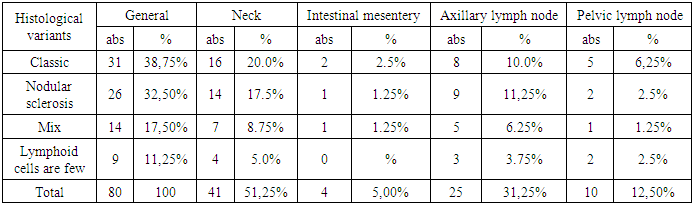
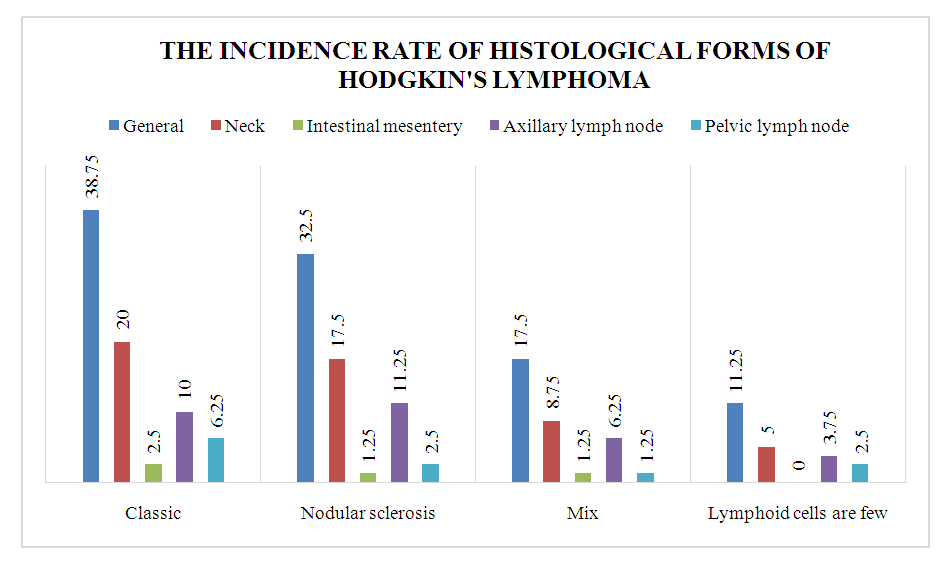
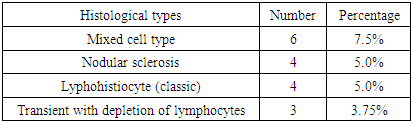
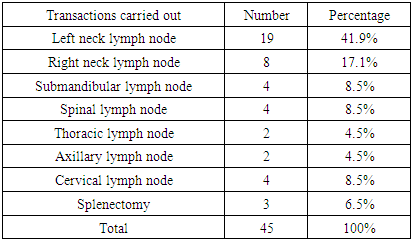
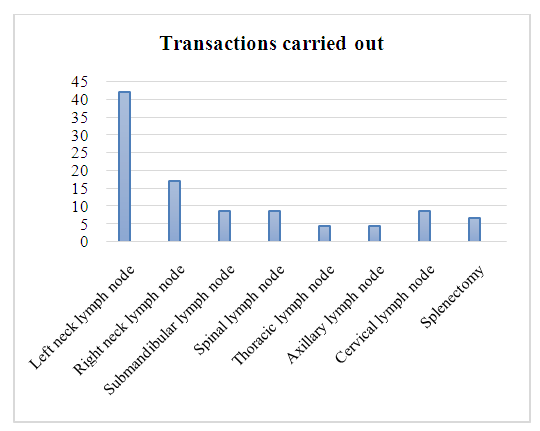
- During the years 2019-2023, the medical histories and patient cards of 80 patients with Hodgkin's lymphoma were treated retrospectively, histological and immunohistochemical examinations were conducted, and the results of the operations performed on the patients were studied at the Khorezm Branch of the Republican Specialized Scientific and Practical Medical Center of Oncology and Radiology.Discussion of the results obtained during the study. Research results of 80 patients who were diagnosed with Hodgkin's lymphoma and received treatment at the dispensary during 2019-2023 at Khorezm Branch of the Republican Scientific and Practical Center of Oncology were analyzed. The classic variant of the disease was detected in 31 (38.75) patients, of which 16 (20.0%) were in the neck lymph nodes, 2 (2.5%) were in the lymph nodes around the mesentery, 8 (10.0%) were in the axilla. lymph nodes and in 5 (6.25%) cases, the lymph nodes were identified in the lymph nodes; The variant of nodular sclerosis was detected in 26 (32.50%) patients, of which 14 (17.5%) were neck, 1 (1.25%) intestinal retention, 9 (11.25%) axilla, 2 (2.5 %) pelvic lymph, the lymph nodes were found in the lymph nodes; In the mixed variant, a total of 14 (17.50%) patients were identified, of which 7 (8.75%) were identified in the neck, 1(1.25%) in the mesentery, 5(6.25%) in the axillary lymph node, and 1(1.25%) in the pelvic lymph node.; Low variant of lymphoid cells was detected in 9(11.25%) patients, and it was observed in 4(5.0%) patients. It was found in 3 (3.75%) patients in axillary lymph nodes and in 10 (12.50%) patients in the pelvic lymph node. The results obtained during the scientific research are reflected in Table 1.
|
 | Figure 1 |
|
 | Figure 2 |
|
 | Figure 3 |
3. Conclusions
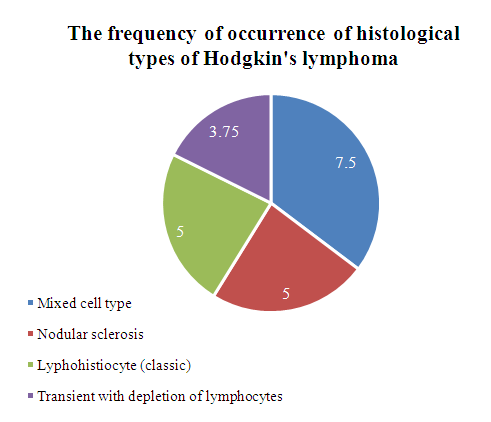
- It can be said that the classic type of Hodgkin's lymphoma is observed more often than other types, and the first place of localization is the neck lymph nodes. It can be seen that the first closest lymph node can be damaged due to the decrease in immunity after acute viral diseases, pharyngitis, laryngitis.It should also be noted that in the diagnosis of patients with Hodgkin's lymphoma, cytology prevails over laboratory examination due to the high importance of histological and immunohistochemical examination methods.