
-
Paper Information
- Previous Paper
- Paper Submission
-
Journal Information
- About This Journal
- Editorial Board
- Current Issue
- Archive
- Author Guidelines
- Contact Us
American Journal of Medicine and Medical Sciences
p-ISSN: 2165-901X e-ISSN: 2165-9036
2024; 14(10): 2518-2521
doi:10.5923/j.ajmms.20241410.15
Received: Sep. 18, 2024; Accepted: Oct. 10, 2024; Published: Oct. 17, 2024

Assessment of Clinical and Laboratory Syndromes in Kayakers and Canoers
 Abstract
 Reference
 Full-Text PDF
 Full-text HTML
Jasur Alimdjanovich Rizaev1, Shokhrukhbek Davronbekovich Khusainboev1, Rajabiy Muzayyana Aziz Kizi2
1Samarkand State Medical University, Uzbekistan
2Tashkent State Dental Institute, Uzbekistan
Correspondence to: Jasur Alimdjanovich Rizaev, Samarkand State Medical University, Uzbekistan.
| Email: |  |
Copyright © 2024 The Author(s). Published by Scientific & Academic Publishing.
This work is licensed under the Creative Commons Attribution International License (CC BY).
http://creativecommons.org/licenses/by/4.0/

The purpose of this study is to study structure of the body and hemodynamic parameters of athletes involved in kayaking and canoeing. There were examined 24 male athletes aged 14-18 years, who were divided into two groups: rowing athletes - 24 people who systematically engage in kayaking and canoeing and having sports categories from I to III adults, and non-athletes - 12 people included young men who were not involved in sports. There were studied body structure and indicators of the cardiovascular system in adolescent athletes. The analysis of body structure showed statistically significant differences between the rowers and the group of non-athletes in terms of weight and muscle mass. Physical performance, recorded through the PWC-170 test, was better in the group of athletes, which apparently indicates a more rational functioning of the musculoskeletal system.
Keywords: Physical performance, Endurance sports, Kinds of sport, Require special
Cite this paper: Jasur Alimdjanovich Rizaev, Shokhrukhbek Davronbekovich Khusainboev, Rajabiy Muzayyana Aziz Kizi, Assessment of Clinical and Laboratory Syndromes in Kayakers and Canoers, American Journal of Medicine and Medical Sciences, Vol. 14 No. 10, 2024, pp. 2518-2521. doi: 10.5923/j.ajmms.20241410.15.
1. Introduction
- Kayaking and canoeing are endurance sports that require special strength training while practicing in these kinds of sport. [1] The strength abilities of kayak and canoe rowers are realized through muscular efforts by creating forces acting within the rower-oar-boat system (seat, footrest, oar), which have their own characteristics; in particular, dynamic and static muscle strength, which are realized in maximum traction on the oar and ensure the maintenance of the rower’s working posture. Speed-strength abilities that determine the maximum tempo of rowing, the intensity of the increase in effort on the oar during the stroke, the maximum power of the stroke; strength endurance (static and dynamic), manifested in the magnitude and nature of the application of effort to the oar, helping to maintain a rational working posture of the rower. It should be noted that the morpho-functional prerequisites for a rower’s strength abilities depend on muscle system, anthropometric characteristics of the body, energy capabilities and topography of muscle groups. To maintain high sports results, it is also necessary to develop effective preventive measures that support human functional reserves. In order to protect the health of people professionally involved in sports, their regular medical examinations are carried out, which are aimed at identifying early signs of occupational pathology based on the results of an in-depth medical examination. The disadvantage of this approach is that the prescription of treatment and rehabilitation measures must be combined with the correction of the educational and training process, which may not allow reaching the planned level of sports form within the planned time frame. A more effective approach is aimed at identifying the initial stages of failure to adapt to physical and psycho-emotional stress before the manifestation of clinical symptoms of occupational pathology. In this situation, it is more appropriate to develop a set of universal criteria that allow us to judge various aspects of adaptation to sports activity, the state of various organs and systems, and prevent the threatening failure of adaptation at the pre-illness stage. In the research [2], it was proven that the development of rowing is largely connected with the study of the anthropometric and morphological data of the athlete. At the same time, the reliability of measurements can be achieved only with strict adherence to the relevant requirements, instructions and the use of special proven tools. At the same time, neglect of instructions and standardization requirements for anthropometric measurements leads to incomparable results. Anthropometric, height, weight and other dimensional indicators of academic rowers predetermine the technical capabilities of rowers, namely, the amplitude and speed characteristics of the rowing cycle, which are associated with the mechanisms of formation of support on the oar and determine the effective rowing technique. It should be noted that body structure, the amount of muscle mass and the composition of skeletal muscle fibers determine the potential for developing the strength and special endurance required by the rower and maintaining it at the appropriate level at a standard distance. The purpose of this study was to body structure and hemodynamic parameters of athletes involved kayaking and canoeing for development of prophylactic measures aimed at preventing the negative effects of oxidative stress, which is one of the reasons for the failure to adaptation to the stress of modern sports.
2. Materials and Methods
- There were examined 24 male athletes aged 14-18 years, who were divided into two groups: rowing athletes - 24 people systematically involved in kayaking and canoeing and having sports categories from I to III adult. The control group consisted of 12 students of the Faculty of Physical Education, who matched the main group in age and gender. The research was carried out at the bases of training camps at the water stadium during the athletes training of the national team of the Republic of Uzbekistan in kayaking and canoeing in February - March 2024. The subjects were asked to perform the PWC 170 test, which took place as follows: two five-minute loads on a Monark Ergomedic 828 E bicycle ergometer with a power of 50 watts, followed by a three-minute rest and a repeated five-minute load with a power determined by the formula PWC170. The recording of indicators was made before the load, after the first and at the end of the second load.The following indicators are significant for the daily assessment of the functional state of the body (FSB) of athletes, reflecting the level of functional readiness and the effectiveness of the training process according to R. M. Baevsky: Sp02 (oxygen saturation of hemoglobin in the blood), SBP, DBP (systolic and diastolic blood pressure), RR (respiratory rate), HR (heart rate), SV (stroke volume), MBV (minute blood volume). In terms of height and weight indicators, the subjects of both groups were identical. During the study, data on fat (%, kg), muscle mass (kg), and weight and height indicators were recorded. The results of the study were processed using the SPSS 20 program. Tests were used to assess the normality of the distribution of the studied indicators and means of assessing statistical significance between the studied samples depending on the nature of the distribution of values (t-test, Man-Whitney test, etc.)
3. Results and Discussion
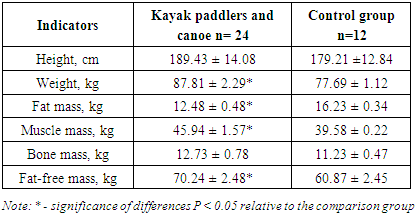
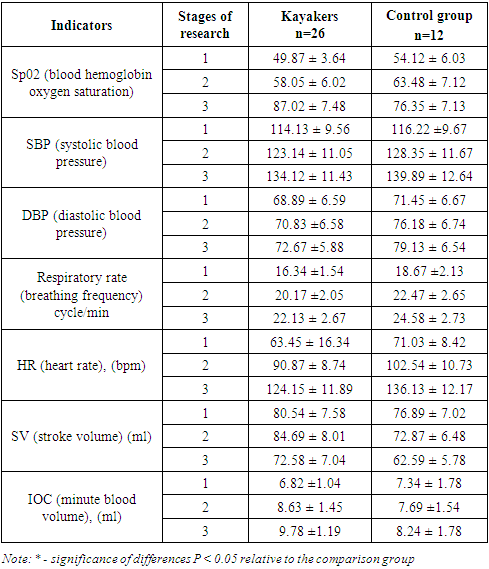
- Body condition and body structure characteristics play an important role in most sports and in rowing particularly. High athletic results in this sport are achieved only by those athletes who have certain inclinations and abilities. The anthropometric and morphological characteristics of academic rowers provide both an effective rowing technique and the ability for long-term muscular work - a manifestation of special endurance. It has been established that athletes involved in rowing are tall and have greater body weight (due to greater muscle mass and less fat mass). As a result of a study of body structure indicators in kayaking and canoe rowers, significant differences in muscle mass and total weight were identified between rowers and the comparison group. Analysis of weight and height parameters revealed the following: the body length of academicians is in the range from 186 before 193 cm, body weight from 83 before 91 kg. We compared the obtained data on weight and height indicators with the data of rowers who currently have the titles of Master of Sports and Candidate Master of Sports and non-athletes - young men who are not involved in sports.Anthropometric, height, weight and other dimensional indicators of academic rowers have mainly biomechanical significance. They predetermine the technical capabilities of rowers, namely, the amplitude and speed characteristics of the stroke cycle, which are associated with the mechanisms of formation of emphasis on the oar and determine the effective rowing technique [4]. As our research has shown (Table 1), academic rowers are on average superior to their peers in a number of anthropometric characteristics - in terms of height - by 4.4%, and in weight - by 7.3%. At the same time, significant differences emerged in terms of body structure indicators and, in particular, in the size of muscle, fat and fat-free masses. The analysis of body structure showed statistically significant differences between the rowers and the group of non-athletes in terms of weight and muscle mass. The increase in weight in the rowers studied was due to the development of the muscle component, while the fat mass remained almost within normal limits. As is known, body structure, the amount of muscle mass and the composition of skeletal muscle fibers determine the potential possibilities for developing the strength and special endurance required by the rower and maintaining it at the appropriate level at a standard distance [5]. In our studies, the greatest differences between athletes and non-athletes were found in absolute and relative (in relation to body weight) indicators of fat and muscle mass. In terms of bone mass, no significant differences were found between the study groups. Significant differences appeared in terms of fat-free mass - by 13%. Thus, academic rowers have a number of significant, distinctive characteristics of physical and body structure that can be used as criteria when selecting for academic rowing, these are body length and weight, the amount of muscle, fat and fat-free mass in relative form (in relation to body weight). All obtained body composition parameters for kayaking and canoeing rowers allow us to evaluate clearly both the individual characteristics of a particular athlete and the degree of approximation to the standard of a group of athletes. Moreover, systematic measurements (with an annual or six-month interval) make it possible to determine trends in the assessment of one or another parameter in the dynamics of an athlete’s development and improvement. It should be noted that the lowest efficiency values were manifested by the fat mass criterion, which means that the proportion of fat in the body structure is not taken into account and is not controlled during the training of academic rowers, although its reduction would have a noticeable effect - it would lead to an increase in the proportion of muscle mass. Thus, in our opinion, when organizing the selection of young men for rowing, it is advisable to use as selection criteria not only height and weight (as is currently the case in practice), but also indicators of muscle and fat body mass in relative form (in percentage of body weight). This will improve the selection efficiency and avoid errors at the initial selection stage. At the next stage of research, we studied the characteristics of blood circulation in rowing athletes and non-athletes. The study found that in terms of cardiovascular system indicators (Table 2), no large differences were found between the study groups. In addition to the chronotropic function of the heart, lower heart rate values were observed in canoeists compared to the control group. At the same time, a similar situation is observed according to data obtained at different stages for such indicators as Sp02 (blood hemoglobin oxygen saturation), HR (pulse rate), SBP, DBP (systolic and diastolic blood pressure), RR (respiratory rate), HR (heart rate), SV (stroke volume), MBV (minute blood volume).
|
|
4. Conclusions
- 1. Body structure analysis showed statistically significant differences between the rowers and the non-athlete group in terms of weight and muscle mass. 2. Physical performance, recorded through the PWC-170 test, was better in the group of athletes, which apparently indicates a more rational functioning of the musculoskeletal system.