
-
Paper Information
- Next Paper
- Paper Submission
-
Journal Information
- About This Journal
- Editorial Board
- Current Issue
- Archive
- Author Guidelines
- Contact Us
American Journal of Medicine and Medical Sciences
p-ISSN: 2165-901X e-ISSN: 2165-9036
2024; 14(10): 2507-2509
doi:10.5923/j.ajmms.20241410.12
Received: Jun. 18, 2024; Accepted: Jul. 2, 2024; Published: Oct. 17, 2024

The Use of Kupral in the Complex Treatment of the Periodontal Disease
 Abstract
 Reference
 Full-Text PDF
 Full-text HTML
Abdullaeva Nilufar Ikrombekovna1, Akhmedov Alisher Astanovich2
1Assistant of the Orthopaedic Dentistry Department, Samarkand State Medical University, Samarkand, Uzbekistan
2DSc, Associate Professor, Dean of Stomatological Faculty, Samarkand State Medical University, Samarkand, Uzbekistan
Correspondence to: Abdullaeva Nilufar Ikrombekovna, Assistant of the Orthopaedic Dentistry Department, Samarkand State Medical University, Samarkand, Uzbekistan.
| Email: |  |
Copyright © 2024 The Author(s). Published by Scientific & Academic Publishing.
This work is licensed under the Creative Commons Attribution International License (CC BY).
http://creativecommons.org/licenses/by/4.0/

The bacteriological, molecular biological (PCR), histological and clinical evaluation of two methods of application of copper-calcium hydroxide (CCH) in the complex treatment of periodontitis. We treated 86 patients with chronic generalized periodontitis of varying severity using membrane microorganism (MM) to inactivate the periodontal pocket microflora (within one day) using CCH for 5-14 days. The introduction of CCH into periodontal pockets for one day resulted in a 5-25 times decrease in the activity of periodontal pathogens. Curettage of periodontal pockets with the use of CCH resulted in their rapid elimination due to epithelial lysis and formation of an aragocyte-calcite membrane. (Directed tissue regeneration). The use of CCH is effective in preventing bacteremia during surgical treatment. Curettage with CCH is effective in mild and moderate periodontitis, especially in diabetic patients. [1,3]
Keywords: Conservative treatment of periodontitis, Copper-calcium hydroxide
Cite this paper: Abdullaeva Nilufar Ikrombekovna, Akhmedov Alisher Astanovich, The Use of Kupral in the Complex Treatment of the Periodontal Disease, American Journal of Medicine and Medical Sciences, Vol. 14 No. 10, 2024, pp. 2507-2509. doi: 10.5923/j.ajmms.20241410.12.
1. Introduction
- In recent years, copper-calcium hydroxide (CCH), a compound composed of highly dispersed copper and calcium hydroxides in equilibrium with hydroxycuprate ion, has been successfully utilized in periodontal practice [2,4]. CCH exhibits a potent bactericidal effect, which can be attributed to its ability to interact with Sulphur-containing amino acids of microorganisms, leading to protein destruction, in addition to proteolysis. The formation of copper supplied as an intermediate product in this process contributes to its high bactericidal properties. Importantly, CCH demonstrates a broad-spectrum disinfecting effect against various microorganisms, including bacteria, fungi, and spores.Furthermore, copper ions have been found to exert a stimulating effect on reparative processes within periodontal tissues. They promote the formation of new collagen fibers, as well as re-ossification and ossification processes. This suggests that the application of CCH not only provides an antibacterial effect but also supports the regenerative capacity of periodontal tissues.
2. Materials and Methods
- The study involved 86 patients (31 males and 55 females) aged 25 to 73 years who were diagnosed with non-oralized periodontitis. Among them, 26 patients had type II diabetes mellitus in a compensated form, and 29 patients had other general concomitant somatic pathology. Clinical examination using the 'Florida-probe' and X-ray examination revealed that 22 patients had severe periodontitis, 47 had moderate severity, and 17 had mild severity.Patients with mild and 20 patients with moderate periodontitis underwent a classical variant of 'CCH curettage' as part of comprehensive periodontal treatment. This procedure involved inserting cotton threads soaked in a suspension of CCH (copper-calcium hydroxide) into the periodontal pockets around 4-6 teeth. The ends of the threads were secured in the interdental spaces and left in place for a period of 5 to 14 days. After the treatment period, the filaments were removed. [3,4]The contents of the periodontal pockets were collected and used as clinical material for bacteriological and molecular biological studies. The molecular biological study aimed to detect the DNA of the main periodontal pathogens and was conducted using the polymerase chain reaction (PCR) technique. To collect the pocket contents, a single-use sterile file, specifically a canal drying absorber #30, was utilized. The file was carefully inserted into the pocket, and the contents were collected. Subsequently, the collected material was placed in an Eppendorf tube containing 500 ml of sterile physiological solution. The contents and solution were mixed thoroughly, and the absorber was then removed. The prepared sample, containing the pocket contents in the physiological solution, was used for DNA extraction. [4,5]Samples were collected both before the implementation of the CCH curettage' method and a day after the removal of the CCH -soaked threads from the pockets. In total, 172 samples were obtained and subjected to analysis. The purpose of these bacteriological and molecular biological studies was to evaluate the presence and abundance of DNA from the main periodontal pathogens. PCR, a sensitive and specific technique, allows for the amplification and detection of specific DNA sequences, enabling the identification of microorganisms associated with periodontal diseases.
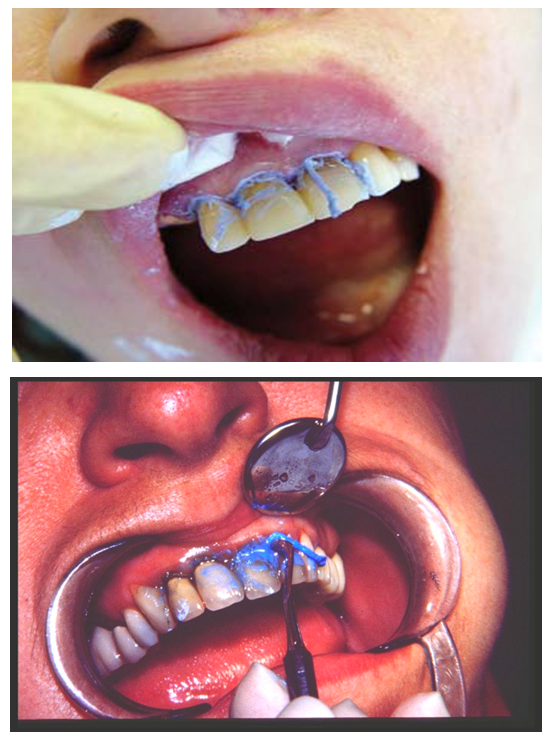 | Figure 1. Kupral application stage in the gingiva |
3. Discussion
- Histological studies were conducted on gingival biopsy specimens obtained from the periodontal pockets at various stages of ' CCH curettage.' The findings revealed notable changes in the epithelium of the pocket lining over the course of treatment.Starting from 3-5 days of treatment, a gradual breakdown of the epithelium of the internal pocket lining was observed in the depth of the pocket. This breakdown was characterized by the disruption of the connection between the epithelial layer and the underlying tissue, as well as the disintegration of epithelial cells. The epithelium gradually thinned, and in some cases, it penetrated or underwent lysis. Concurrently, a new layer or membrane, which appeared to have a protective function, was observed in the histological preparations. This membrane varied in thickness, ranging from 1 to 30 microns. Some sections of the membrane included the nuclei of epithelial cells. The reaction between the serum buffer from living tissue and CCH leads to the formation of a calcium carbonate membrane, which exhibits an increase in thickness proportional to the square root of time. Initially, this membrane consists of calcite crystals arranged in a tiled pattern. The presence of this membrane serves to hinder the diffusion of alkaline solution into the living tissue. However, due to the action of the serum buffer, the penetrating solution retains sufficient alkaline activity to effectively control the inflammatory process. [5,6]The formation of an aragocyte-calcite membrane was observed starting from 5-7 days after the application of CCH C. These findings suggest that the 'curettage' procedure, utilizing CCH, can be considered as a distinctive method of directed tissue regeneration for periodontal tissues. The lysis of the epithelial lining prevents early ingrowth of the epithelium into the root-tooth cement, while maintaining a strongly alkaline reaction, alongside notable suppression of microflora activity. This combination of factors has the potential to contribute to an accelerated progression of reparative processes. In summary, the use of CCH in the 'curettage' technique appears to facilitate directed tissue regeneration in periodontal tissues. The breakdown of the epithelial lining prevents premature epithelial ingrowth, while the persistent alkaline environment, coupled with the suppression of microbial activity, supports an expedited reparative response. [6,7] It is important to note that further research is necessary to fully comprehend the specific mechanisms and clinical implications of these observed phenomena.
4. Conclusions
- 1. Bacteriological analysis indicated that the main periodontal pathogens found in chronic periodontitis exhibited resistance to most modern antibiotics. This suggests that alternative approaches may be necessary for effective treatment.2. The introduction of cotton threads soaked in copper-calcium hydroxide into periodontal pockets for one day resulted in a significant reduction in the activity of periodontopathogenic microflora. This reduction, ranging from 5-25 times, may be beneficial in preventing bacteraemia (bacteria in the bloodstream) during subsequent curettage or flap surgery. This highlights the potential antimicrobial properties of copper-calcium hydroxide.3. The 'curettage' technique utilizing CCH over a period of 5-14 days can be considered a viable alternative to surgical interventions for eliminating pathological periodontal pockets in cases of mild and moderate chronic periodontitis. This suggests that MMC treatment may be effective in managing these conditions without the need for surgery.4. The presence of copper-calcium hydroxide within the periodontal pocket depth has several effects. It lyses the epithelium of the inner lining of the pocket and the dento-gingival junction. Additionally, it promotes the formation of an aragocyte-calcite membrane, which can be viewed as a form of directed tubular regeneration. This membrane may play a role in tissue healing and regeneration processes.