
-
Paper Information
- Paper Submission
-
Journal Information
- About This Journal
- Editorial Board
- Current Issue
- Archive
- Author Guidelines
- Contact Us
American Journal of Medicine and Medical Sciences
p-ISSN: 2165-901X e-ISSN: 2165-9036
2024; 14(6): 1694-1698
doi:10.5923/j.ajmms.20241406.48
Received: Jun. 8, 2024; Accepted: Jun. 23, 2024; Published: Jun. 25, 2024

Genetic Polymorphism A38G of the CC16 Gene in Children with Acute Bronchiolitis
 Abstract
 Reference
 Full-Text PDF
 Full-text HTML
Аzimova Kamola Talatovna1, Garifulina Lilya Maratovna2
1Basic Doctoral Student of the Department of Pediatrics No. 3 and Medical Genetics of Samarkand State Medical University, Uzbekistan
2PhD, Associate Professor, Head of the Department of Pediatrics, Faculty of Medicine, Samarkand State Medical University, Uzbekistan
Copyright © 2024 The Author(s). Published by Scientific & Academic Publishing.
This work is licensed under the Creative Commons Attribution International License (CC BY).
http://creativecommons.org/licenses/by/4.0/

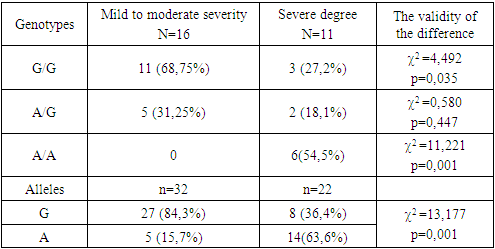
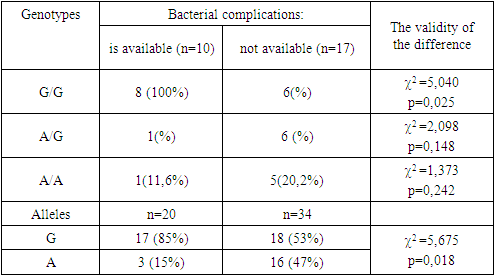
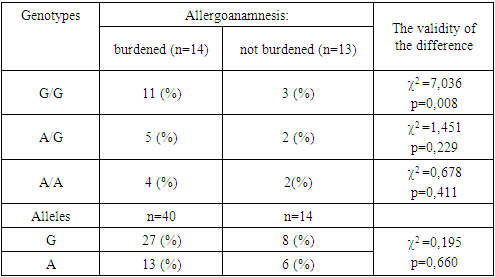
DNA samples obtained from 27 children with acute bronchiolitis were examined and similar samples of 23 children with acute pneumonia and 20 conditionally healthy children aged 2 months to 2 years were studied for comparison. The study of genetic polymorphism was carried out using polymerase chain reaction by allelic discrimination with registration of the results using electrophoresis. The protective effect of the A/G genotype of the A38G polymorphism of the CC16 gene has been established, namely, its decrease in the occurrence of acute bronchiolitis in young children. It has been proven that the A/A genotype is associated with severe acute bronchiolitis with the development of severe bronchoobstructive syndrome. The association of the G/G genotype with the development of bacterial complications in children with acute bronchiolitis and with the formation of a burdened allergic anamnesis in this category of patients was revealed. The totality of the analysis of clinical and anamnestic indicators in correlation with genetic factors can provide the basis for building a forecasting model and creating an individual scenario for the development of the disease.
Keywords: Acute bronchiolitis, Severity of course, Children, Genetic polymorphism, A38G gene CC16
Cite this paper: Аzimova Kamola Talatovna, Garifulina Lilya Maratovna, Genetic Polymorphism A38G of the CC16 Gene in Children with Acute Bronchiolitis, American Journal of Medicine and Medical Sciences, Vol. 14 No. 6, 2024, pp. 1694-1698. doi: 10.5923/j.ajmms.20241406.48.
1. Introduction
- Lower respiratory tract infections are a common cause of hospitalization in infants. According to experts, children under 12 months of age with bronchiolitis account for 18% of all pediatrician hospitalizations [1], which poses a great burden for industrialized health systems every winter [2,3]. This condition is caused mainly by viruses such as influenza virus, rhinovirus, respiratory syncytial virus (RSV) and bacterial pathogens that can be transmitted from person to person by airborne droplets and by contact with an infected object [4,5].The relationship between asthma and bronchiolitis may be bi-directional [6,7], as additional studies have linked viral respiratory infections with the development of asthma [8]. Studies conducted in Spain have shown that children with HBoV bronchiolitis, human metapneumovirus bronchiolitis (hMPV), RSV bronchiolitis are at increased risk of developing asthma at the age of 5-7 years [6,7]. On the other hand, an earlier study in the United States showed that the severity of childhood bronchiolitis is associated with the severity of early asthma [6].Currently, a number of works have appeared characterizing the active participation of secret globin (CC16), synthesized by cells of the mucous membrane of the airways (Clara cells), in the inflammatory process of the lungs, while its relationship with both the acute inflammatory process and the development of recurrent chronic lung pathology is noted.The influence of the A38G polymorphism of the CC16 gene in the realization of the recurrent nature of Broncho obstructive syndrome is also possible. In the works of foreign researchers, the relationship of the homozygous position of the mutant allele A of the CC16 gene with the development of bronchial asthma has been traced.It was revealed that the CC16 level was reduced in Broncho alveolar lavage of asthma patients [10]. The single nucleotide polymorphism A38G (rs3741240), according to the A allele, is associated with a decrease in the transcriptional activity of the gene [11]. It was revealed that the AA genotype is associated with allergies and asthma [11]. It was revealed that patients with the AA genotype had significantly lower serum CC16 levels higher than in patients with the GG and AG genotype [12]. There is reason to suspect that children with bronchial obstruction and having the CC16 38A/38A genotype (and lower serum CC16 levels) have the highest level of local inflammation and bronchoconstriction and, consequently, an increased likelihood of developing bronchial asthma [13].At the same time, there are no studies clarifying the effect of this gene on the course of the inflammatory process in infectious diseases of the lower respiratory tract, namely acute bronchiolitis, as well as the possible effect on the development of recurrent obstructive pulmonary pathology in this cohort of patients in subsequent years of life.In this regard, we set a goal: to study the polymorphism of the A38G gene in children with acute bronchiolitis and to clarify the possible relationship between the degree of polymorphism and the severity of the disease.
2. Materials and Methods
- 70 children aged 2 months to 2 years were examined, including 27 children diagnosed with acute bronchiolitis, and for comparison, 23 children diagnosed with acute pneumonia and 20 conditionally healthy children were examined.The studies were conducted in the period 2021-2022. The observed sample of patients, depending on the severity of their condition, were hospitalized in the department of pulmonology and the intensive care unit of the Samarkand Regional Children's Multidisciplinary Center and in the department of emergency pediatrics and the department of pediatric intensive care of the Samarkand branch of the Republican Scientific Center for Emergency Medical Care. In children with acute bronchiolitis, bronchial obstruction of varying degrees was observed, in children with acute pneumonia, respiratory failure of a mixed type of varying degrees.To assess the prognosis of the severity of bronchiolitis, a score scale based on clinical and auscultative signs of ESBA was used (J.M. RamosFernandezetall, 2013) [14]. All patients with acute bronchiolitis underwent laboratory and instrumental examination, polymerase chain reaction in real time to detect viral antigen (RSV, adenovirus, rhinovirus, parainfluenza). Reverse transcription and PCR reactions were performed using commercial kits Revert and Amplisens-200 (Russian Federation). Polymerase chain reaction (PCR) of fragments of the CC16 gene was performed using a ready-made reaction mixture from the manufacturer "GenTerra" (Russian Federation).DNA samples were isolated from the patients' blood by phenol-chloroform extraction [15]. The study of A (38)G polymorphism was carried out using a polymerase chain reaction by allelic discrimination [16], using a system of three primers — two direct allele-specific, differing in 3-terminal nucleotide: direct 1 5'CAgAgACggAACCAgAgACA, direct 2 5'AgAgACggAACCAgAgACg, and a common reverse primer 5'TCCTgAgAgTTCCTAAgTCC. The synthesis of primers was carried out by Algimed, Belarus.The programmable thermal Cyclerrotorgene 6000 (QIAGEN, Germany) was used for amplification.The polymerase chain reaction was carried out in a volume of 25 µl in two test tubes. A master mix was added to each tube. Next, direct primer 1 and reverse primer were added to one tube, and direct primer 2 and reverse primer were added to the other. DNA was added in an amount of 1 µl to each tube. Also, water for PCR in each tube. After that, the tubes were placed in a thermal cycler for amplification.Homozygotes were marked by effective amplification by peak elevation in only one test tube. In heterozygotes, effective amplification occurred in both tubes, which was accompanied by a peak rise in both tubes [17].To process the data obtained, statistical methods consisted in calculating the frequency of alleles and the frequency of allelic combinations and their correspondence to the Hardy— Weinberg equilibrium according to criterion 2 with the calculated ones, rejecting the null hypothesis when Р < 0,05 [18].
3. Results and Discussions
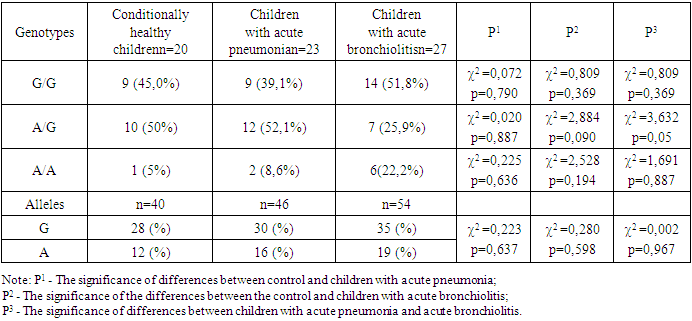
- In the course of our research, the frequency of occurrence of polymorphism A38G of the CC16 gene in patients with acute bronchiolitis was determined and a group of children with acute pneumonia was studied for comparative characteristics. The blood of conditionally healthy children without the presence of chronic bronchopulmonary pathology was presented as a control.During the study, the frequency distribution of alleles and genotypes according to the A38G polymorphism of conditionally healthy children of the Uzbek population did not differ from the world literature data and amounted to the frequency of genotype G/G in 45.0% of cases, genotype A/G in 50% of cases, and the lowest percentage of genotype/A in 5% of cases.To confirm the association of polymorphism of the CC16 gene with the risk of subsequent development of Broncho obstructive diseases in children who suffered from acute bronchiolitis at an early age, a comparison of the frequencies of genotypes of children with acute bronchiolitis occurring with Broncho obstructive syndrome, and acute pneumonia, which is one of the frequent pathologies of the respiratory system of young children, as well as with indicators of conditionally healthy children, was carried out. The observed distribution of genotype frequencies did not differ from the theoretically expected distribution according to the Hardy-Weinberg equation. No significant differences in the frequency of occurrence of alleles and genotypes of the A38G polymorphism of the CC16 gene were found when comparing acute pneumonia with the control group (Table 1), which indicates that no special differences in the genotype of children with acute pneumonia and conditionally healthy children were observed and these genotypes did not contribute to the development of acute pneumonia.
|
|
|
4. Conclusions
- The association of the G/G genotype with the development of bacterial complications in children with acute bronchiolitis and with the formation of a burdened allergic anamnesis in this category of patients was revealed.The totality of the analysis of clinical and anamnestic indicators in correlation with genetic factors can provide the basis for building a forecasting model and creating an individual scenario for the development of the disease.
References
| [1] | Hasegawa K, Tsugawa Y, Brown DF, et al.. Trends in bronchiolitis hospitalizations in the United States, – 2019. Pediatrics 2017; 132: 28–36. |
| [2] | Rose, E.B.; Wheatley, A.; Langley, G.; Gerber, S.; Haynes, A. Respiratory Syncytial Virus Seasonality—United States, 2017. MMWR 2018, 67, 71–76. |
| [3] | Chen, P.C.; Mou, C.H.; Chen, C.W.; Hsieh, D.P.H.; Tsai, S.P.; Wei, C.C.; Sung, F.C. Roles of Ambient Temperature and PM2.5 on Childhood Acute Bronchitis and Bronchiolitis from Viral Infection. Viruses 2022, 14, 1932. |
| [4] | Silver, A.H.; Nazif, J.M. Bronchiolitis. Pediatr. Rev. 2019, 40, 568–576. |
| [5] | Ghazaly, M.; Nadel, S. Characteristics of children admitted to intensive care with acute bronchiolitis. Eur. J. Pediatr. 2018, 177, 913–920. |
| [6] | Sigurs, N.; Aljassim, F.; Kjellman, B.; Robinson, P.D.; Sigurbergsson, F.; Bjarnason, R.; Gustafsson, P.M. Asthma and allergy patterns over 18 years after severe RSV bronchiolitis in the first year of life. Thorax, 65, 1045–1052. |
| [7] | Meissner, H.C. Viral Bronchiolitis in Children. N. Engl. J. Med.2016, 374, 62–72. |
| [8] | Jartti, T.; Mäkelä, M.J.; Vanto, T.; Ruuskanen, O. The link between bronchiolitis and asthma. Infect. Dis. Clin. N. Am, 19, 667–689. |
| [9] | Del Rosal, T.; García-García, M.L.; Calvo, C.; Gozalo, F.; Pozo, F.; Casas, I. Recurrent wheezing and asthma after bocavirus bronchiolitis. Allergol. Immunopathol. 2016, 44, 410–414. |
| [10] | Sung, F.-C.; Wei, C.-C.; Muo, C.-H.; Tsai, S.P.; Chen, C.W.; Hsieh, D.P.H.; Chen, P.-C.; Lu, C.-Y. Acute Bronchitis and Bronchiolitis Infection in Children with Asthma and Allergic Rhinitis: A Retrospective Cohort Study Based on 5,027,486 Children in Taiwan. Viruses 2023, 15, 810. https://doi.org/10.3390/v15030810. |
| [11] | Henning Stenberg, Erik Wadelius, Subhabrata Moitra, Ida Åberg, Jaro Ankerst, Zuzana Diamant, Leif Bjermer & Ellen Tufvesson (2017): Club cell protein (CC16) in plasma, bronchial brushes, BAL and urine following an inhaled allergen challenge in allergic asthmatics, Biomarkers, DOI: 10.1080/1354750X.2017.1375559. |
| [12] | J.A. Castro-Rodriguez, I. Atton, G. Villarroel, C.A. Serrano Relation between serum CC16 levels and asthma predictive index in pre-schoolers with recurrent wheezing Allergol Immunopathol (Madr). 2018; 46(5): 460-466. |
| [13] | Sultan Almuntashiri, Yin Zhu, Yohan Han, Xiaoyun Wang, Payaningal R. Somanath and Duo Zhang Club Cell Secreted Protein CC16: Potential Applications in Prognosis and Therapy for Pulmonary Diseases. J. Clin. Med. 2020, 9, 4039; doi: 10.3390/jcm9124039. |
| [14] | Rivas-Juesas C, et al. A comparison of two clinical scores for bronchioli-tis. A multicentre and prospective study conducted in hospitalised infants. Allergol Immunopathol (Madr). 2017. http://dx.doi.org/10.1016/j.aller.2017.01.012. |