Tursunkhodzhaeva L. A.1, Ergasheva Yu. Y.2
1Department of Narcology and Adolescent Psychopathology Center for the Development of Professional Qualifications of Medical Workers, Uzbekistan
2Department of Psychiatry, Narcology and Medical Psychology Bukhara State Medical Institute, Uzbekistan
Copyright © 2024 The Author(s). Published by Scientific & Academic Publishing.
This work is licensed under the Creative Commons Attribution International License (CC BY).
http://creativecommons.org/licenses/by/4.0/

Abstract
Due to its high prevalence worldwide, tuberculosis remains a global public health problem. Insufficient knowledge of suicidal behavior in patients suffering from tuberculosis and with disabilities determines the relevance of research in this area. Using the Minnesota Multifactor Personality Inventory (MMPI), a comparative study was undertaken to study the personality of tuberculosis patients who had attempted suicide (the main group) and had not shown suicidal tendencies throughout their lives (the comparison group). It has been established that with the typological similarity of character accentuations in patients of both groups, significant intergroup differences are revealed in the severity of depression, anxiety, hypochondria, reaching the degree of neurotic reactions in suicidal patients.
Keywords:
Tuberculosis, Disability, Suicide, Personality, Minnesota Multifactor Personality Questionnaire
Cite this paper: Tursunkhodzhaeva L. A., Ergasheva Yu. Y., Studying the Personality of Suicidents Suffering with Tuberculosis Using a Multifactor Personality Questionnaire, American Journal of Medicine and Medical Sciences, Vol. 14 No. 1, 2024, pp. 42-45. doi: 10.5923/j.ajmms.20241401.10.
1. Introduction
According to the World Health Organization, in 2022 a record number of tuberculosis cases was registered for the entire period of global monitoring of the tuberculosis situation carried out by WHO since 1995. Tuberculosis was diagnosed in 7.5 million people, which, on the one hand, is associated with the restoration of access to its diagnosis in pre-Covid volumes, and on the other, with the so far unsuccessful attempt of countries to stop the epidemic of this disease [7].In 2021, tuberculosis was the second leading cause of death caused by a single infectious disease, second only to COVID-19. Mortality from tuberculosis is almost twice that of HIV/AIDS and is one of the ten leading causes of death in the world [6].Despite the high prevalence of tuberculosis worldwide, the disability associated with it has not been assessed. There are only a few studies of its mental complications, which include suicide. A number of researchers have identified a positive correlation between the mortality rate from tuberculosis and the suicide rate in the population [3]. Depression, especially when combined with somatic disorders, is commonly cited as the main cause of suicide [1]. It has been established that more than a third of patients with tuberculosis have deviations in their emotional state in the form of mild depression of a situational or neurotic nature, and approximately 10% of patients experience true subdepression and depression that require medical intervention [2,4,5].The multifactorial, dynamic, and intermittent nature of suicidal behavior requires examination of the interactions between clinical and personal factors that coexist when a person decides to commit suicide. From these positions, studying the personality of suicide victims suffering from various clinical forms of tuberculosis and having disabilities becomes particularly relevant.Purpose of the study: To study the personal characteristics of suicide victims suffering from tuberculosis in comparison with a group of tuberculosis patients without suicidal tendencies.
2. Material and Methods
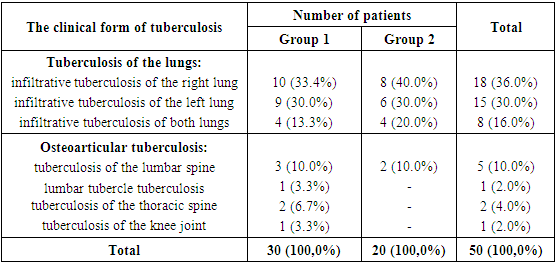
At the Bukhara Regional Phthisiological Hospital, 50 patients (18 men and 32 women) with disability groups I, II or III for tuberculosis were examined. The criteria for inclusion of patients in the study were age over 30 years, satisfactory general condition, ensuring the ability to communicate with the researcher and fill out a personal questionnaire, and the presence of voluntary informed consent for testing.The age of the patients at the time of examination ranged from 34 to 76 years. By the time of the examination, 3 patients (6.0% of the number of those examined) had been diagnosed with disability for the first time in their lives, the rest had been on disability for several years, were hospitalized at least twice and received treatment on an outpatient and inpatient basis many times.During the study, two groups of patients were identified: the main group consisted of 30 tuberculosis patients who made a suicide attempt before admission to the hospital; The comparison group included 20 tuberculosis patients who did not show suicidal tendencies throughout their lives. The distribution of patients depending on the clinical form of tuberculosis is shown in Table 1.Table 1. Distribution of patients depending on the clinical form of tuberculosis
 |
| |
|
The table data shows that the selected groups were quite comparable both in the number of patients with a pulmonary form (76.7% of patients in group 1 and 90.0% of patients in group 2; p > 0.05) and in the number of patients with osteoarticular form of tuberculosis (26.7% of patients in group 1 and 10.0% in group 2; p > 0.05). The duration of the disease from the moment of diagnosis in patients of group 1 ranged from 2 to 6 years, in patients of group 2 – from 1 year to 4 years. All patients were aware of their diagnosis.To determine personality traits, the MMPI personality questionnaire was used. The methodology contains 11 scales, of which 8 are basic and 3 are evaluative. The first three rating scales measure the sincerity of the test taker, the degree of reliability of the test results, and the amount of correction introduced by excessive caution. The main 8 scales assess personality traits. The first “Hypochondria Scale (Hs)” measures the subject’s “closeness” to the astheno-neurotic type, the second “Depression Scale (D)” - to the dysthymic personality type.The third “Hysteria Scale (Well)” reveals a tendency to psychosomatic reactions and reactions of the conversion type. The fourth “Psychopathy Scale (Pd)” measures the similarity of the subject with the sociopathic variant of personality development. The sixth “Paranoia Scale (Ra)” measures the degree of “closeness” of the subject to a paranoid personality type, touchiness and tendency to affective reactions.The seventh “Psychasthenia Scale (Pt)” is intended for diagnosing an anxious-suspicious personality type, the eighth “Schizoidity Scale (Sc)” - a schizoid personality type. The ninth “Hypomania Scale (Ma)” measures the degree of “closeness” of the subject to the hyperthymic personality type, his activity and excitability. Acceptable limits of normal values for MMPI scales were determined in the range from 30 to 70 T-scores with an average of 50 T-scores. When interpreting the MMPI profile, not only deviations of the indicators of certain scales from normal values were taken into account, but also their combinations.Testing using the MMPI technique was carried out 10-25 days after admission to the hospital after the somatic condition of the patients improved. To assess the significance of differences between groups, the Student's test (p) was used; differences were considered statistically significant at p < 0.05.
3. Research Results and Discussion
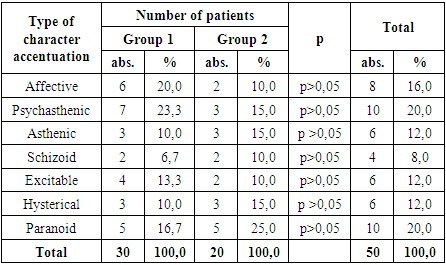
The study of premorbid characterological personality traits was carried out both clinically and using the MMPI psychometric technique in order to simultaneously assess many aspects of personality. Data obtained using experimental psychological techniques made it possible to identify more subtle disorders in the field of motivation, emotional response and volitional regulation, hidden from the researcher when using the clinical method. The data obtained using the MMPI were correlated with the results of a clinical examination and observation of the subject at the time of the study.Analysis of MMPI profiles showed that the majority of patients with suicidal tendencies had a combination of peaks on the scales of the neurotic triad (scales of hypochondriasis Hs, depression D, hysteria Hy) with a high scale of Pt (psychasthenia) and Sc (schizoid), reflecting the presence of mental discomfort, anxiety, depression, hypochondriacal fixation on the somatic state, reaching the level of neurotic reactions. In patients from the comparison group, the indicators of these scales did not go beyond normal values.Quite high scores on the paranoia scale (Pa) in patients of both groups emphasized the tendency of patients to doubt the correctness of the diagnosis, the competence of doctors, and the effectiveness of the treatment. The persistence of a hypochondriacal fixation on a somatic condition, a high level of anxiety, mistrust of doctors, a pessimistic prognosis of the disease, accompanied by a feeling of hopelessness and helplessness, contributed to the fixation of suicidal tendencies and hindered recovery, ensuring low compliance with treatment.The personality traits identified in tuberculosis patients did not go beyond character accentuations and did not interfere with social adaptation before the onset of the infectious disease. The distribution of patients depending on the type of personal accentuations is presented in Table 2.Table 2. Distribution of tuberculosis patients depending on the type of character accentuation
 |
| |
|
Typological personality traits with a predominance of inhibited character traits (asthenic, psychasthenic, schizoid) occurred in almost the same number of patients in both groups (40.0% of patients in group 1 and 40.0% of patients in group 2; p > 0.05). Patients with a high rise on the hypochondriasis scale (Hs) presented with numerous complaints, clearly exaggerated the severity of their condition, sought out more and more suffering, experienced an unreasonable fear of death, and exaggerated the side effects of medications. The character of such patients was dominated by asthenic traits in the form of a combination of sensitivity and vulnerability with irritability, exhaustion, and inability to endure prolonged stress (10.0% of patients in group 1 and 15.0% of patients in group 2; p > 0.05). In addition, in suicidal patients with inhibited character traits, in contrast to patients from the comparison group, quite pronounced depressive states were detected with feelings of anxiety, restlessness, lack of faith in recovery, and a pessimistic assessment of the future.In suicidal individuals belonging to the affective type, who were distinguished by a tendency to frequent mood swings and emotional lability (20.0% of patients in group 1), pathological changes were observed on the depression scale (D), reflecting the presence of a pronounced depressive state with thoughts of one’s own worthlessness and pessimistic assessment of the future. In patients from the comparison group with affective character traits (10.0% of patients in group 2; p > 0.05), the decrease in mood did not go beyond a psychologically understandable reaction.High scores on the hysteria scale (Hy) occurred in 10.0% of patients in group 1 and 15.0% of patients in group 2 (p > 0.05). Such patients sought to demonstrate their suffering, demanded care and attention, immediate fulfillment of their requests, emphasized the severity of their condition, trying to evoke the sympathy of others. Excitable individuals (13.3% of patients in group 1 and 10.0% of patients in group 2; p > 0.05) had outbursts of anger, irritability, demanding of others. In such patients, psychopathy scale (Pd) scores typically exceeded 50 points, indicating difficulties in social adaptation.Patients with a paranoid personality type (16.7% of patients in group 1 and 25.0% of patients 2 groups; p > 0.05) in the MMPI profile had a high paranoia scale (Pa), reflecting the tendency to form overvalued ideas. They showed distrust in the correctness of the diagnosis, suspicion of medications and procedures, and an unfriendly attitude towards others.Thus, the examination of tuberculosis patients using the MMPI personal technique made it possible to judge not only the typological characteristics of character, but also to determine the degree of fixation of the patient on the functions of the somatic sphere of the body, a depressive reaction to stress, the level of anxiety and general tension, a tendency to hysterical reactions, the presence of excessive suspicion and a tendency to form situationally determined ideas of attitude.It has been established that with similar characteristics of characterological properties between patients with and without suicidal tendencies, significant differences are revealed in the degree of mental maladaptation caused by the stressful impact of the fact of severe somatic illness and disability. If in patients with tuberculosis changes in the mental state did not go beyond the scope of psychologically understandable reactions, then the majority of suicide victims experienced states of depression, anxiety, and hypochondria expressed at a pathological level with a feeling of hopelessness and a pessimistic assessment of the prognosis of the disease.
4. Сonclusions
1. The use of the MMPI psychometric technique can serve as a reliable tool for differentiating psychological and psychopathological reactions in patients with various clinical forms of tuberculosis. 2. In the MMPI profile, suicidal psychopathological states in patients with tuberculosis are represented by the presence of peaks on the scales of the neurotic triad in combination with a high scale of psychasthenia, reflecting the presence of mental discomfort, anxiety, depression, hypochondriacal fixation on the somatic state, reaching the level of neurotic reactions.
References
| [1] | Bagisheva N.V., Udalova T.Yu., Mordyk A.V., Aroyan A.R., Rudenko S.A. The severity of depressive tendencies in tuberculosis patients and patients in whom tuberculosis is combined with chronic obstructive pulmonary disease // Bulletin of the Russian Military Medical Academy. – 2015. – 4 (52). – Pp. 52-55. |
| [2] | Zolotova N.V., Baranova G.V., Streltsov V.V., Kharitonova N.Yu., Bagdasaryan T.R. Psychological features of newly diagnosed patients with pulmonary tuberculosis in the aspect of psychotherapeutic care during inpatient treatment // Tuberculosis and lung diseases. – 2019. – vol. 97, No.1. – pp.19-22. |
| [3] | Razvodovsky Yu.E., Zotov P.B., Kandrychyn S.V. Suicides and epidemiological parameters of tuberculosis in Russia: the population level of communication // Suicidology. - Vol.8, No. 1. – pp. 39-45. |
| [4] | Sofronova A.A., Kozlova A.V. The influence of tuberculosis infection on the mental status of a patient: V International (75 All-Russian) scientific and practical conference "Topical issues of modern medical science and healthcare. – С.83-87. |
| [5] | Аmbaw F. Is depression associated with pathway to care and diagnosis delay in people with tuberculosis in Ethiopia? / F. Аmbaw [et al.] // Glob Menth Health (Camb). – 2019. - №23 (6). Р.20. |
| [6] | World Health Organization. Global tuberculosis report. – Geneva, 2022. |
| [7] | World Health Organization. Global tuberculosis report. – Geneva, 2023. |
| [8] | Juraev Sh.J., Ergasheva Yu.Yu. Somatic disease, disability and suicidal behaviors among elderly people. Internotional Scientific Research journal 2022; 227-232. |
| [9] | Ergasheva Yu.Y. Suicidal Thoughts And Attempts Among Patients With. |
| [10] | Chronic Somatic Diseases With Disabilities Journal of Pharmaceutical Negative Results ¦ Volume 13 ¦ Special Issue 8 ¦ 2022 DOI: 10.47750/pnr.2022.13.S08.8. |
| [11] | Tursunkhojaeva L.A., Ergasheva Yu.Y., Suisidal behaviors in liver cirrhosis patients/ Art of MedicineVolume-2 International Medical Scientific Journal 302-308, 2022у. |
| [12] | Ergasheva Yu.Y; Zhuraev Sh.Zh., Depressive disorder and suiside risk among those waith liver disease and their association with qualite of life an International Multidisciplinary Research Journal ISSN: 2249-7137 Vol. 12, Issue 05, May 2022 SJIF 2022. |
| [13] | Ergasheva Y.Y; Shukurlayeva M.F; Kholmurodova Sh.E., Risk factors Associated with suiside among patients with kidney cancer institute An International Multidisciplinary Research Journal ISSN: 2249-7137 Vol. 12, Issue 05, May 2022 SJIF 2022. |
| [14] | Yu. Yu. Ergasheva Features Of The Course Of Alcohol Dependence, Prior To The Formation Of Complicated Opium Addictio Research Journal of Trauma and Disability Studies Vol. 2 No. 6 (2023). |


 Abstract
 Reference
 Full-Text PDF
 Full-text HTML