
-
Paper Information
- Next Paper
- Previous Paper
- Paper Submission
-
Journal Information
- About This Journal
- Editorial Board
- Current Issue
- Archive
- Author Guidelines
- Contact Us
American Journal of Medicine and Medical Sciences
p-ISSN: 2165-901X e-ISSN: 2165-9036
2023; 13(10): 1559-1563
doi:10.5923/j.ajmms.20231310.40
Received: Sep. 29, 2023; Accepted: Oct. 18, 2023; Published: Oct. 21, 2023

Study on the Specific Toxicology of Dorusim
 Abstract
 Reference
 Full-Text PDF
 Full-text HTML
Khakimov Z. Z.1, Rakhmanov A. Kh.1, Babazhanov A. U.2, Tursunova L. I.3
1Tashkent Medical Academy, Tashkent, Uzbekistan
2Urgench Branch of the Tashkent Medical Academy
3Uzbek Research Chemical and Pharmaceutical Institute named after. A. Sultanov, Tashkent, Uzbekistan
Correspondence to: Rakhmanov A. Kh., Tashkent Medical Academy, Tashkent, Uzbekistan.
| Email: |  |
Copyright © 2023 The Author(s). Published by Scientific & Academic Publishing.
This work is licensed under the Creative Commons Attribution International License (CC BY).
http://creativecommons.org/licenses/by/4.0/

Experimental studies have shown a distinct diuretic activity of the phytocompositiondorusim which activity was equal to Ecustim. It has been established that Dorusim in terms of its pharmacological activity is not inferior to the phytomedicine canephron in experimental aseptic cystitis. Dorusim does not have a local irritant, skin-resorptive effect or cumulative properties. The authors believe that the phytocomposition Dorusim can be recommended as a pathogenetic medicine for the treatment of acute cystitis.
Keywords: Phytocomposition, Diuretic, Skin-resorptive, Local irritant effect, Cumulative properties
Cite this paper: Khakimov Z. Z., Rakhmanov A. Kh., Babazhanov A. U., Tursunova L. I., Study on the Specific Toxicology of Dorusim, American Journal of Medicine and Medical Sciences, Vol. 13 No. 10, 2023, pp. 1559-1563. doi: 10.5923/j.ajmms.20231310.40.
Article Outline
1. Introduction
- One of the important problems of modern pharmacology is the development of effective medicines for the treatment of the most common human diseases [1,2,3]. A large arsenal of medicines has been developed over the last two centuries has significantly changed the outcome of many pathologies, which has led to an increase in life expectancy, working capacity and well-being of the population [4,5]. It is with regret that we have to state that, along with the beneficial effect of medicines has been developed and introduced into practical medicine, especially synthetic ones, the number of various side effects from their use has clearly increased. Therefore, it will have to stop further pharmacotherapy. According to many researchers, a way out of this state can be achieved by developing new effective, low-toxic and affordable medicines. This problem is largely solved by the development of medicines from plant raw materials, which in their properties are close to the animal and human body [6]. With high biological activity, they rarely cause the development of side effects. We have developed a phyto-composition from plant extracts: Herbaalhagi, Folium Uvaeursi, Fructus Rosae, Glycyrrhiza glabra and Flores chamomillae, which have distinct anti-inflammatory activity [7,8]. However, preclinical studies of the specific toxicity of Dorusim have not been fully studied, which determined the need for this work.The purpose of this work was preclinical study of the specific toxicity of Dorusim.
2. Material and Methods
2.1. Experiments
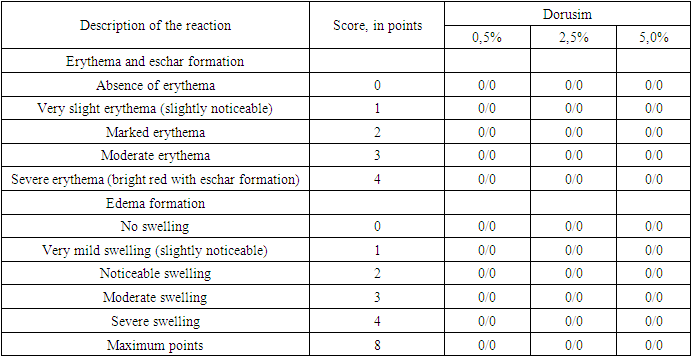
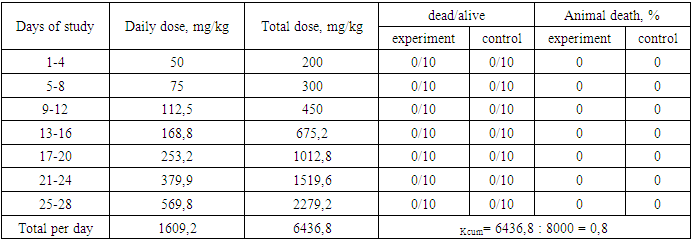
- All experimental studies were carried out on adult white male rats, herd bred, weighing 180-205 g. Before the start of experimental studies, laboratory animals were quarantined for two weeks, after which they were carefully examined and weighed. We took into account animals’ age, gender, skin condition, motor activity and body weight. Animals divided by six individuals in each group. Laboratory animals were kept in a vivarium in plastic cages, bedding made of sawdust at a temperature of 20-24°C, humidity of at least 50%, in a well-ventilated room and day/night light mode, with a standard diet, free access to water and food during the entire period of preparation for the experiment and the research,. Animals were fed according to age. All manipulations with animals were carried out at the same time of day (in the morning) taking into account the chronobiological dependence of most physiological processes in the body. The diuretic activity of the prepared phytocompositions was studied according to the approved methodological recommendations [9,10]. 1 hour before urine collection, healthy rats of the experimental groups were administered the phytocomposition Dorusim at doses of 50, 100 and 200 mg/kg, Ecustim at a dose of 150 mg/kg, and canephron at a dose of 100 mg/kg. Then all animals received a water load at the rate of 3 ml per 100 g of body weight, placed in individual metabolic cages, and the amount of excreted urine was collected during 3, 6 and 24 hours of observation.In another series of experiments, we studied the effect of Dorusim on diuresis in animals with aseptic cystitis. A model of acute aseptic cystitis in rats was developed by double intraperitoneal administration of cyclophosphamide at a dose of 80 mg/kg every other day [11]. A day later, the animals were divided into three groups. Animals of the first group were administered Dorusim at a dose of 50 mg/kg, the second group - Canephron - 100 mg/kg, and the third group - an equivolume saline solution. Animals were then placed in individual metabolic cages to collect urine the total volume of excreted urine and the content of epithelium, erythrocytes, leukocytes and protein were determined in a three-hour urine sample.The local irritant effect of Dorusim was assessed using a conjunctival test. The experiments were carried out on 9 rabbits weighing 2.0-2.5 kg, in which 0.1 ml of 0.5; 2.5 and 5.0% solutions of Dorusim was instilled into the right eye, and 0.1 ml of distilled water was instilled into the left eye (control). The reaction was taken into account after 15 minutes (rapid reaction) and after 24-48 hours (delayed hypersensitivity) and was assessed on the following scale (in points):- slight redness of the tear duct;- redness of the tear duct and sclera towards the cornea;- redness of the entire conjunctiva and sclera.In addition, the degree of hyperemia, swelling, and lacrimation were taken into account.The local irritant effect of various concentrations of Dorusim was also studied in another series of experiments on 18 rats, weighing 150 - 165 g. The animals hair cover was clipped on both sides of the spinal column (4 fields) size 2x2 cm. On the right side of rats on 2 clipped areas of their backs, 0.5 ml of Dorusim solution was applied in concentrations (0.5, 2.5 and 5.0%) for 10 days. To the control clipped areas (2 left fields) the distilled water was applied in the same volume. Observation was carried out hourly for 6 hours on the first day and for the next 13 days (14 days in total).The skin-resorptive effect of the medicine Dorusim in various concentrations was studied on 18 white outbred male rats weighing 150-170 g, which were fixed in special fixing apparatus and 2/3 length of the their tails were immersed in a test tube with 0.5; 2.5 and 5.0% Dorusim solution. The test tubes were placed in a water bath with a temperature of 28-30°C. The exposure time was 4 hours. Then, after exposure, the rats' tails were pulled out and washed with warm water and soap.The cumulative properties of the medicine studied in repeated administration, which contributes to the accumulation of toxic substances and it is determined on the basis of a quantitative indicator - the cumulation coefficient [12].To solve this problem, the cumulative properties of Dorusim was studied under conditions of subchronic repeated enteral administration of medicine to experimental animals according to Lim. The experiments were carried out on adult rats with an initial body weight of 150-165 g. Aqueous solutions of Dorusim were administered intragastrically with a special metal canula daily 1 hour before feeding. Control animals were administered distilled water in an equivalent volume at the same time. The experiment was carried out for 28 days; Throughout the entire experiment, the animals were monitored, their condition and degree of activity were taken into account. We also assessed the general condition (excitement, depression), the nature and degree of activity and coordination of movements, the reaction of animals to painful stimuli, the presence of tremors, convulsions, paresis, paralysis, discharge from the eye, nose, urinary tract, change in skin color, change in weight body, appetite.All experiments were carried out in compliance with the requirements of the European Convention for the Protection of Vertebrate Animals Used for Experimental or Other Scientific Purposes (Strasbourg 1986).
2.2. Statistical Analysis
- The data obtained were processed by the method of variation statistics using the paired Student's test and one-way analysis of variance using the standard software package BIOSTAT 2009 with an assessment of the significance of indicators (Mean±Std error). Differences in the compared groups were considered significant at a significance level of 95% p <0.05.
3. Results and Discussion
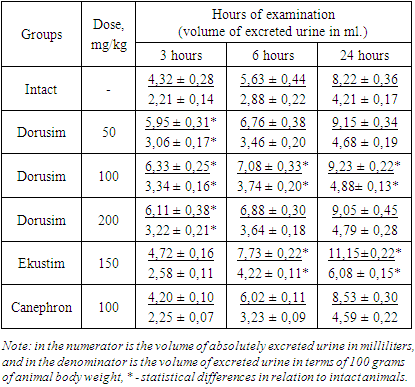
- It is known that preclinical studies of new medicines include not only chemical, physical, biological and microbiological, but also pharmacological and toxicological studies. In this case, the ultimate aim of the study is to obtain an objective assessment of the evidence of the effectiveness and safety of medicine.One of the common diseases of the urinary system is acute cystitis [13,14]. Despite important advances in the field of pharmacotherapy for this pathology, its effectiveness is not satisfactory, which has a negative impact on the ability to work and quality of life of patients. Considering the insufficient arsenal of medicines used in the treatment of cystitis and the lack of domestic medicines, it is currently actual to develop medicines for the treatment of inflammatory diseases of the urinary tract. Biologically active compounds contained in medicinal plants: Herbaalhagi, Folium Uvaeursi, Fructus Rosae, Glycyrrhiza glabra and Flores chamomillae, conventionally called “Dorusim”, have an antioxidant and membrane stabilizing effect [15,16,17,18], which allows us to assume the presence of anti-inflammatory effects in this phytocomplex. The expected effect was compared with the well-known herbal medicines – Ecustim and canephron [19,20].The results of conducted experimental studies in this regard have showed that Dorusim in healthy rats increased diuresis in the first three hours after water load by 37.7% at a dose of 50 mg/kg, by 46.5% at a dose of 100 mg/kg and 41.4% at a dose of 200 mg/kg (Table 1). In this observation period, Ekustim caused an increase in diuresis by only 9.2%, and canephron did not have a significant effect. The volume of urine excreted during the first six hours under the influence of Dorusimincreased by 21.1; 25.7 and 22.2%, respectively, from doses of 50, 100 and 200 mg/kg. Ekustim in this period, that is, six hours after the water load, increased diuresis compared to intact animals by 37.3%, and canephron did not lead to statistically significant changes, although there was an increase in diuresis by 6.9%. It should be noted that by the end of the first day of observation, diuresis increased under the influence of dorusim by 10.0-12.0%, and under the influence of Ekustim increased by 35.6%, while canephron did not have a noticeable effect on the volume of excreted daily urine. From the data in Table 1, it is clear that in terms of its effectiveness, Dorusim significantly increased diuresis especially at an average dose and it surpassed Ekustim in its activity. However, diuretic activity of Ekustim did not appear in the first hours of observation, but it appeared six hours after the water load and remained at this level until the end of the experiment. The results of this series of experiments suggest that Canephron does not have diuretic activity.
|
|
|
4. Conclusions
- 1. The phytocompositionDorusim has a distinct diuretic activity.2. The pharmacological activity of Dorusim is not inferior to the phytodrugcanephron in experimental aseptic cystitis.3. Dorusim does not have a local irritant, skin-resorptive effect or cumulative properties.4. Dorusim can be recommended as a pathogenetic agent in the treatment of acute cystitis.
AKNOWLEDGMENTS
- The work was supported by grant PZ-202102233.