
-
Paper Information
- Next Paper
- Previous Paper
- Paper Submission
-
Journal Information
- About This Journal
- Editorial Board
- Current Issue
- Archive
- Author Guidelines
- Contact Us
American Journal of Medicine and Medical Sciences
p-ISSN: 2165-901X e-ISSN: 2165-9036
2023; 13(10): 1555-1558
doi:10.5923/j.ajmms.20231310.39
Received: Sep. 28, 2023; Accepted: Oct. 13, 2023; Published: Oct. 21, 2023

The Nature of Purulent-Inflammatory Diseases of the Retroperitoneal Region in Patients with Diabetes Mellitus
 Abstract
 Reference
 Full-Text PDF
 Full-text HTML
Babadjanov B. D., Matmurotov K. J., Kuchkarov A. A.
Department of General Surgery, Tashkent Medical Academy, Tashkent, Uzbekistan
Correspondence to: Matmurotov K. J., Department of General Surgery, Tashkent Medical Academy, Tashkent, Uzbekistan.
| Email: |  |
Copyright © 2023 The Author(s). Published by Scientific & Academic Publishing.
This work is licensed under the Creative Commons Attribution International License (CC BY).
http://creativecommons.org/licenses/by/4.0/

Conducted a retrospective data analysis of 439 patient records with purulent-inflammatory diseases of the retroperitoneal space, receiving inpatient treatment in the department of purulent surgery of the multidisciplinary clinic of the Tashkent Medical Academy from 2010 to 2022, in order to select the observation group. All patients, along with general clinical laboratory studies, underwent MSCT and ultrasound of the retroperitoneal region before the start of the treatment complex to determine the operational tactics of treatment. At the same time, a limited pathological focus (abscess) was detected in 28.7% of cases, signs of phlegmon were noted in 51.4% of cases, and combined types or postoperative fistulas were observed in 19.9% of cases.
Keywords: Diabetes, Retroperitoneal absess, Purulen process
Cite this paper: Babadjanov B. D., Matmurotov K. J., Kuchkarov A. A., The Nature of Purulent-Inflammatory Diseases of the Retroperitoneal Region in Patients with Diabetes Mellitus, American Journal of Medicine and Medical Sciences, Vol. 13 No. 10, 2023, pp. 1555-1558. doi: 10.5923/j.ajmms.20231310.39.
Article Outline
1. Introduction
- Purulent-inflammatory diseases of the retroperitoneal region are characterized by the development of purulent-destructive processes and are accompanied by clinical and laboratory parameters. This group includes all forms of purulent processes (purulent paranephritis, abscess and renal carbuncle), festering renal cysts and hematomas, paranephritis and anaerobic phlegmon [1,10].The main reasons for the development of this pathology can be considered treatment errors, failure to timely detect primary kidney disease and inadequate sanitation during the Initial operation. One of the main causative agents of acute pyelonephritis is E. coli, but in the etiology of purulent-destructive forms of pyelonephritis, the following bacteria are determined: E. coli, Klebsiella, Proteus, Serratiaspp., Pseudomonas and enterococci. In this regard, it is very important to choose adequate antibacterial and antimicrobial drugs [2,9].Up to 14% of all kidney diseases is pyelonephritis in the acute phase, while 30% of patients develop various forms of purulent pyelonephritis (apostematous pyelonephritis, abscess, carbuncle). Most frequently, purulent kidney diseases lead to a total purulent-destructive disease of the retroperitoneal space and complicate the tasks of the surgeon in terms of surgical treatment [3,4,11]. In recent years, clinical cases have been observed in surgical practice, when a purulent-inflammatory process spreads distally to the inguinal area and thigh. This pattern is most often observed in patients with diabetes mellitus and indicates improvements in the existing surgical standards for the treatment of such a contingent of patients [5,7].Purulent-destructive processes in the retroperitoneal region of both the kidneys and other organs are very dangerous for the life of the patient and require special attention in determining the strategy of surgical treatment. The most formidable complication of purulent-destructive pyelonephritis is the development of urosepsis and may be the cause of nephrectomy. Nephrectomy reaches 35% due to purulent pyelonephritis . In diseases with a complicated form of urosepsis, mortality reaches 28.4-80%. For that matter, timely and high-qualified treatment is important [8].The purpose of the study is to study clinical and laboratory indicators in the studied patients with purulent-inflammatory processes of the retroperitoneal space.
2. Materials and Methods
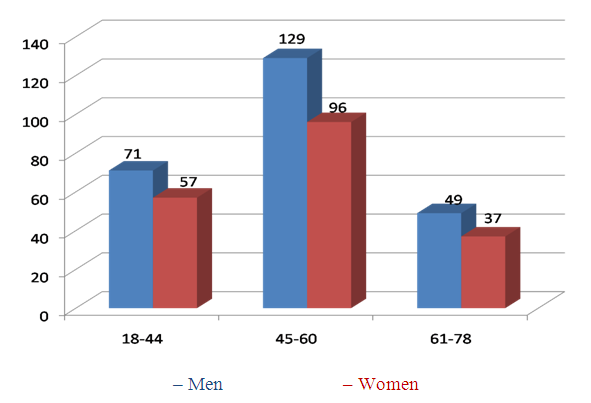
- Conducted a retrospective data analysis of 439 patient records with purulent-inflammatory diseases of the retroperitoneal space, receiving inpatient treatment in the department of purulent surgery of the multidisciplinary clinic of the Tashkent Medical Academy from 2010 to 2022, in order to select the observation group. The age of patients among women ranged from 15 to 74 and averaged 39.7 years; among men varied from 28 to 74 and amounted to 42.5 years. The distribution of patients by sex and age is shown in Figure 1.
 | Figure 1. Distribution of patients by sex and age |
3. Result and Discussion
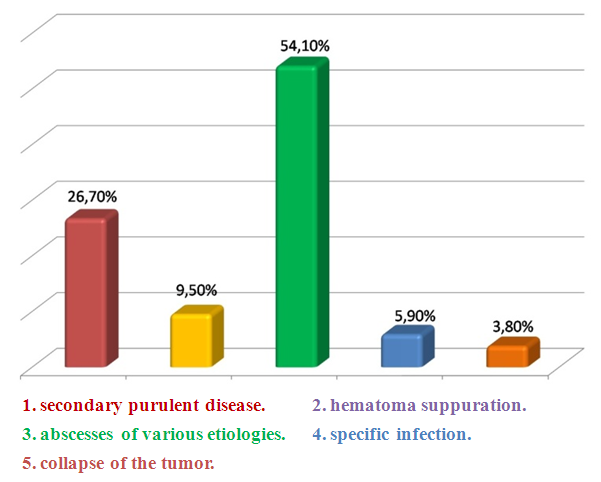
- Among the clinical forms of purulent diseases of the retroperitoneal space, the abscesses of various etiologies were more common than others - 54.1% of those examined, secondary purulent diseases amounted to 26.7% of patients after primary operations, hematoma suppuration occurred in 9.5% of cases, a specific process (spinal tuberculosis) in 5.9%, and disintegration of the retroperitoneal tumor in 3.8% of cases (Figure 2).
 | Figure 2. Clinical forms of purulent diseases of the retroperitoneal space |
 | Figure 3. Leukocyte index of intoxication |
4. Discussion
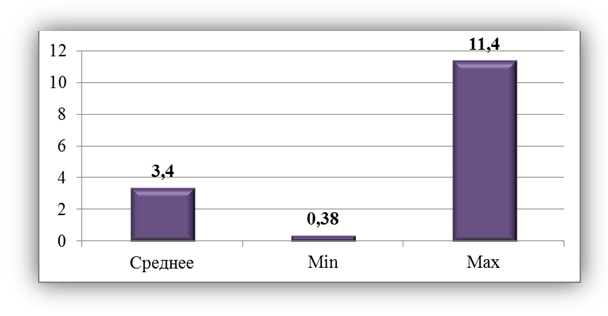
- The most frequently detected microflora in the study of urine culture was E. coli. According to the study on antibiotic resistance, E.Coli strain is most sensitive to the following drugs: polymyxin, meropenem + sulbactam, clindamycin, piperacillin + tazobactam, amikacin. Thus, the study shows that: most often purulent-inflammatory diseases of the kidneys and retroperitoneal space were found among young people with a predominance in women;The abscesses of the retroperitoneal area of various were prevailed among all clinical forms with 54.1%. Based on the comorbidities, type I and II diabetes mellitus was detected in 79.9%. Purulent-inflammatory diseases are the most severe in patients with type II diabetes mellitus, since the rapid progression of the purulent process complicates the treatment of the patient and the surgical approach;laboratory studies revealed an increase in the indicators of the leukocytic intoxication index, the index of the ratio of leukocytes and ESR, the lymphocytic-granulocytic index, which indicated the intoxication of the body associated with the inflammatory process. In our studies, the average value of LII was: 3.4±1.06 (min–0.38, max–11.4), ESR–8.03±2.0 (min–0.38 max–19.3), LHI: 1.96±0.42 (min–0.53 max –4.49).The main performed surgical treatment: autopsy and sanitation of the pathological focus with drainage of the retroperitoneal region. During open operations, we used a new method of drainage of the retroperitoneal space, the purpose of which was to prevent further progression of the purulent-inflammatory process along the fascia in patients with DM. As well as patients underwent minimally invasive operations: drainage of abscesses, decapsulation of the kidney was performed in 56.5%. A history of nephrectomy was performed in 12 patients (21.7%).Thus, in order to obtain a favorable postoperative result in patients with purulent-inflammatory diseases of the retroperitoneal space against the background of diabetes, many factors and the nature of the purulent process should be considered, since these patients have a high probability of developing fasciitis. So nowadays, the development of an adequate treatment and diagnostic algorithm in the treatment of purulent diseases of the retroperitoneal space in patients with diabetes is the main direction of modern surgery.
5. Conclusions
- Purulent-inflammatory diseases of the retroperitoneal region in most cases are preceded by abscesses (54.1%) and primary surgical operations on the organs of the retroperitoneal space (26.7%). Against the background of diabetes mellitus, purulent-inflammatory diseases generally proceed latently and laboratory parameters in these patients are not clear criteria for determining the surgical tactics of treatment. In connection with the peculiarity of the clinical course of the purulent process in patients with diabetes mellitus, all factors that affect the final result in the postoperative period should be studied, and these data indicate the need for research in this direction.
Consent
- It is not applicable.
Ethical Approval
- It is not applicable.
Competing Interests
- The authors have declared that no competing interests exist.