
-
Paper Information
- Paper Submission
-
Journal Information
- About This Journal
- Editorial Board
- Current Issue
- Archive
- Author Guidelines
- Contact Us
American Journal of Medicine and Medical Sciences
p-ISSN: 2165-901X e-ISSN: 2165-9036
2023; 13(9): 1302-1304
doi:10.5923/j.ajmms.20231309.27
Received: Sep. 8, 2023; Accepted: Sep. 25, 2023; Published: Sep. 26, 2023

Short-Latency Auditory Evoked Potentials in Noise-Induced Hearing Disorders
 Abstract
 Reference
 Full-Text PDF
 Full-text HTML
Nasretdinova Makhzuna Taxsinovna1, Raupova Kamola Musinovna2
1Doctor of Medical Sciences, Professor, Head of the Department of Otorhinolaryngology No. 2, Samarkand State Medical University, Samarkand, Uzbekistan
2First Year Basic Doctoral Student, Samarkand State Medical University, Samarkand, Uzbekistan
Correspondence to: Nasretdinova Makhzuna Taxsinovna, Doctor of Medical Sciences, Professor, Head of the Department of Otorhinolaryngology No. 2, Samarkand State Medical University, Samarkand, Uzbekistan.
| Email: |  |
Copyright © 2023 The Author(s). Published by Scientific & Academic Publishing.
This work is licensed under the Creative Commons Attribution International License (CC BY).
http://creativecommons.org/licenses/by/4.0/

Workers at the majority of enterprises of aviation industry, heat and hydro power engineering are exposed to a complex of unfavourable factors of industrial environment, among which the phenomena of physical nature occupy one of the leading places. Influencing the human organism, they are capable to give biological effects, reflecting on its well-being, efficiency and health condition, up to development of those or other diseases.
Keywords: Short-latency, Auditory, Hearing disorders of noise etiology
Cite this paper: Nasretdinova Makhzuna Taxsinovna, Raupova Kamola Musinovna, Short-Latency Auditory Evoked Potentials in Noise-Induced Hearing Disorders, American Journal of Medicine and Medical Sciences, Vol. 13 No. 9, 2023, pp. 1302-1304. doi: 10.5923/j.ajmms.20231309.27.
Article Outline
1. Introduction
- Workers at most enterprises of aviation industry, heat and hydropower are exposed to a complex of unfavourable factors of industrial environment, among which the phenomena of physical nature occupy one of the leading places. Affecting the human body, they are capable of producing biological effects that affect its well-being, efficiency and health, up to the development of certain diseases. Morbidity at such enterprises is mainly caused by work in conditions of vibration and noise. According to the authors' data, the rates of occupational morbidity in the aircraft industry and power engineering in the Irkutsk region were in different years: 7.8-49.3 and 0.9-6.9 per 10 thousand workers; in the Republic of Buryatia -6.2-34.0 and 0-4.02 per 10 thousand workers, respectively [1,3,7]. It is known that exposure to vibration and noise leads to tension of non-specific compensatory mechanisms in the human body. Recent advances in haematology and immunology create opportunities to search for specific immunological mechanisms involved in the occurrence and development of various pathologies under the influence of physical factors on the body. A number of researchers in persons with vibration-dangerous occupations have established a violation of the activity of various systems of the organism, which later were confirmed in experimental works on animals [2,5]. However, the data on the effect of vibration on haematological and immunobiological parameters, which are the basis of various changes in the organism, are very limited and contradictory. By the present time, the idea that among a significant number of life-supporting systems, the immune system fulfils protective, censor, regulatory, and regeneration stimulating functions has been finally formed. All the above-mentioned determined the purpose of the study - to analyse the data concerning the natural reactivity of the organism of workers due to the impact of vibration and noise [4,6,8].Anichin V.F. in 2014 in his work proved that under the influence of noise there are changes not only in the receptor, but also in the brainstem region, where the conductive pathways of the auditory analyser pass. Studies in recent years have also shown that pathological processes in the brainstem region cause changes in the latency values of the peaks of short-latency auditory evoked potentials [1], According to EEG data, some authors have identified changes in the subcortical structures of the brain in workers with occupational hearing impairment.
2. Purpose of the Study
- To investigate short-latency auditory evoked potentials in hearing disorders of noise aetiology.
3. Materials and Methods
- We studied a group of 25 patients in the period 2022 - 2023. The studies were conducted in Samarkand metallurgical plant, our studies were carried out on a specialised complex of MK-6 equipment of "Amplaid" company (Italy). CSVP registration was carried out in response to sound clicks of 100 µs duration, intensity 50, 50 and 70 dB above the subjective threshold of audibility of clicks. Ipsilateral potential withdrawal was used. Of those examined, 25 young, otologically healthy individuals aged 19 to 25 years who had previously worked in noise conditions (control group) and 45 workers in noise occupations with hearing impairment by the type of damage to the sound-receptive apparatus were studied. The age of the persons in the main group ranged from 22 to 51 years, and work experience in noise conditions ranged from 2 to 33 years, the level of the latter in industrial premises was 90-95 dBA. Persons with asymmetrical hearing impairment and conductive hearing loss were not included in the main group. According to the degree of hearing loss, the examined persons were subdivided into three groups: Group 1 consisted of 14 people with bone and air conduction hearing impairment in high frequencies up to 20 dB; Group 2 - 13 with hearing loss in high frequencies from 20 to 50 dB and Group 3 - 18 patients with hearing loss from 50-70 dB. At the same time, intelligibility of speech tests was preserved in them.
4. Results
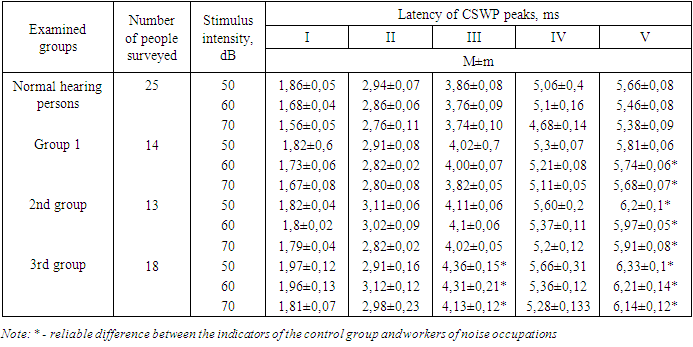
- We identified a control group where all CSVP waves were clearly defined and their latent periods decreased with increasing stimulus levels (Table 1).
|
5. Conclusions
- Thus, the conducted studies allow us to conclude that the impact of noise on a person is not limited to the damage of the peripheral part of the auditory analyser, but causes changes in its higher parts. Registration of CSVP in workers of noise occupations allows to obtain data on the state of the brainstem and thereby clarify the topics of the auditory analyser lesion under noise exposure, which is of theoretical and practical importance.