
-
Paper Information
- Next Paper
- Paper Submission
-
Journal Information
- About This Journal
- Editorial Board
- Current Issue
- Archive
- Author Guidelines
- Contact Us
American Journal of Medicine and Medical Sciences
p-ISSN: 2165-901X e-ISSN: 2165-9036
2022; 12(9): 970-974
doi:10.5923/j.ajmms.20221209.25
Received: Aug. 25, 2022; Accepted: Sep. 19, 2022; Published: Sep. 28, 2022

Features of Morbidity of Workers in the Copper Industry
 Abstract
 Reference
 Full-Text PDF
 Full-text HTML
Bakhrom M. Mamatkulov1, Bobirjon A. Abdurakhimov1, Zilola Sh. Sharofiddinova2
1School of Public Health, Tashkent Medical Academy, Tashkent, Uzbekistan
2Faculty of Treatment, Tashkent Medical Academy, Tashkent, Uzbekistan
Copyright © 2022 The Author(s). Published by Scientific & Academic Publishing.
This work is licensed under the Creative Commons Attribution International License (CC BY).
http://creativecommons.org/licenses/by/4.0/

The aim of the study was to study the state of health, age and occupational characteristics of morbidity of workers of the honey smelting and processing plant. Includes data on medical appeals and periodic medical examinations of 1761 workers of the main workshops of the copper smelter and enrichment plant. The leading diseases among the workers were respiratory, digestive, skin and subcutaneous diseases. Predicting the risk of developing various classes of diseases depending on age and work experience allows developing the most effective preventive measures.
Keywords: Mining industry, Copper, Age, Work experience, Health status, Morbidity, Risk factors, Temporary disability
Cite this paper: Bakhrom M. Mamatkulov, Bobirjon A. Abdurakhimov, Zilola Sh. Sharofiddinova, Features of Morbidity of Workers in the Copper Industry, American Journal of Medicine and Medical Sciences, Vol. 12 No. 9, 2022, pp. 970-974. doi: 10.5923/j.ajmms.20221209.25.
1. Introduction
- The mining and metallurgical combined is the basis of most industries, therefore, in most countries of the world, the mining and metallurgical industry has great economic and social importance. According to experts of the International Labor Organization, the mining and metallurgical industry is considered as a unique industry, which, along with hard work, is affected by unfavorable working conditions, harmful and dangerous production factors. [4,6]Unfavorable working conditions are the main reason for the development of diseases associated with poor health and temporary disability of people of various professions. [3]The working conditions of workers in copper mines are characterized by a number of harmful and dangerous production factors, mainly high levels of dust, fibro genic aerosols, strong noise, vibration and uncomfortable microclimate, labor intensity, their levels are significantly exceeding hygienic standards. [1,2,8,9]The constant improvement of working conditions and the improvement of personal protective equipment partially prevents the impact of harmful production factors on almost all workers. [6,8]. It should be noted that the health of workers is affected not only by harmful and dangerous production factors, but also by their lifestyle and conditions, bad habits (smoking, alcohol consumption), natural processes of biological aging and etc. [10]Among the classes of health disorders and diseases of workers working in hazardous and unsafe production conditions, diseases of the musculoskeletal system and connective tissue predominate.However, vibration disease, tumor diseases of the ear and mammary glands, diseases of the respiratory system and the nervous system are also common among miners. [5,7]An increase in the duration of work in hazardous working conditions (work experience) was noted in the dynamics of the incidence of diseases of the circulatory system and the nervous system, the musculoskeletal system, and the respiratory system.The work done is an important element in minimizing the risk of developing diseases associated with MTD, taking into account the age and experience of miners.
2. Aim
- To study the characteristics of the health status of workers at the Copper Processing Plant (CPP) and the Copper Smelter (CS), the influence of age and work experience on the development of diseases.
3. Materials and Methods
- We studied the data of the medical examination of 1761 workers by random selection of workers working at the Copper Processing plant (CPP) and the Copper Smelter (CS), the number of calls to outpatient clinics (2015-2020).In order to study the dynamics, five (20-29 years old, 30-39 years old, 40-49 years old, 50-59 years old, 60 years old and older) and six groups of internships (20-29 years old, 30-39 years old) were examined. The health status of workers, indicators of general morbidity depending on age and length of service (up to 6 years, 6-10 years, 11-15 years, 16-20 years, 21-25 years, 26 years and older) (Figure 1). The state of health of workers was assessed by extensive and intensive indicators (the proportion of disease classes in the total morbidity, % of cases and the number of days per 100 workers).
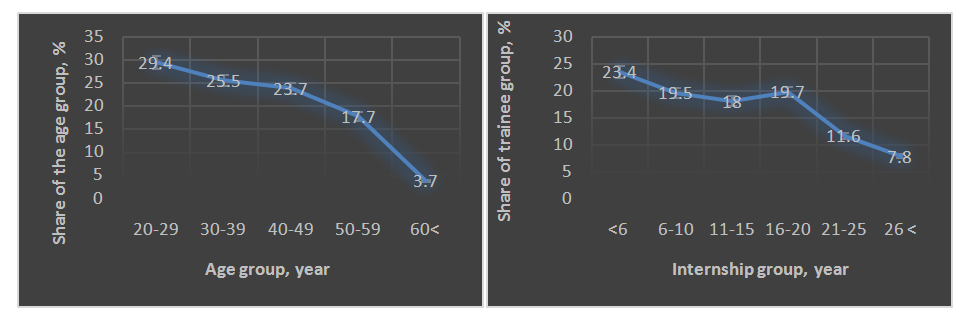 | Figure 1. Distribution of workers by age and length of service |
4. Results and Discussion
- 80.2% were men and 19.8% were women out of the selected 1791 workers. The average age of workers was 38.58 ± 0.28 years, and the average total length of service was 13.19 ± 0.2 years. The correlation coefficient showed that there is a direct and strong relationship between the average age of workers and the total length of service. (r= 0.81) (Table 1). Changes in the dynamics of the health status of workers, general morbidity depending on age and work experience in five (20-29 years old, 30-39 years old, 40-49 years old, 50-59 years old, 60 years and older) and six groups of internships (up to 6 years old, 6-10 years old, 11-15 years old, 16-20 years old, 21-25 years old, 26 years old and over).
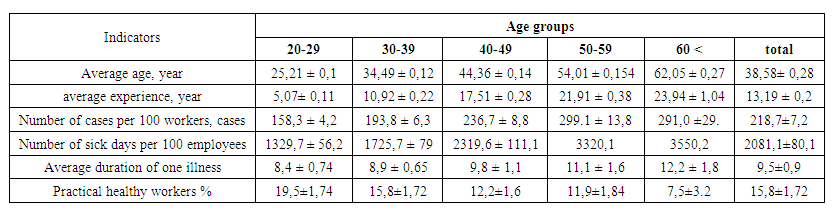 | Table 1. Health status of employees of different age groups |
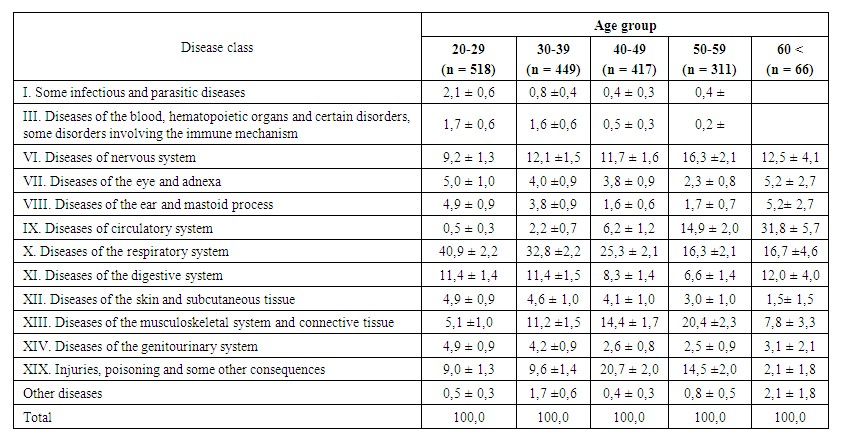 | Table 2. Share of occupational diseases by main classes and age groups (in %) |
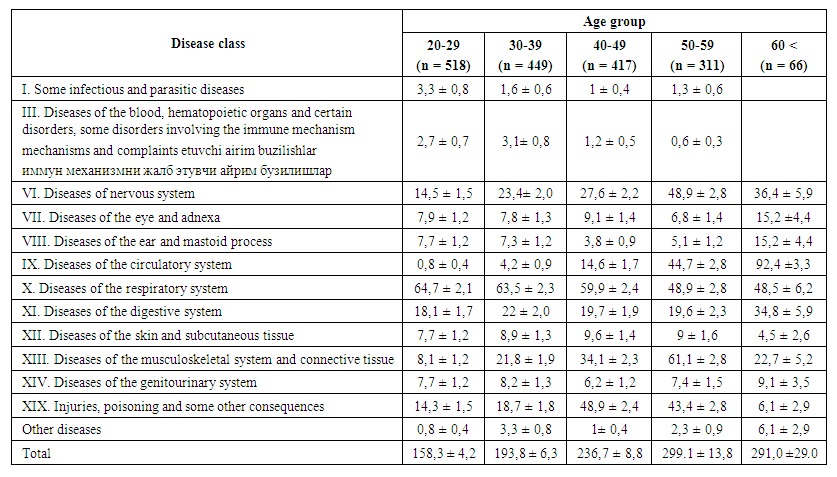 | Table 3. Temporary disability by age (per 100 employees) |
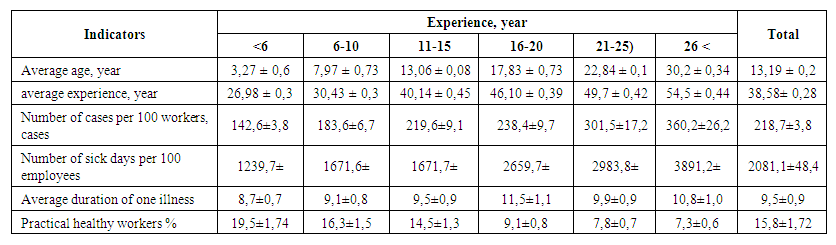 | Table 4. The health status of workers with different work experience |
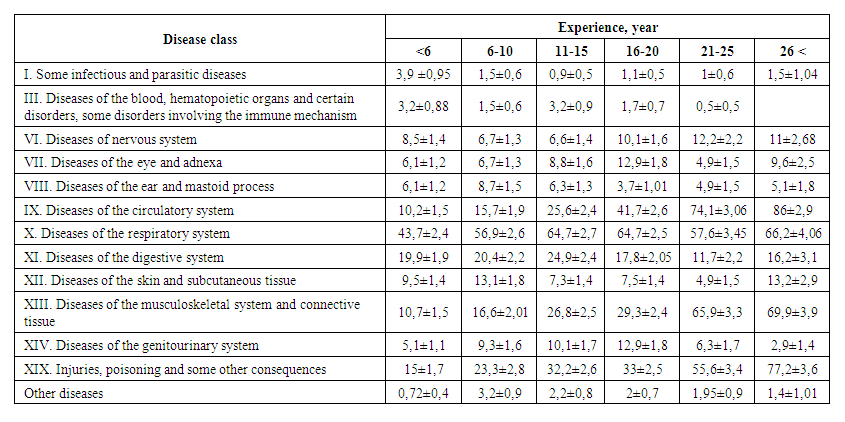 | Table 5. Temporary disability by length of service (per 100 employees) |
5. Conclusions
- Summarizing the data on the initial state of health of workers and its changes with different work experience, we can draw the following conclusions:1. A study of the state of health, taking into account changes in age and work experience, showed that workers have an increased risk of injury, poisoning and some other consequences of external causes from diseases of the nervous system and circulatory system, musculoskeletal system and connective tissue. However, the importance of diseases of the eye and its accessory organs, diseases of the respiratory system, digestive organs, skin and subcutaneous tissue, some infectious and parasitic diseases decreases with age and work experience.2. 22.0% of miners with less than 6 years of experience do not have chronic diseases. There are changes in the health status of workers with work experience of 11-15 and 20-25 years, manifested by a 2.34-fold increase in the number of diagnosed diseases per 100 workers and a decrease in the number of practically healthy workers;3. Determination of age and work experience is one of the most effective preventive measures in determining the risk of developing various classes of diseases.