Yusupov Alimardon Mirzaevich1, Djurabekova Aziza Takhirovna2, Utaganova Guljakhon Kholmuminovna3, Savronov Javlon Savronovich4
1Doctoral Student of the Department of Neurology Samarkand Medical Institute
2Professor Head of Department of Neurology Samarkand Medical Institute
3Associate Professor of the Department of Neurology Samarkand Medical Institute
4Clinical Resident, Department of Neurology, Samarkand Medical Institute
Copyright © 2022 The Author(s). Published by Scientific & Academic Publishing.
This work is licensed under the Creative Commons Attribution International License (CC BY).
http://creativecommons.org/licenses/by/4.0/

Abstract
Translated from Greek, urination means - enuresis. According to various literature sources, this disease ranges from 1-30% among children and adolescents. Koroleva I.V. et al. (2008) consider enuresis to be a consequence of various dysfunctional states of the brain, and as a result, the variety of clinical forms of enuresis [1,3]. Interest in enuresis is shown not only by the fact that the problem is not completely clear to the scientific world, but also by the fact that it is of great practical importance in pediatrics, neurology, nephrology, neurosurgery, endocrinology. The opinion of numerous data coincides with respect to the age contingent, it is believed that bedwetting up to 3-4 years is a physiological moment, and only after 5 years, where the duration of enuresis lasts for several months (6-8 months) allows making a diagnosis [2,6].
Keywords:
Diagnosis, The scientific world, A result, Enuresis, Dysfunctional states
Cite this paper: Yusupov Alimardon Mirzaevich, Djurabekova Aziza Takhirovna, Utaganova Guljakhon Kholmuminovna, Savronov Javlon Savronovich, Risk Factors, Clinical and Neurological Parameters and Optimization of the Treatment of Children with Enuresis, American Journal of Medicine and Medical Sciences, Vol. 12 No. 3, 2022, pp. 258-261. doi: 10.5923/j.ajmms.20221203.05.
1. Introduction
The very feeling of holding urine, when it is filled, comes to the 3rd year of a child's life. The main mechanism for ensuring this process is the normal functional work of the nervous system, in the relationship of both the central and peripheral nervous systems. Therefore, one of the theories of the onset of the disease is considered to be precisely the delay in the development of the nervous system in the pre- and perinatal period [4,7], as evidenced by numerous epidemiological studies. Attention should also be paid to the fact that in such children the indicators of general physical development and sexual development are also reduced [5,8]. All this requires a thorough analysis of the diagnostic, and subsequently, optimization of treatment tactics.To study risk factors, clinical, neurological and diagnostic parameters in making a diagnosis, with the development of tactics for the treatment of children with enuresis.
2. Material and Research Methods
The examination included children with enuresis (according to ICD-10), in the amount of 56, aged 10±2 years, who were hospitalized in the Department of Pediatric Neurology of the 1st Clinic of SamMI for the period 2020-2022. These children made up the main study group (MG), the control group (GK) of 22 children of identical age without signs of enuresis, healthy, who were examined on an outpatient basis, during a preventive examination at the place of residence (polyclinic No. 3 of Samarkand ). All examinations passed staged observation, at stage 1 it was necessary to conduct a sample for the main group, where more than 100 children were examined for the presence of non-organic enuresis (that is, it was necessary to exclude diseases of the genitourinary system, kidneys; spinal cord injury; diabetes mellitus, etc.); Stage 2 consisted of a comprehensive examination of the children of the main group and the control group (analysis, clinical-neurological, neurophysiological), stage 3 - the children of the main group were divided into subgroups depending on the proposed therapy. It should be noted that parents were asked to answer the questions of the questionnaire, as well as to keep a diary of the patient for 3 months, where the number of episodes of urinary incontinence was recorded. Statistical processing was carried out on an individual computer according to standard Student's degree indicators.
3. Research Result
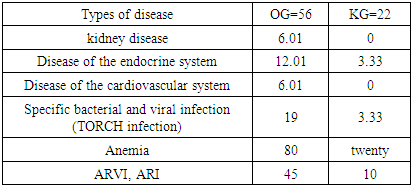
Based on the set goal, first of all, in the examined children, it was necessary to study the risk factors for the disease, taking into account the obstetric history of the mother. To do this, a thorough history of pregnancy and childbirth was collected, using a questionnaire (composed arbitrarily) so, basically, in more than 50% of children, the age of mothers was on average 30 years old. More than 62% of women noted early preeclampsia of pregnancy, and about 37% of women, including severe eclampsia and preeclampsia, suffered from this number, 11% of women in the second trimester. Chronic diseases in the form of diabetes mellitus were found in 1 woman, kidney disease in 5 women, rheumatism in 3 women. In 3% of women, had TORCH infection (cytomygalovirus, herpes virus). Separately, women with autoimmune goiter were noted (consultation of an endocrinologist during the entire pregnancy confirms this fact), thyroid dysfunction was detected in 29% of women. 2 women (excluding seizures during eclampsia) have epilepsy, one of the two took anticonvulsants throughout the pregnancy, the other only the first 2 months.Table 1. Diseases of mothers of examined children during pregnancy (%)
 |
| |
|
Table 2. Complications during pregnancy and childbirth in mothers of examined children (%)
 |
| |
|
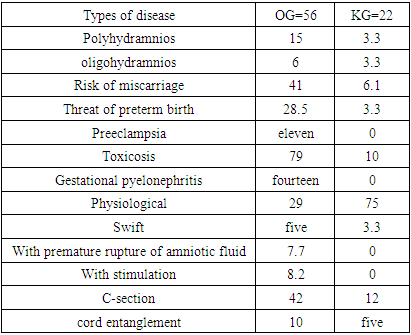
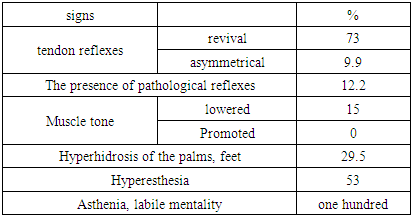
Thus, in the examined children with enuresis, only 6 women had a favorable obstetric history during pregnancy. As for the births themselves, preterm births in 28.5%, 42% delivery by Caesarean section, with placental abruption, 2 women were admitted to the maternity ward, protracted births (often first births) were noted in 10%. That is, complicated births were noted in 58% of mothers whose children suffer from enuresis, which is noted as a risk factor for enuresis in the presence of perinatal encephalopathy in children.Thus, based on the study of the occurrence of predisposing and provoking factors in children, it is possible to calculate the risk factor for the development of enuresis. Using standard anthropometric scales for assessing physical development, we determined the nature of violations of indicators in comparison with a healthy group of children of identical age. Of the examined children of the main group (MG), children with low body weight 43% with growth deficiency (body length) 21%. The body mass index (the ratio of weight and height) had an average decrease of 20%, and very low rates of 17% of children. Bedwetting is associated, according to many authors of the literature, with a violation of the autonomic nervous system, both sympathetic and parasympathetic. Accordingly, the study of the nature of the disturbance in the NS in the examined children with enuresis was necessary to confirm the role in the nervous system in the formation of the disease. When assessed by the values of diagnostic pressure and pulse, we studied the indicator of the activity of the ANS (Kerdo index). A significant difference between the MG and the control group (GC) was revealed, at the same time, a shift towards below zero in 67% was noted, which confirms the assumption of shifts in the autonomic balance in children with enuresis towards the parasympathetic department, which indicates the active participation of the ANS in the mechanism of nocturnal urinary incontinence (enuresis).The next step in the work was a survey of clinical and neurological signs of the disease. The average age of the surveyed was 10 ± 2 years, while boys were predominantly more than 85%. An important point was recorded during the collection of anamnesis, the children were found to have a hereditary burden for the disease, the presence of this pathology in a straight line (in the father and mother).According to the parents, the leading complaint of urinary incontinence was noted in all the examined main group. At the same time, 2 children had involuntary movements (tics); logoneurosis was noted in 1 patient, 1 patient was admitted with a complaint of pain in the legs (there was no desire to walk, a complete comprehensive examination revealed a hysterical reaction); 7 patients complained of headache; one patient had encopresis, and only during the day, and only when she was at home, no such signs were noted at school. When examining children, neurological changes of the following nature were revealed (no violations were found on the part of the cranial nerves); on the part of the motor sphere - an increase in tendon reflexes, more from the legs in 73% of cases, a difference in reflexes (asymmetry) in 5 patients; pathological reflexes in 7 children of the Rossolimo type. Conversely, a decrease in tendon reflexes of the knee and Achilles reflex, muscle hypotension was noted in 9 patients. Sensitive disturbances prevailed in the direction of hyperesthesia, but since children could exaggerate this symptom artificially, in stationary conditions, this symptom was not reliable, but almost all parents noted signs of asthenia and aggressiveness. Several children refused to go to school for fear of urinary incontinence during the day; such children had a labile psyche, not sociable, retired, separated from the children's team.Table 3. Clinical and neurological disorders in children with enuresis n =56
 |
| |
|
Thus, the clinical and neurological picture gives grounds to talk about changes in the nervous system, according to the type of minimal cerebral dysfunction, and in some cases as residual encephalopathy or vegetative vascular dystonia.Since the standard examination of children with enuresis includes an electroencephalography study, all patients underwent neurophysiological diagnostics in dynamics before and after treatment. The EEG revealed cerebral changes in the bioelectrical activity of the brain, at a slow pace, with a predominance of median structures in 37%, with a persistent change in cortical rhythm ( theta and delta ranges predominated) in 12 children. A decrease in the threshold of convulsive readiness was noted in 4 children (presence of slow waves, single sharp waves). Electroencephalographic indicators with their diverse violation in 89% of patients of the main group confirm the role of dysfunction of the central nervous system in the formation of pathoclinical manifestations of enuresis in children.Patients were treated with the division of the main group into two subgroups. In both subgroups, taking into account the conducted anamnestic analysis (perinatal burden), Cortexin was prescribed intramuscularly at 10 mg for 10 days, 2 courses, with an interval of 40 days; A-subgroup 20 patients received spasmex 1 tab. 2 times a day for 3 months (the drug can be prescribed from the age of 6, even taking into account perinatal damage and pezidative complications of the brain). The B-subgroup, in addition to taking spasmex, received physiotherapy in the form of magnetotherapy (BTL 5000-2016, Germany), 10 sessions (days), in 1 month according to the course, only 3 times. The result of treatment was re-evaluated according to the questionnaire for parents (comparing the patient's diary for 3 months), clinical and neurological symptoms, and according to electroencephalography.An overall positive result was recorded in 61% of cases, and in 19% a very high positive trend (without episodes of nocturnal and daytime urinary incontinence). In a comparative analysis between subgroups, higher recovery rates were found in children of subgroup B (combined pharmacotherapy and physiotherapy), 37% higher. Repeated EEG showed an improvement in the regularity of the rhythm range, background activity decreased, decreases in the amplitude of theta waves in the range, and convulsive readiness decreased. During the examination, tendon reflexes in 40% returned to normal. Decreased aggressiveness and impulsivity in children in both subgroups, but more in subgroup B. As for episodes of urinary incontinence (more at night), in subgroup -A improvement (1-2 cases in 3 months) in 39%, in subgroup -B 55%, respectively. No episodes for 3 months, enuresis in subgroup A in 15%, in subgroup B, 45%, respectively.Thus, enuresis of inorganic nature (functional) is typical for children older than 5 years, in the absence of urological disease and spinal cord injury (according to MHB10). Analysis of the data obtained showed that the presence of a burdened obstetric history in the mother is typical for all children with enuresis and is considered as a risk factor for the disease. Hereditary predisposition is a risk factor for the disease. Clinical and neurological symptoms characteristic of children with enuresis correspond to the dysfunction of the central, peripheral and autonomic nervous systems in the aggregate, which must be taken into account in the selection of basic therapy.
References
| [1] | Morozov V.I., Baibikov R.S., Zakirov A.K., Yulmetov G.A. Treatment of neurogenic bladder dysfunction and secondary enuresis in children and adolescents // Journal of Experimental and Clinical Urology, No. 4. 2018. P. 104-109. |
| [2] | Kazanskaya I.V., Otpuschennikova T.V. Rationale for the therapeutic tactics of enuresis in children with overactive bladder // Russian Medical Journal "RMZH". No. 16 dated 08.08. 2006 p. 1199. |
| [3] | Morozov V.I., Salikhova L.T. MODERN APPROACHES TO THE DIAGNOSIS AND TREATMENT OF SECONDARY ENURESIS IN CHILDREN AND ADOLESCENTS // Modern problems of science and education. - 2015. - No. 5. https://science-education.ru/ru/article/view?id=22697 (date of access: 02/18/2022). |
| [4] | MAGSHEDOVA E. T. ENUREZIS SYNDROME IN NATASHISH PSHREYDISHI CAUDSHYSHHH DEPARTMENTS OF THE SPINAL CORD // Abstract of the thesis. dis. to. m. n..... Kazan 1990, 17 p. |
| [5] | Ganina E. Yu. Enuresis in young men of military age // Dis.... c.m.s., 2008. 166 p. |
| [6] | Zavadenko N. N., Kolobova N. M., Suvorinova N. Yu. Attention deficit hyperactivity disorder and enuresis in children and adolescents. Journal of Neurology and Psychiatry. S.S. Korsakov. 2010; 110(2): 50-55. |
| [7] | Primary neurosis-like enuresis icb code 10 - Other emotional and behavioral disorders, usually beginning in childhood and adolescence (F 98) / / https://fobii.org/raznoe/pervichnyy-nevrozopodobnyy-enurez-kod-po-mkb-10/. |
| [8] | CLINICAL PROTOCOL FOR DIAGNOSTICS AND TREATMENT - NEUROGENIC BLADDER DYSFUNCTION IN CHILDREN // http://u6.gg/ksa56. |


 Abstract
 Reference
 Full-Text PDF
 Full-text HTML