-
Paper Information
- Previous Paper
- Paper Submission
-
Journal Information
- About This Journal
- Editorial Board
- Current Issue
- Archive
- Author Guidelines
- Contact Us
American Journal of Medicine and Medical Sciences
p-ISSN: 2165-901X e-ISSN: 2165-9036
2021; 11(8): 575-577
doi:10.5923/j.ajmms.20211108.06
Received: Jul. 18, 2021; Accepted: Aug. 4, 2021; Published: Aug. 15, 2021

Characteristics of the Identified Allergens and Risk Factors in Children with Allergicrhinitis
 Abstract
 Reference
 Full-Text PDF
 Full-text HTML
Jumayeva Zukhra J.
Bukhara Medical Institute, Uzbekistan
Correspondence to: Jumayeva Zukhra J., Bukhara Medical Institute, Uzbekistan.
Copyright © 2021 The Author(s). Published by Scientific & Academic Publishing.
This work is licensed under the Creative Commons Attribution International License (CC BY).
http://creativecommons.org/licenses/by/4.0/

Allergic diseases are a global health problem. Allergic rhinitis is most common among both children and adults. According to WHO more than 40% of the population of developed countries have signs of allergic readiness. Currently, the frequency of allergic rhinitis in the general population is 10–20%, and at the same time, these figures tend to further increase this disease [1,4,8]. According to a number of epidemiological studies conducted in different regions of the world, the prevalence of AR in the pediatric population reaches 22%.
Keywords: Allergy, Rhinitis, Ecology, Epidemiology, Population
Cite this paper: Jumayeva Zukhra J., Characteristics of the Identified Allergens and Risk Factors in Children with Allergicrhinitis, American Journal of Medicine and Medical Sciences, Vol. 11 No. 8, 2021, pp. 575-577. doi: 10.5923/j.ajmms.20211108.06.
Article Outline
1. Introduction
- According to the results of epidemiological studies, about 20% of the population of all age groups suffer from allergic rhinitis. According to various sources, in 54-75% of patients with allergic diseases, a hereditary predisposition is revealed, the relationship between the course of AR and the functional state of the autonomic nervous system (ANS), the features of the manifestation of autonomic changes in various forms and severity of the course of the disease, their dynamics under the influence of various methods of treatment, targeted correction, morphological changes in the tissues of the nasal cavity, taking into account the initial autonomic tone (IWT) of the body [2,3,5].Thus, an analysis of modern literature has shown that the problem of the formation and course of AR in children is one of the significant aspects of medicine, including otorhinolaryngology and allergology [6].The occurrence and course of allergic diseases are significantly influenced by climatic and geographic conditions of the human environment, ethnic characteristics of the population, lifestyle and nutrition, individual reactivity of the body, that is, the disease has clearly defined regional features.
2. Objective of the Study
- To determine the features of the identified allergens and predisposing factors in children with allergic rhinitis.
3. Materials and Methods of Research
- Objectification and verification of the diagnosis was achieved through the obligatory confirmation of its clinical and laboratory parameters, i.e., characteristic complaints and allergic history, including the presence of the influence of risk factors for the development of allergies, clinical symptoms, characteristic changes in the general blood test, skin allergological tests, IgE in serum nasal secretion, positive treatment results with the use of antihistamines in the past. In the case when it was not possible to determine the causal allergens, the diagnosis was verified on the basis of an assessment in the dynamics of the other above-mentioned indicators.All 217 AR children were divided into two groups. The first group consisted of 92 CAR children. The second group included 125 ATS children. In turn, in each group, 3 subgroups were identified, taking into account the state of the IWT.
4. Results and Discussion
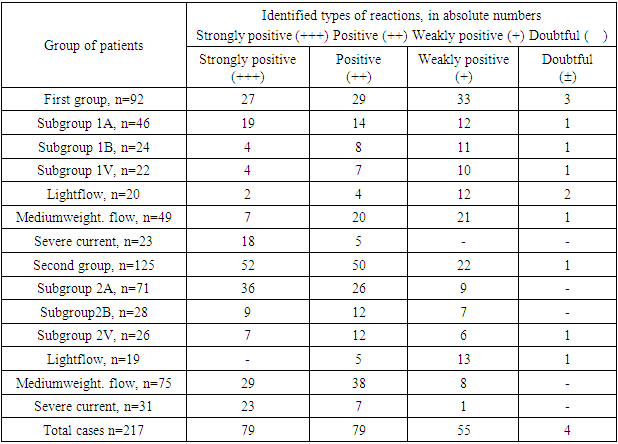
- The list of allergens and predisposing factors for the development of AR was studied on the basis of complaints from patients and their parents, the history of the development of the disease and life, scarification allergological tests.Of the total number of examined children, only 56 (25.8%) children and their parents gave the name of allergens, upon contact with which the disease began and the course of AR worsens. Of these, 38 cited only one as a causal allergen, 10 - two, 6 - three, 3 - four, 1 - five or more. Among this contingent, children with SAR were predominant compared to CAR, respectively 37 (66.1%) and 19 (33.9%). Girls (34-60.1%) have a better causative allergen of the disease than boys (22-39.9 14 (25%) individuals calculated the type of allergen themselves, and in the remaining 42 (75%) the type of allergen was identified by an allergist earlier prior to this study. The list of causal allergens indicated by patients and their parents is shown in Table 1.As can be seen from the table, most often the patients indicated house dust, a feather of a pillow, wool of a sheep and a dog, an egg. These same allergens have often been involved in polysensitization. Girls more often indicated the smell of flowers, washing powder, wool of a sheep and a dog, boys - citrus fruits, a smell of flowers, walnuts, wool of a sheep and a dog.In total, 158 (72.8%) children of AR and their parents indicated the presence of allergic diseases in their relatives. In relation to the examined child-proband, allergic diseases were manifested in 38 (24.1%), ascending and 30 (19%) - in the lateral directions of the family tree, and 90 (56.9%) revealed their combination in various variations.Relatives of 28 (17.7%) had food allergies, 20 (12.7%) - allergic rhinitis, 19 (12%) drug allergies, 14 (8.9%) - bronchial asthma, 14 (8.9%) - allergic dermatitis, 6 (3.7%) - urticaria and 57 (36.1%) their combination.The list and frequency of previous diseases as a triggering factor for the development of AR is presented in Table 1.
|

|