
-
Paper Information
- Next Paper
- Previous Paper
- Paper Submission
-
Journal Information
- About This Journal
- Editorial Board
- Current Issue
- Archive
- Author Guidelines
- Contact Us
American Journal of Medicine and Medical Sciences
p-ISSN: 2165-901X e-ISSN: 2165-9036
2021; 11(8): 569-571
doi:10.5923/j.ajmms.20211108.04
Received: Jul. 17, 2021; Accepted: Jul. 30, 2021; Published: Aug. 15, 2021

Clinical Features of the Course of Exudative Otitis Media in Benign Neoplasms of the Nose, Paranasal Sinuses and Nasopharynx
 Abstract
 Reference
 Full-Text PDF
 Full-text HTML
Kobilova Shakhodat Shokovna, Lutfullaev Gayrat Umrillayevich, Valieva Nigina Karimovna, Khamraev Farid Khamidullaevich
Faculty of Postgraduate Education, Department of Otorhinolaryngology, Samarkand State Medical Institute, Uzbekistan
Correspondence to: Kobilova Shakhodat Shokovna, Faculty of Postgraduate Education, Department of Otorhinolaryngology, Samarkand State Medical Institute, Uzbekistan.
| Email: |  |
Copyright © 2021 The Author(s). Published by Scientific & Academic Publishing.
This work is licensed under the Creative Commons Attribution International License (CC BY).
http://creativecommons.org/licenses/by/4.0/

Exudative otitis media is a polyetiological disease, often caused by a combination of several causal factors. With tumors located near the pharyngeal mouth of the auditory tube, early manifestations may be symptoms from the ear and the auditory tube-the phenomenon of exudative otitis media. In this article, we present the features of the clinical course of exudative otitis media in benign neoplasms of the nose, paranasal sinuses and nasopharynx.
Keywords: Exudative otitis media, Benign neoplasms of the nose, Paranasal sinuses and nasopharynx, Clinical course
Cite this paper: Kobilova Shakhodat Shokovna, Lutfullaev Gayrat Umrillayevich, Valieva Nigina Karimovna, Khamraev Farid Khamidullaevich, Clinical Features of the Course of Exudative Otitis Media in Benign Neoplasms of the Nose, Paranasal Sinuses and Nasopharynx, American Journal of Medicine and Medical Sciences, Vol. 11 No. 8, 2021, pp. 569-571. doi: 10.5923/j.ajmms.20211108.04.
1. Relevance
- Over the past decades, the authors have noted an increase in the incidence of exudative otitis media (EOM), and it is 15-17% among all ear diseases.EOM is a polyethological disease, often caused by a combination of several causal factors [2,4,6].It is known from the scientific literature that in patients with EOM, attention should be paid to the state of the pharyngeal mouth of the auditory tubes and anatomical structures bordering on this area, since it is their pathological changes that most often lead to the development of the disease. Obstructive dysfunction is the most common cause of EOM. It can be caused by a mechanical violation of the patency of the auditory tube due to benign and malignant neoplasms of the nose, paranasal sinuses and nasopharynx [1,2,3,5].The purpose of our study was to study the features of the clinical course of exudative otitis media in benign neoplasms of the nose, paranasal sinuses and nasopharynx.
2. Research Materials
- We conducted a retrospective analysis of the medical histories of 164 patients with benign neoplasms of the nose (DNN), paranasal sinuses (PS) and nasopharynx (NP) and 140 patients with inflammatory diseases of the nose, PS, treated in the ENT department 1 of the SamSMI clinic.We conducted the following research methods: clinical, ENT examination of organs, audiological.According to the results of the distribution of patients by age categories (1-diagram): in the main group, the largest number of patients was found in the age group of 15-24 years, 51.2%, and 25-34 years, 25.6%, while in the control group, younger patients aged 6-14 years prevailed, 47.8%.
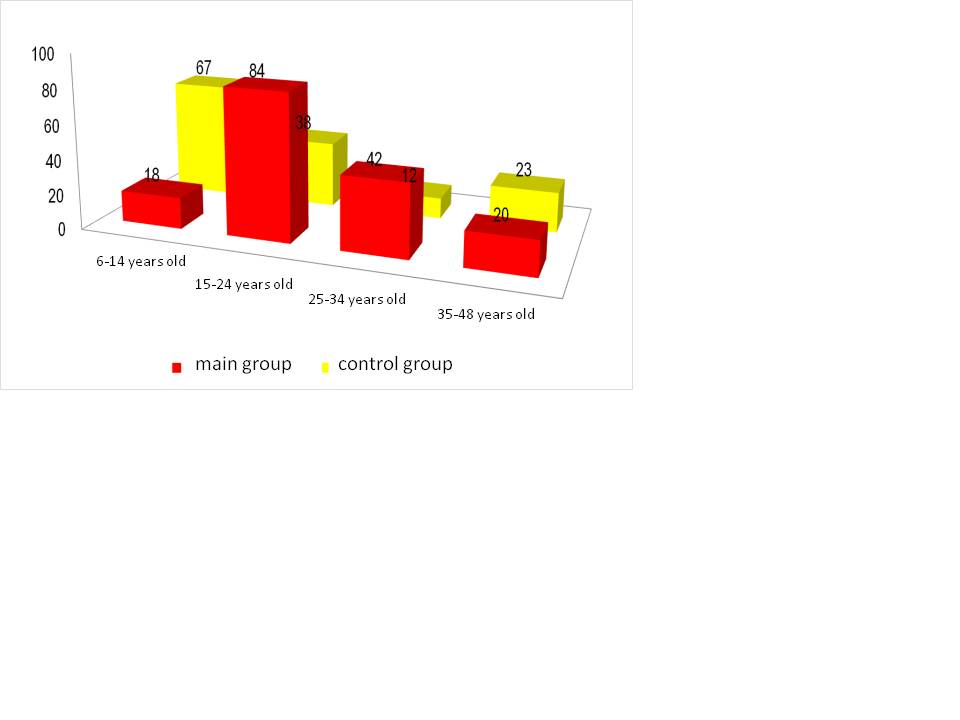 | Diagram 1. Distribution of patients by age |
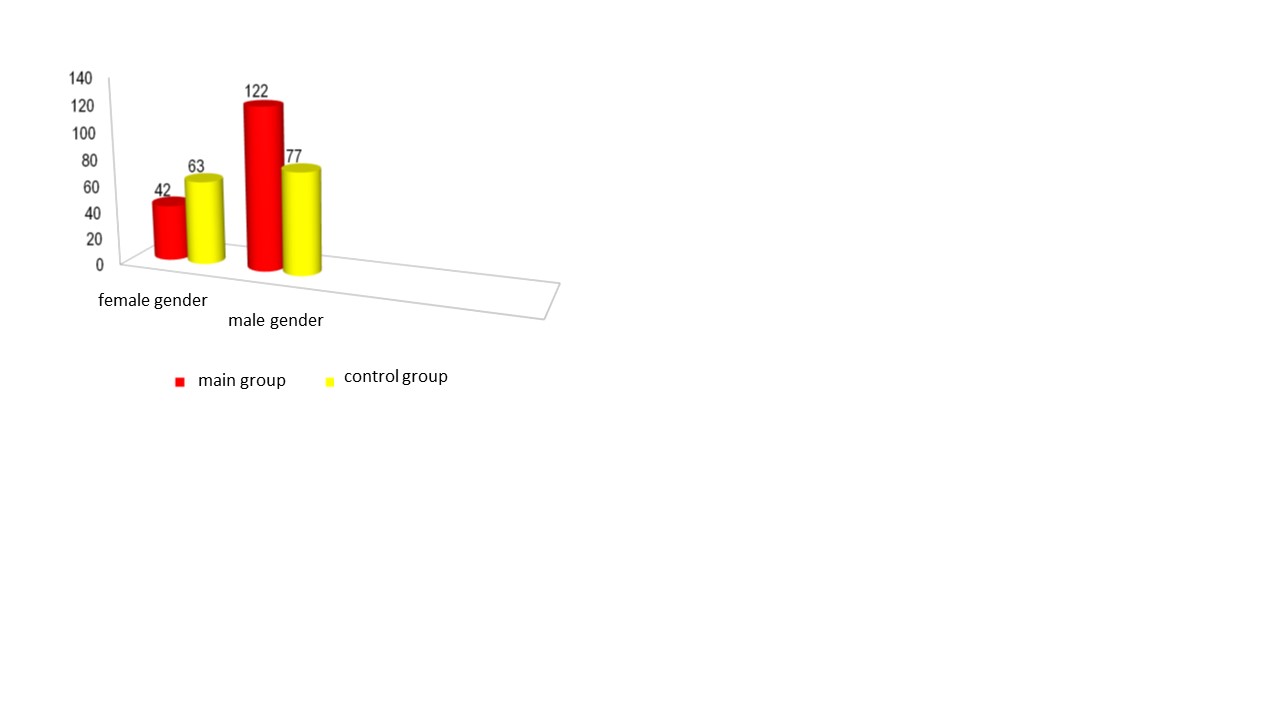 | Diagram 2. Distribution of patients by gender |
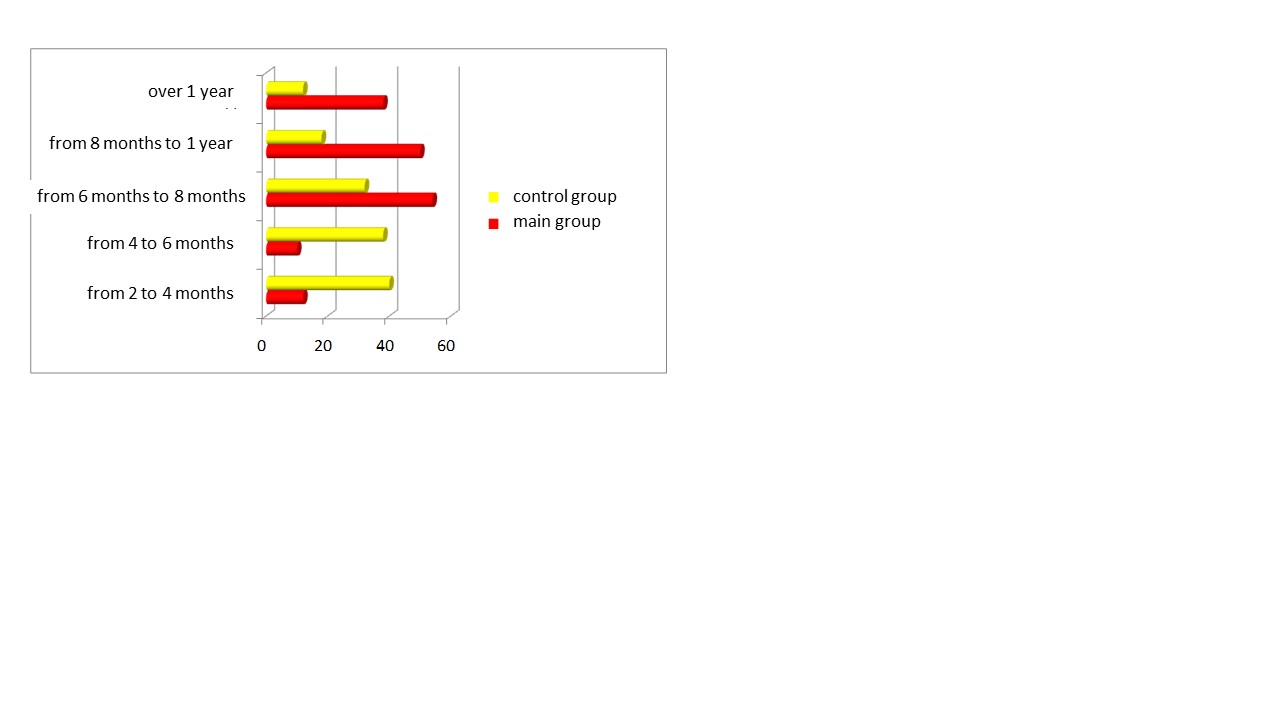 | Diagram 3. Distribution of patients by the period of prescription of the disease |
|
|
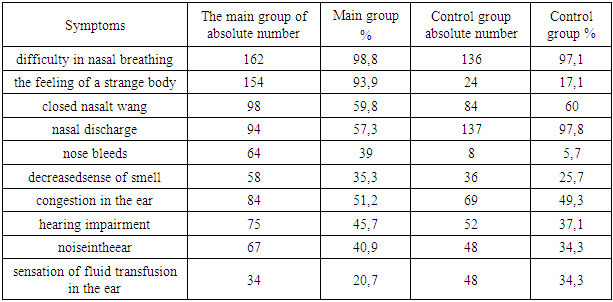
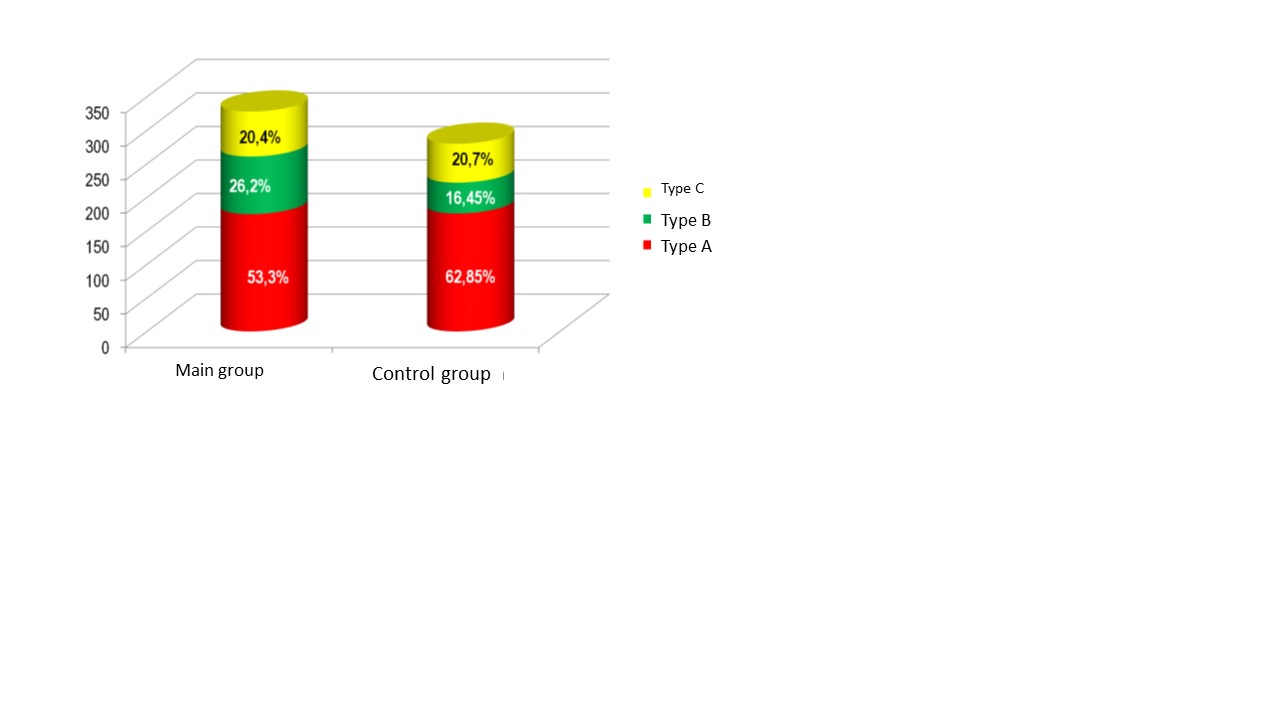 | Diagram 4. Tympanometry results (each ear was examined separately in patients) |
3. Conclusions
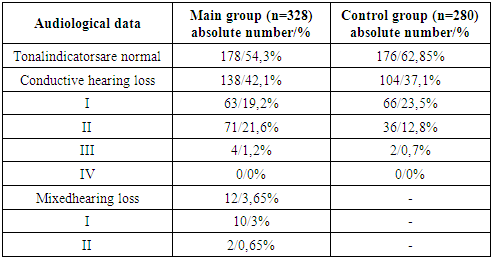
- Our studies have shown that exudative otitis media occurs in the early stages of DON, ONP and NG, which is clinically manifested by ear congestion (51.2%), hearing impairment (45.7%), tinnitus (40.9%), a feeling of transfusion fluid in the ear (20.7%). EOM in DNN, PS and NP are characterized by a unilateral violation of the functional state of the ear (69.3%), a violation of the ventilation function of the auditory tube of the III (28.7%) and IV (31.9%) stages, conductive type of hearing loss I (61.9%), II (33.3%) stages, and there is also I (42.4%) and II (51.5%) stages of mixed type of hearing loss, a tympanogram of type B was registered in 56.2% of cases.