
-
Paper Information
- Paper Submission
-
Journal Information
- About This Journal
- Editorial Board
- Current Issue
- Archive
- Author Guidelines
- Contact Us
American Journal of Medicine and Medical Sciences
p-ISSN: 2165-901X e-ISSN: 2165-9036
2021; 11(4): 308-311
doi:10.5923/j.ajmms.20211104.11
Received: Mar. 5, 2021; Accepted: Mar. 28, 2021; Published: Apr. 2, 2021

Diagnostic Significance of TNF-α (-308g / A) Gene Polymorphism in Children with Congenital Glaua with Poor Healing after the Application of Glautex Drainage
 Abstract
 Reference
 Full-Text PDF
 Full-text HTML
Turakulova Dilfuza 1, Nazirova Zulfiya 2, Kamalov Zainitdin 2, Ruzibakiyeva Malika 2, Abdurakhmanova Charos 2
1Tashkent Pediatric Medical Institute
2Institute of Immunology and Human Genomics of the Academy of Sciences of the Republic of Uzbekistan
Copyright © 2021 The Author(s). Published by Scientific & Academic Publishing.
This work is licensed under the Creative Commons Attribution International License (CC BY).
http://creativecommons.org/licenses/by/4.0/

An immunogenetic examination of 115 children with refractory glaucoma (RG) was carried out. As a control, 45 healthy children of comparable age were examined. Hypercytokinemia was revealed both before and after surgical treatment. An association of TNF-α -308G / A polymorphism with the content of TNF-α in blood serum in sick children with heterozygous carriage in the group with poor healing was established, indicating the presence of a relationship between immune disorders and their genetic determination.
Keywords: Children, Congenital glaucoma, Cytokines, Polymorphism, Gene
Cite this paper: Turakulova Dilfuza , Nazirova Zulfiya , Kamalov Zainitdin , Ruzibakiyeva Malika , Abdurakhmanova Charos , Diagnostic Significance of TNF-α (-308g / A) Gene Polymorphism in Children with Congenital Glaua with Poor Healing after the Application of Glautex Drainage, American Journal of Medicine and Medical Sciences, Vol. 11 No. 4, 2021, pp. 308-311. doi: 10.5923/j.ajmms.20211104.11.
1. Introduction
- Congenital glaucoma (CH) continues to be one of the main causes of irreversible blindness and visual disability, and therefore the treatment of this disease remains a very urgent problem in pediatric ophthalmology [4,8]. Surgery is the main treatment for congenital glaucoma. The importance and value of surgical treatment is confirmed by the results of studies conducted by the European Glaucoma Society (2011), which indicate that surgical methods are more effective in reducing and normalizing intraocular pressure (IOP) [1].In recent years, in ophthalmic pathology, much attention has been paid to the study of the role of cytokine polymorphisms in predicting healing and early scarring after surgery. The primary postoperative immune response is mediated by the production of proinflammatory cytokines, in particular, tumor necrosis factor alpha (TNF-α) [2,7].Tumor necrosis factor alpha (TNF-α) is a protein that is a product of monocytes, macrophages, endothelial, mast and myeloid cells, neuroglia cells and has a wide spectrum of biological effects. This cytokine plays a role in the development of the inflammatory response, and also stimulates the proliferation of T and B lymphocytes [3,5,6].The TNF gene encoding TNF-α is located on the short arm of chromosome 6 (6p21.1 6p21.3) within the cluster of class III genes of the major histocompatibility complex. One of the most studied polymorphic variants in this gene is rs1800629 (G-308A), located in the gene promoter, associated with the level of gene expression and production of TNF-α - allelic variant A-308 is associated with a high concentration [9,10].In connection with the above, it seems relevant to study the genetic polymorphisms of cytokine genes in children with congenital glaucoma to expand the understanding of the pathogenetic mechanisms of the formation of the immune response in glaucomatous processes and the postoperative outcome of the disease in carriers of polymorphic mutations.Purpose of the study – to identify the role of genetic polymorphism of the TNF-α gene (G-308A) in the healing of drainage.
2. Materials and Methods
- Immunological and genetic studies were carried out in the laboratory of immunoregulation of the Institute of Immunology and Human Genomics of the Academy of Sciences of the Republic of Uzbekistan. The study included 115 patients aged 2-14 years with refractory glaucoma and 45 apparently healthy children of the same age, who made up the comparison group.Measurement of the concentration of TNFα was carried out by the method of enzyme-linked immunosorbent assay (ELISA) using commercial reagent kits LLC "Vector-Best" (Russia, Novosibirsk).The data were statistically processed using the Statistica 6.0 computer program. The significance of differences in the mean values of the compared indicators was assessed by the Student's test (t).The SNP of the TNFα gene promoter -308G / A (rs1800629) was determined by the polymerase chain reaction (PCR) method using kits for the determination of polymorphisms in the human genome, OOO NPF Litekh (Moscow), by the method of allele-specific polymerase chain reaction with electrophoretic detection.The correspondence of the observed distributions of genotype frequencies to theoretically expected by the Hardy-Weinberg equation was assessed using the χ2 test. To assess associations, the relative risk (OR) was calculated with a confidence interval (CI) at a 95% significance level.
3. Results and Its Discussion
- As a result of the comparative analysis, an increased content of TNF-α in sick children with congenital glaucoma was found in relation to the indicators of the control group. The serum concentration of the studied cytokine in children of the main group before surgery averaged 124.06 ± 2.42 pg / ml, which was significantly higher than this indicator in the control group 20.37 ± 2.14 pg / ml (P <0, 05) and this indicated a pronounced hypercytokinemia in the development of the glaucomatous process.Comparative analysis of TNFα-308G / A genotypes for the GG genotype revealed significant differences between the general group of patients with GV and the control group (OR = 0.41; 95% CI: 0.213> 0.41> 0.789; χ2 = 7.352). Analysis of the heterozygous GA genotype revealed differences between the frequency of occurrence in patients with GV and the control group (33.06% and 16.84%, respectively; OR = 2.439; 95% CI: 1.267> 2.439> 4.694; χ2 = 7.352).The data obtained indicate that the -308 (G / A) TNF polymorphism makes a significant contribution to the susceptibility to disease.The proinflammatory cytokine TNF-α influences the development of such postoperative complications as early scarring, and its level affects the duration of these complications. It was found that the higher the serum TNF-α level, the higher the frequency, severity and duration of reactive complications after drainage.Analysis of the results after surgery allowed us to identify situations, the most favorable and unfavorable course of the postoperative period, on the basis of which two groups were formed. The main criteria for selecting patients by groups were factors of unsatisfactory (poor) and satisfactory (good) healing, based on determining the concentration of the studied mediator-immune response in blood serum.To identify a more accurate state of drainage healing, we carried out a comparative analysis of the TNF-α content in the blood serum over time, on the 3rd, 7th and 14th days after surgery (Fig. 1).
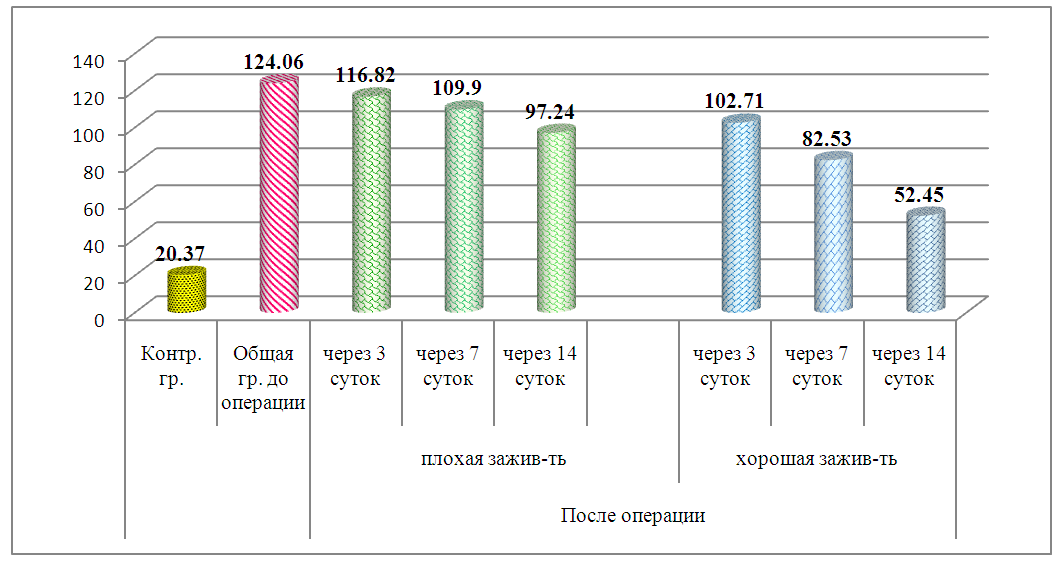 | Figure 1. TNF-α content in groups of children before and after surgical intervention |
4. Conclusions
- 1. It was revealed that in children with GV before surgery, the concentration of TNF-α in the blood serum is 6 times higher than in the control group.2. It was found that in the group of children with poor healing ability, surgical treatment did not reduce the expression of the studied mediator, and the analysis of TNF-α in dynamics revealed a slight decrease in the synthesis of this cytokine, which is associated with genetic determination.3. Certainly, the obtained typing data of the TNF-α gene indicate that the -308 (G / A) TNF polymorphism, in particular, heterozygous carriage, makes a significant contribution to the predisposition of early scarring, as it promotes adhesion of the wound canal and vice versa leads to the accumulation of intraocular fluid.