M. K. Mirrakhimova 1, N. U. Nishonboyeva 1, M. B. Kasimova 2
1Tashkent Medical Academy, Tashkent, Uzbekistan
2Senior Lecturer, Department of Therapeutic Direction №1, Tashkent State Dental Institute, Tashkent, Uzbekistan
Copyright © 2020 The Author(s). Published by Scientific & Academic Publishing.
This work is licensed under the Creative Commons Attribution International License (CC BY).
http://creativecommons.org/licenses/by/4.0/

Abstract
The prevalence of symptoms of allergic pathology (bronchial asthma (BA), allergic rhinitis (AR) and atopic dermatitis (AD)) in children under the age of five years old living in ecologically unfavorable areas was determined using a questionnaire. The incidence of allergic diseases among children under 5 remains unnoticed by pediatricians and primary medical staff, so there is underdiagnosis of these diseases. Observing the difference between official statistics and expert data points out the necessity for careful research to determine the prevalence of atopic diseases among children under 5 in these regions.
Keywords:
Young children, Allergic diseases, Atopic dermatitis, Allergic rhinitis, Ecology
Cite this paper: M. K. Mirrakhimova , N. U. Nishonboyeva , M. B. Kasimova , Characteristics of Allergic Pathologies Progression in Young Children, American Journal of Medicine and Medical Sciences, Vol. 10 No. 9, 2020, pp. 652-656. doi: 10.5923/j.ajmms.20201009.05.
1. Introduction
Allergy symptoms are linked with certain periods of development, in other words there are allergic steps [2,8,10]. It is interesting that, the start of allergic pathology corresponds to the age under 5 [1,6,7,9]. In that age manifestations of allergy effect many organs of a child, causing systemic morphofunctional failure; it also effects pregnancy progression in mothers [3,5,11]. But at the same time in that age it is possible to effect the development of allergy from the prophylactic and therapeutic points of view. Every age period in a child’s development has certain stages of reactivity development which are called “atopic steps” or “atopic march” [4,7,12]. Until now there were no scientific researches performed to study the prevalence and characteristics of allergic diseases (BA, AR, and AD) among the children under 5 in the industrial districts of the Republic of Uzbekistan. According to official data in these three districts of Tashkent region there are 0.001% children under 5 diagnosed and registered with bronchial asthma.
2. Research Methods and Materials
We performed a poll among the parents of children under 5. According to the inclusion criteria the study involved children from 2 to 5 years old. The poll was performed in kindergartens, and the questionnaires were filled by parents. The poll enrolled parents of 2300 children.
3. Results
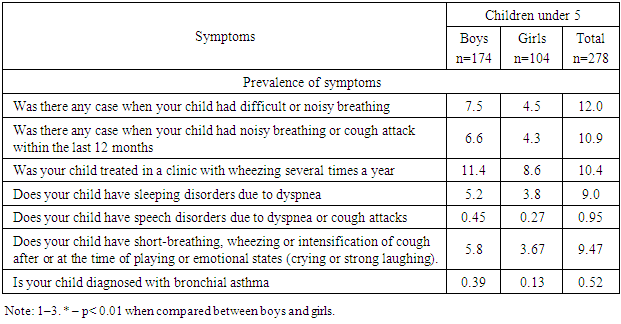
According to the results of the study parents of 278 children (12%) answered positively to the questions about symptoms of BA. Analysis of the answers (Table 1) showed that, 12% of 278 mothers answered positively to the question about any case of difficult or noisy breathing observed in their child, while 10.9% confirmed that their children had noisy breathing or cough attack within the last 12 months.Table 1. Prevalence of BA symptoms among the children under 5 according to the results of the poll (%)
 |
| |
|
The prevalence of whistling breathing attacks was 4 – 12 times in 6.8% of the children with greater frequency among boys, than girls (Figure 1). 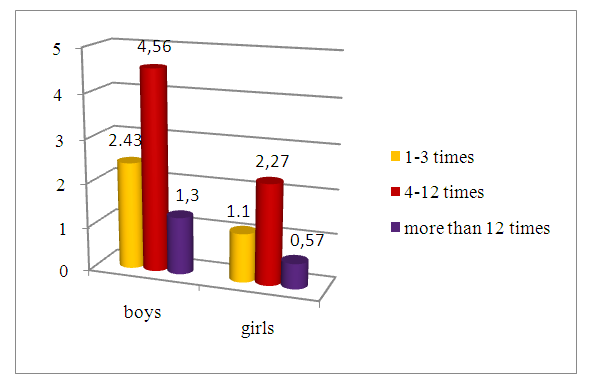 | Figure 1. Frequency of whistling breathing attacks within the last year |
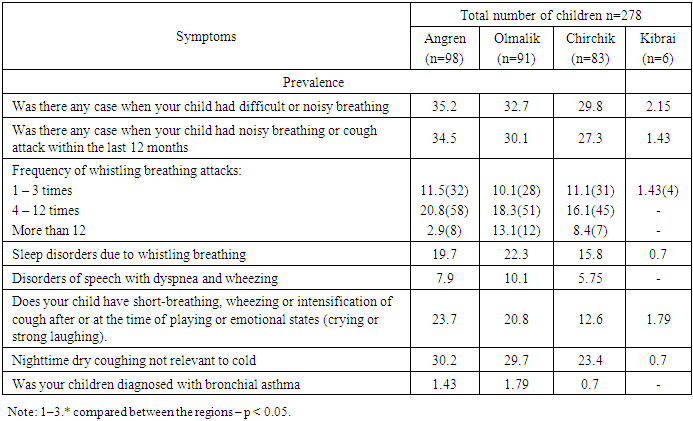
Results of our study (similar with literature data) showed that, according to the distribution by gender symptoms of BA were observed very often among boys from 2 to 5 years old. For example, sleeping disorders due to dyspnea (9.0%); speech disorders due to cough attack or dyspnea; short-breathing, wheezing, and intensification of coughing in emotional states (crying, laughing) or after it (9.47%). According to the literature data, compared to girls respiratory pathways in boys are narrower and shorter, epithelial resistance to viruses is lower with certain hormonal differences. That, in its turn, increases the risk of whistling development after cold or viral diseases [7]. In our study we also paid attention to the prevalence of BA symptoms in children under 5 according to the place of living. These data are presented in Table 2. Comparison of asthma-like symptoms (Table 2) showed high rate of positive answers to questions about noisy breathing or cough attacks within the last 12 months and any case of noisy or difficult breathing among the children under 5 living in Angren than among those living in Olmalik and Chirchik, while the questions about cases of dry coughing not linked with cold and diagnosis of bronchial asthma were positively answered more often by parents of children living in Angren and Olmalik.Table 2. Prevalence of BA symptoms among the children under 5 according to the place of living (%)
 |
| |
|
The results of the poll of asthma-like symptoms and clinically diagnosed bronchial asthma among the children under 5 obtained with the help of questionnaire confirmed under diagnosis of the pathology. Thus, the research we performed in the industrial districts of Tashkent region to study the prevalence of BA among the children under 5 showed under diagnosis of the disease and higher prevalence rate of coughing type of the pathology among these children. When children under five have 4 or more whistling breathing or dry coughing attacks it is important to assess the probability or risk of bronchial asthma development. When all the other causes of wheezing and dry coughing attacks are excluded there is high probability of correct diagnosis of BA. These patients receive trial therapeutic dose of anti-asthmatic agents. If the dose has successful therapeutic effect a specialist can answer the question if it is asthma or not. According to the results of our work parents of 202 children (8.7%) answered positively the questions about the symptoms of allergic rhinitis, parents of 287 children (12.4%) noticed the symptoms of atopic dermatitis. Distribution of the symptoms of allergic rhinitis among the children under 5 according to the place of living is presented in Figure 2. From the obtained data we can see that prevalence of allergic rhinitis is the highest (48.5%) in Chirchik region compared to other regions (Olmalik and Angren), and the symptoms were mostly observed among the children of 3-5 years old (67.2%) and more often in boys (61.8%). 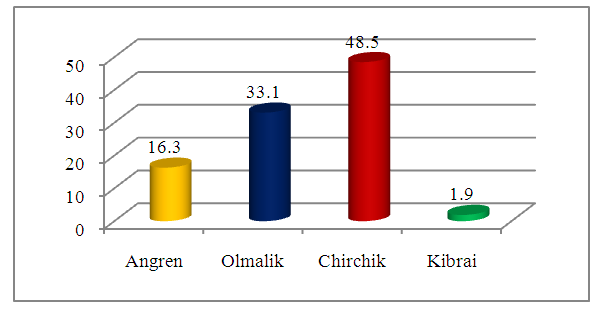 | Figure 2. Prevalence of allergic rhinitis symptoms according to the place of living % |
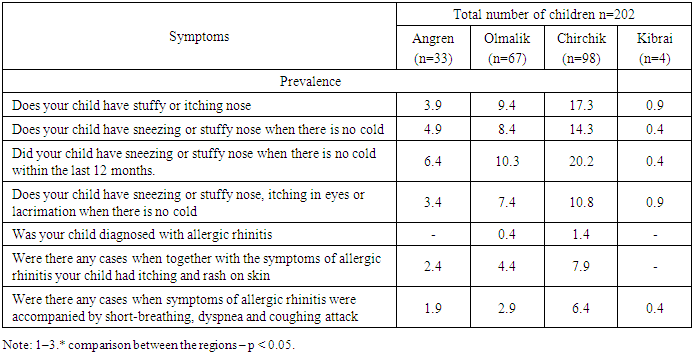
The reason of that is location of Uzoilgasmach Ltd., a large holding manufacturing technologies for chemic industry, in Chirchik where it periodically emits chlorine steam into the atmosphere. The amounts of ammonia and nitrogen registered in Maksam-Chirchik company were 2.6 and 4.7 folds higher than normal limits, respectively. The study of the prevalence of AR symptoms in the regions (Table 3) showed that the questions about the cases of sneezing, stuffy nose when there was no cold within the last 12 months and stuffy or itching nose received more positive answers (20.2%, 17.3%) from the mothers of children from Chirchik region.Table 3. Prevalence of AR symptoms in children under 5 according to the place of living (%)
 |
| |
|
Significant difference between the defined prevalence of allergic rhinitis symptoms and diagnosis of allergic rhinitis among the children under 5 confirmed the present underdiagnosis of the pathology. The difference between the obtained results can be explained by the similarity of allergic pathological symptoms with the symptoms of other diseases and the fact, that primary line specialist mostly do not take into account immune pathological mechanisms of the disease development. 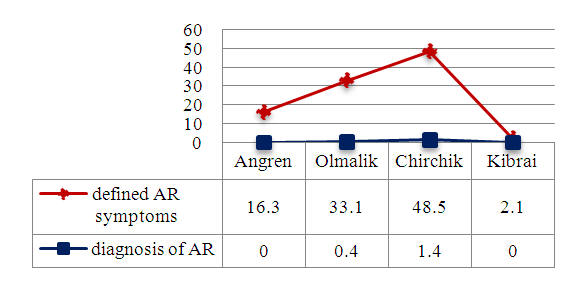 | Figure 3. * comparison between regions – р < 0.05 |
The obtained data demonstrate (Figure 4) that when distributed according to the place of living atopic dermatitis is observed in 41.1% of Angren children 30.6% of Olmalik children, and relatively most often in Chirchik with 70% among the children under 3 years old and more often in girls (59.2%). 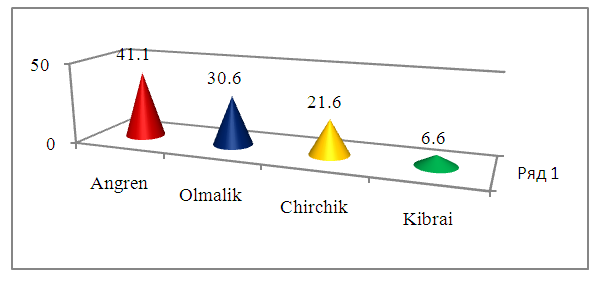 | Figure 4. Prevalence of AD symptoms in children according to the place of living % |
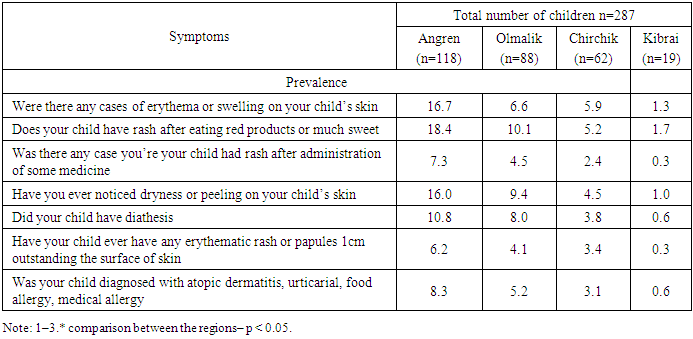
Primary sensitivity in atopic dermatitis before 3 years old is sensitivity to food proteins [2]; in our study the symptoms of atopic dermatitis in children under 3 were also caused by food proteins.The study of medical data of the children supposed to have atopic dermatitis in our research showed (Table 4) that 18.4% of mothers of the children living in Angren answered positively the question about rash appearing after their children consumed red products or much sweets. Some mothers of the children living in ecologically unfavorable regions also answered positively the question about the established diagnosis of atopic dermatitis, urticaria, food allergy, and medication allergy, moreover, these diagnosis were more often registered in children from Angren (8.3%). Table 4. Prevalence of AD in children under 5 according to the place of living (%)
 |
| |
|
The reason of that is location of the branch of metallurgic industry in Angren where they a lot of aluminum is emitted to soil. In Kochbulok mine company the registered values of nitrogen ammonia was 9.26 folds, sulfates 2.7 times, and nitrogen nitrites 3 times higher than normal limits. Among the children under 5 allergic rhinitis, atopic dermatitis and its clinical manifestations were registered significantly more often in Kibrai district.In our study among the children under 3 etiologically significant allergens of atopic dermatitis were: cow milk 72.2%, eggs 41.3%, grains 24.5%, soya 13.4%, fish 9.3%, vegetables and fruit 31.8%. Thirty one (1.3%) children of those under 5 had two and twenty-two (0.9%) had combination of three allergic pathologies.
4. Conclusions
Thus, among the children under 5 living in ecologically unfavorable districts of Tashkent region prevalence of allergic diseases (bronchial asthma, allergic rhinitis, and atopic dermatitis) and corresponding clinical symptoms was relatively higher in Kibrai districts. Among the children under 5 allergic diseases remain unnoticed by pediatricians and primary line specialists, in other words there is under diagnosis of these pathologies. These pathologies remain uncovered by allergologist-immunologists, so theey are not included in the corresponding statistical data. It means that, there is no information about the real prevalence of allergic diseases among the children under 5 consequently there is no in-time adequate pathogenetically-based therapy. The difference between official statistical data and expert results shows the necessity of careful research to study the prevalence of atopic pathologies among the children under 5 in these districts.
References
| [1] | Balabolkin I.I. Allergic morbidity of children and adolescents in the moder ecologic conditions [Allergicheskayazabolevayemostdeteiipodrostkovv sovremennihecologicheskihusloviyah] //Pediatrics, Moscow. 2014. № 2.p.40–46. (in Russian). |
| [2] | Volkova N.A. et al. Structure of allergic diseases and the role of various allergens in the development of atopic pathology in young and preschool age children in forest areas of Sverdlovsk region [Strukturaallergicheskihzabolevaniiirolrazlichnihallergenovpriformirovaniiatopicheskoipatologiiudeteiranneg oidoshkolnogovozrastavlesnoisverdlovskoioblasti] //Russian allergology Journal. 2015. №2. p.59-63. (in Russian). |
| [3] | Kamaltinova Y.M. Prevalence, clinical allergologic characteristics of allergic diseases in children in Tomsk city and Tomsk region [Rasprostranyonnostklinokoallergologicheskayakharakteristikaallergicheskihzabo levaniudeteitomskaitomskoioblasti]. Abst.diss.cand.of med.scien. Tomsk, 2013. p39. (in Russian). |
| [4] | Karimova F.R., Muminova A.U. Acute allergic states in children living in ecologically unfavorable region of Bukhara [Ostriyeallergicheskiyesostoyaniyaudeteiprojivayushihvecologicheskineblagopriyatnomregione gorodabukhari] // Chelyabinsk region Young scientists and specialists’ Committee Bulletin. 2017. V. 1. № 1 (16). p. 6-9. (in Russian). |
| [5] | Brozek G. Childhood asthma prevalence and risk factors in three Eastern European countries - the Belarus, Ukraine, Poland Asthma Study (BUPAS): an international prevalence study / G. Brozek, J. Lawson, A. Shpakou et al. // BMC Pulm Med. - 2016. - Vol. 16, №1. - P. 11.]. |
| [6] | Jae W. Choi, Barno T. Khalmatova, Feruza I. Salomova, Ilmira S. Razikova, Maktuba H. Mirraximova et al. The prevalence of symptoms of allergic diseasesin children residing in industrialregions of Uzbekistan //International Journal of Psychosocial Rehabilitation 2020. Volume 24 - Issue 4. pp: 2105-2115. |
| [7] | Lee E., Hong S. J. Phenotypes of allergic diseases in children and their application in clinical situations //Journal of the Korean Pediatric Society. – 2019. |
| [8] | M. Kh. Mirrakhimova, G. A. Toshmatova et al. Clinical efficacy of montelukast (l-montus kid®) in the control of mild persistent bronchial asthma in children //Journal of Critical Reviews 2020. Volume 7 - Issue 5. pp: 805-807. |
| [9] | M. Kh. Mirrakhimova. Improving methods of treatment of atopic pathology in children //Journal of Critical Reviews 2020. Volume 7 - Issue 12. pp: 190-192. |
| [10] | Mirrahimova M. H. Bronchial asthma in children: a modern view of the problem //Central Asian Journal of Medicine. – 2019. – Т. 2019. – №. 1. – pp. 74-80. |
| [11] | Nishonboyeva N. Y., Mirrakhimova M. Kh., Ibragimova Sh. A. Digestive organs status in children with atopic dermatitis //Journal of Critical Reviews 2020. Volume 7 - Issue 5. pp: 678-679. |
| [12] | Olutola BG., Claassen N. Factors associated with parent-reported wheeze and cough in children living in an industrial area of Gauteng, South Africa.// Environ Sci Pollut Res Int] 2018 Sep 28. |


 Abstract
 Reference
 Full-Text PDF
 Full-text HTML