Igamova Saodat, Djurabekova Aziza
Samarkand State Medical Institute
Correspondence to: Igamova Saodat, Samarkand State Medical Institute.
| Email: |  |
Copyright © 2020 The Author(s). Published by Scientific & Academic Publishing.
This work is licensed under the Creative Commons Attribution International License (CC BY).
http://creativecommons.org/licenses/by/4.0/

Abstract
The central nervous system is the main mechanism that determines the nature of the reactivity and adaptation of the body to a set of environmental factors. At the same time, autonomic imbalance acts as the root cause of the pathological process or as a predisposing factor, and it is advisable to use the cardiovascular system as an indicator of neurohumoral regulation its reactions are associated with the activity of the central nervous system, autonomic nervous system and subcortical centers.
Keywords:
Newborns, Perinatal lesions, Psychomotor development
Cite this paper: Igamova Saodat, Djurabekova Aziza, Dynamics of Psychomotor Development of Newborn Children with Perinatal Disease of the Nervous System, American Journal of Medicine and Medical Sciences, Vol. 10 No. 4, 2020, pp. 197-200. doi: 10.5923/j.ajmms.20201004.04.
1. Introduction
In the structure of childhood disability, perinatal lesions of the nervous system (PLNS) account for about 50%, and pathology of the nervous system in 70% of cases, perinatal factors caused disability in children [1,3,7]. Brain damage associated with cerebral hypoxia occurs in 48% of newborns. With fetal and newborn asphyxiation, the frequency of brain damage is 20–40%, and in children born with low body weight, it reaches 60–70% [2,4,6].Damage to the developing brain is the most common CNS pathology in children, which mainly determines the development of such serious conditions as resistant epilepsy, behavioral disorders, and school adaptation problems [5,8].High perinatal mortality is caused by perinatal pathology: 75% of intrauterine deaths are associated with gross malformations of the Central Nervous System, and among children dying in the first year of life, 40% have at least one brain malformation.
2. Aim of Studying
The dynamics of the psychomotor development of newborns with perinatal damage of the nervous system.
3. Material and Methods
The study was based on a clinical and laboratory examination of 161 newborns with PLNS of hypoxic origin. The research bases were the Department of Neurology and Neurosurgery of the Samarkand State Medical Institute, the Department of Pediatric Neurology and the maternity ward of the 1-st Clinic of SamSMI, Resuscitation and Intensive Care Unit of the 2-nd Clinic of SamSMI, Samarkand Regional Branch of the Republican Center for Social Adaptation of Children. 300 children with PLNS of various symptoms and clinical manifestations were examined, of which 127 with PLNS of hypoxic origin were selected. The data obtained were subjected to statistical processing using a standard application package using the built-in statistical processing functions. During statistical processing, the initial array of clinical data was mandatory checked for compliance with the law of normal distribution), standard error of the mean (m), relative values (frequency, %), statistical significance of the measurements obtained when comparing the average values were determined by the Student’s criterion (t) with the calculation of the probability of error (P) when checking the normality of the distribution (by the excess criterion) and the equality of the general variances (F – criterion of Fisher). Further to the initial data, methods of variation parametric and nonparametric statistics were used with calculation of the arithmetic mean of the studied indicator (M), standard deviation (We analyzed the neuropsychic development of newborns using the tabular method (according to Drujinina L.V., Dubinina I.D., Yurko G.P.). After evaluating the results, we identified groups of CPD proposed by Pechora K.L., as well as assessed neuropsychic development in maternity periods of up to 3, 6 months and 1 year.
4. Discussion of Results
Brain activity affects psychomotor development, which is conditionally divided into 2 levels: the formation of the psyche and motor activity of the child.Mental activity includes sublevels of speech development (sensory and motor speech) and social adaptation, with indicators of sensory development (sensitive sphere). Movement activity includes sublevels of motor skills and manual skill. According to the results obtained in children of the analyzed groups, significantly more often during 3 months of life a lag in the neuropsychic development was determined 12 (%) in children with 1 degree, 32 (%) - 2 degrees and 13 (%) - 3 degrees (P <0.01). At the age of 3 months to 6 months, children with 1 degree having deviations amounted to 7.2%, with 2 degree the number of children increased by 12, and with 3 degree of improvement was not observed.By the year 1, there was a tendency toward an improvement in the neuropsychic development of children - in the 1st degree, the number of children with a lag completely leveled off, with a 2nd degree decreased by 2 times, and no changes were observed with a 3rd degree (Fig. 1).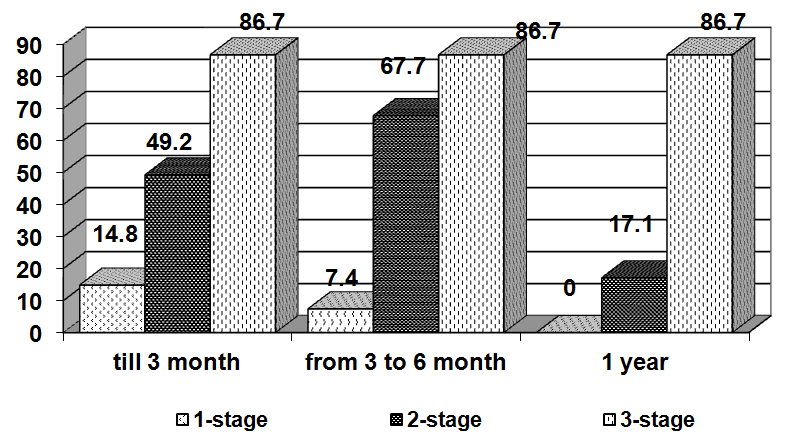 | Figure 1. The dynamics of the lag of children in neuropsychic development |
In 14.8% of children with 1 degree up to 3 months, motor speech lag was noted, which was completely restored by 1 year of life. In the third part of children with 2 degrees, there was also a lag in the development of motor speech, while in children with 3 degrees, it was observed in half, exceeding 1.5 times. By the 1st year of life, children with grade 1 with impaired motor speech were not detected, with grade 2 their number decreased by 2 times, with grade 3, - 53.3% were detected, exceeding grade 2 by 8.5 times (fig. 2).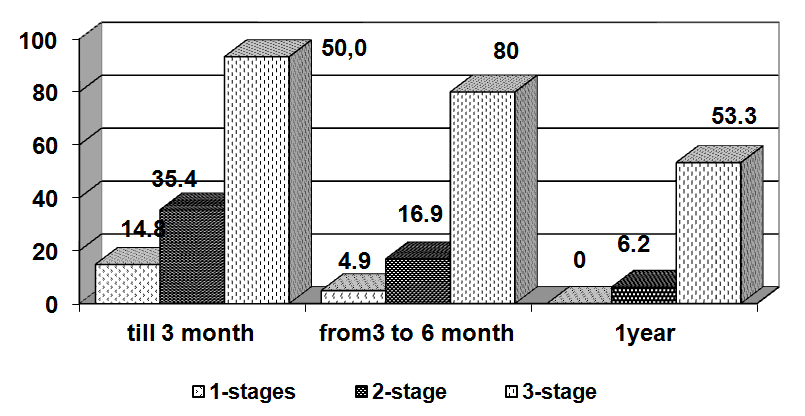 | Figure 2. Dynamics of deviations in the examined children during 1 year of life in speech development |
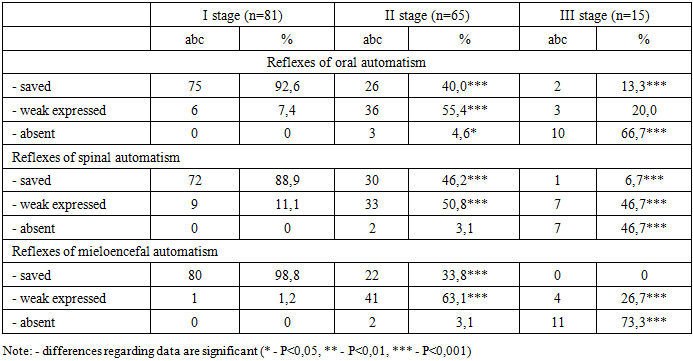
At the same time, reliably outstripping rates of restoration of development in 1 and 2 degrees of newborn children were determined (p <0.01). By the first year of life, children with grade 3 in psychomotor retardation had an adequate formation of behavioral skills. However, along with the lag in speech and motor development, they not only had a lag in the ability to master new skills, but also partially lost their previous ones. The above features of neuropsychological development is important to consider in the aspect of early intervention in the behavioral skills of children with PLNS, as well as fixing them to 1 year and beyond. This also applies to the formation of motor and speech reactions in them. In our opinion, children born with PLNS need individual pedagogical, medical and psychological influences.Tendon reflexes in those examined with PLNS at birth were preserved with 1 degree on average up to 78% of newborns, with a second degree - in the fifth part (P <0.01) of newborns. In the majority (88.9%) of premature infants, the search reflex is weakly expressed, which is 2.3 times less and absent 2.1 times more often than in full-term ones. The same picture is observed in the majority of premature infants; all types of reflexes are weakly expressed (P <0.01) (Table 1).Table 1. Reflexes in the examined newborns with PLNS
 |
| |
|
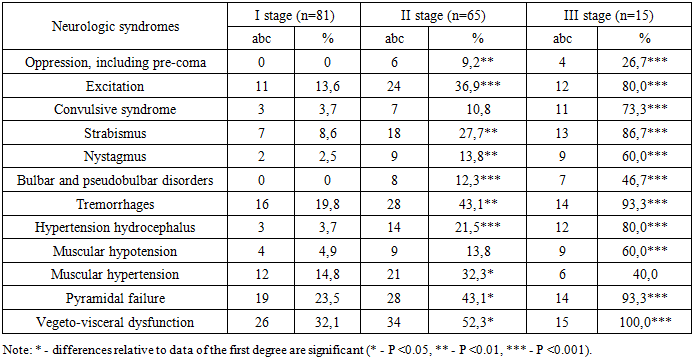
The main neurological symptoms in the early and late neonatal periods were determined not only by the degree and level of damage to the central nervous system, but also by the severity of the general condition, which depended on the concomitant somatic pathology, including with the highest frequency of respiratory disorders, meconial-aspiration pneumonia.It is quite natural that in infants with the III degree in the early neonatal period, the precomatous state, depression syndrome, convulsive syndrome due to metabolic disorders associated with hypoxia and ischemia or destructive processes due to ischemic heart attacks and intracranial hemorrhages are most often diagnosed.During the first weeks of life, significant differences were noted in the structure of neurological disorders in the examined children, associated both with the natural mechanisms of the maturation of the central nervous system and with the course of the recovery processes of the damaged neural tissue of newborns. Never the less, the general trends in the frequency, severity and dynamics of neurological syndromes were primarily due to the severity of the perinatal hypoxic-ischemic lesion of the central nervous system. It should be noted that the syndrome of vegetative-visceral dysfunctions occurred in most newborns of the II and III degrees, manifested by dryness or increased humidity of the skin, its “marble” pattern, acrocyanosis, uneven color of the skin, the appearance of cyanosis during crying and anxiety, and increased breathing to 58– 60 per minute, tachy- or bradycardia, thermoregulatory disorders in the form of non-infectious sub- or febrile condition. Vegeto-visceral dysfunctions occurred in newborns in various combinations, and almost everyone had symptoms of gastrointestinal dyskinesia, pylorospasm or intestinal paresis, stool instability, frequent regurgitation, confirming the opinion that autonomic dysfunctions even in the neonatal period are permanent and are clinically manifested by various disorders of visceral functions (Berejanskaya, S.B., Lukyanova, E.A., Kaushanskaya, E.Ya. et al., 2012). Thus, given the clinical symptoms can be regarded as a manifestation of postnatal constrained adaptation infants with PLNS.In the acute period, 5 clinical syndromes were distinguished: an increase in neuro-reflex excitability, convulsive, hypertensive, hydrocephalic, inhibition syndrome, and coma. Often observed a combination of several syndromes. A feature of the acute period was the dominance of cerebral disorders without pronounced local symptoms. In a mild form of brain damage (Apgar score of 6–7 points), the syndrome of increased neuro-reflex excitability was characteristic (Table 2). Table 2. Reflexes in the examined newborns with
 |
| |
|
In particular, examination of children under one year of age revealed a variety of neurological abnormalities in newborns, which significantly exceeded in children with a 2nd and 3rd severity, compared with a 1st degree: with a 2nd degree, 6 (9.2%) showed CNS depression, and 24 (36.9%) - syndrome of increased neuro-reflex excitability, 14 (21.5%) - hypertension syndrome; with a 3 degree, the indicators were much higher - in 4 (26.7%) children there was a CNS depression syndrome, in 12 (80.0%) - a syndrome of increased neuro-reflex excitability, and in the same number of children - a hypertensive syndrome.The process of establishing the psychomotor status of full-term infants was distinguished by the presence of a certain regularity in the clinical severity of cerebral irritability syndrome. The main signs of cerebral irritability syndrome were superficial sleep, with frequent awakenings, anxiety, trembling, small trembling of the hands, chin, bouts of unmotivated crying. Mood lability was noted in 91.1% of children with a 2nd degree of newborns; most of the children were characterized by moodiness, restless sleep, pathological drowsiness, often woke up with crying, often for no particular reason (62 (76.3%), 63 (96.9%) and 15 (100%) - espectively by group), irritability was observed in 78 (96.3%) in children with 1 degree, 65 (100%) with 2 degrees and 15 (100%) with 3 degrees.
5. Conclusions
An analysis of the state data of children with PLNS showed that, with 2-nd degree newborns were heavier compared to degree 1, while children with a grade of 3 were most severe, with symptoms such as tipping their heads back, rolling eyeballs, feeling of lack of air, sweating, weakness, chin tremor, blueness than children 1 and 2 severity. Febrile seizures were observed 1.5 times more often in patients with 2 degrees and 2 times more often with 3 degrees than with 1 degree of severity.
References
| [1] | Averyanov P.F. Disorders of cerebral circulation in newborns // Materials of the VI Congress of Pediatricians of Russia “Emergency in Children, February 6-8. - M., 2014. - S. 28-29. |
| [2] | Akhutina T. V., Yablokova L. V., Polonskaya N. N. Neuropsychological analysis of individual differences in children: assessment parameters // Neuropsychology and psychophysiology of individual differences / ed. E. D. Chomsky, V. A. Moskvin. - Moscow; Orenburg, 2015. - 432 c. |
| [3] | Skvortsov I.A., Ermolenko N.A. The development of the nervous system in children is normal and pathological. - M .: MEDpress-inform, 2013. - 367 p. |
| [4] | Shamansurov Sh., Studenkin V. Neurology of an early age. - Tashkent, "O’QITUVCHI", 2010. - P.129-141. |
| [5] | Pieter L.J. Degraeuwe, Gerald J. Jaspers, Nicola J. Robertson, Alfons G.H. Kessels. Magnetic resonance spectroscopy as a prognostic marker in neonatal hypoxic-ischemic encephalopathy: a study protocol for an individual patient data meta-analysis // Systematic Reviews. - 2013.- Vol.2 (96). - Page 2 of 6 http://www.systematicreviewsjournal.com/content/2/1/96. |
| [6] | Prechtl H.F.R., Einspieler C. Early preduction of later neurological deficits // In: “Longitudial studies in children at-risk. Satellite Meeting of the 8th International Neurology Congress in Ljubljana”.- Vienna, 1998.- P.5-6. |
| [7] | Özlem Kirmemiş, Mustafa Mansur Tatli, Cüneyt Tayman et al.Subclinical hypoxia of infants with intrauterine growth retardation determined by increased serum S100B protein levels // Turk. J. Med. Sci.- 2011.- Vol.41 (5).- P.795-800. |


 Abstract
 Reference
 Full-Text PDF
 Full-text HTML