
-
Paper Information
- Next Paper
- Previous Paper
- Paper Submission
-
Journal Information
- About This Journal
- Editorial Board
- Current Issue
- Archive
- Author Guidelines
- Contact Us
American Journal of Medicine and Medical Sciences
p-ISSN: 2165-901X e-ISSN: 2165-9036
2020; 10(4): 192-196
doi:10.5923/j.ajmms.20201004.03

Features of Diagnosis and Treatment of Articular Syndrome in Undifferentiated Connective Tissue Dysplasia
 Abstract
 Reference
 Full-Text PDF
 Full-text HTML
Babamuradova Zarrina Bakhtiyarovna1, Shodikulova Gulandon Zikriyevna2
1Basic Doctoral Student of the 3d Course of the Department of the Internal Medicine No. 3 and Endocrinology of Samarkand State Medical Institute, Uzbekistan
2Doctor of Medical Sciences, Associate Professor, Head A of the Department of the Internal Medicine No. 3 and Endocrinology, Samarkand State Medical Institute, Uzbekistan
Correspondence to: Babamuradova Zarrina Bakhtiyarovna, Basic Doctoral Student of the 3d Course of the Department of the Internal Medicine No. 3 and Endocrinology of Samarkand State Medical Institute, Uzbekistan.
| Email: |  |
Copyright © 2020 The Author(s). Published by Scientific & Academic Publishing.
This work is licensed under the Creative Commons Attribution International License (CC BY).
http://creativecommons.org/licenses/by/4.0/

Background. The problem of Undifferentiated Connective Tissue Dysplasia (UCTD) has recently aroused great interest of medical practitioners in connection with the increase in the detect ability of patients with this pathology. The damage of dense connective tissue is manifested by changes on the part of the skeleton: disorder of posture in the form of kyphosis and scoliosis of the spine, deformation of the chest. Weakness of the ligament apparatus in patients with dysplasia leads to the development of generalized joint syndrome that occurs 57 - 94%. Objective. In this regard, the aim of our study was to develop an algorithm for the diagnosis and treatment of joint syndrome in UCTD. Study materials. 105 patients were examined, who were final to anthropometric studies, determination of the level of autoantibodies to collagen of type I, HLA genotyping in blood in patients with UCTD. Results. Anthropometric and phenotypic characteristics of the studied patients showed that all patients experienced flat-footedness (flat-foot index-29%), moderate degree of joint hypermobility, scoliosis of 1 and 2 degree (36%), as well as increased level of autoantibodies to collagen type I depending on severity of clinical manifestations of UCTD (5, 9±0.3 μg/l). A statistically significant increase in the frequency of the class II HLA gene, in particular in the first and second line of kinship, was found to be observed among patients with UCTD, the effectiveness of magnesium and chondroprotectors showed that the level of antibodies to collagen of 1 type was statistically significantly decreased in 2.6 (P <0.001). Conclusion. Based on the principles of the algorithm, which form the basis of diagnosis of various the forms of UCTD, IT is recommended to check Genetic a predisposition in Patients with signs of internal and external phenotypes of dysplasia of the disease and to the Determine the level of autoantibodies to collagen of the type I of. Application of the proposed method of treatment with magnesium and chondroprotectors makes it possible to restore disturbed collagen synthesis and improve connective tissue structure.
Keywords: Undifferentiated Connective Tissue Dysplasia, Joint syndrome, Flat-footedness, Antibodies to collagen of 1 type, HLA II class gene, Magnesium and chondroprotectors
Cite this paper: Babamuradova Zarrina Bakhtiyarovna, Shodikulova Gulandon Zikriyevna, Features of Diagnosis and Treatment of Articular Syndrome in Undifferentiated Connective Tissue Dysplasia, American Journal of Medicine and Medical Sciences, Vol. 10 No. 4, 2020, pp. 192-196. doi: 10.5923/j.ajmms.20201004.03.
Article Outline
1. Background
- In recent years, ideas about connective tissue dysplasia (CTD) have changed significantly. The problem of CTD has recently been of great interest to medical practitioners in connection with an increase in the detection of patients with this pathology [10]. UCTD is a heterogeneous group of diseases, which, in turn, can lead to various chronic diseases with impaired morphology and organ function [3,5,6]. Clinical manifestations, which depend on the predominant lesion of dense or loose connective tissue, the number and quality of mutations, the nature and severity of the violation of fibrillogenesis [9]. Due to the fact that connective tissue is ubiquitous in the body - bones, skin, cartilage, vascular wall, organ stroma, the disease is poly-systemic in nature with various symptoms [11]. Damage to the dense connective tissue is manifested by changes in the skeleton: impaired posture in the form of kyphosis and scoliosis of the spine, stoop, chest deformity [9]. Weakness of the ligamentous apparatus in patients with dysplasia leads to the development of generalized articular syndrome, which occurs in 57 - 94% (fig. 1).
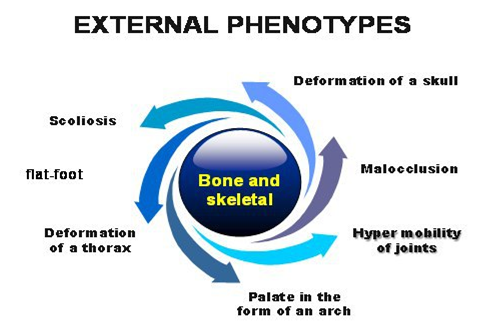 | Figure 1. External phenotypes of undifferentiated connective tissue dysplasia: Joint changes |
2. Objective
- In this regard, the aim of our study was to develop an algorithm for the diagnosis and treatment of articular syndrome with UCTD.
3. Study Materials
- 105 patients were examined on the basis of the Samarkand City Medical Association and the clinic of the Samarkand Medical Institute, as well as family members of these patients. Measurements were made of height, body weight, chest circumference, epigastric angle, arm span, length of the upper body segment, hand, foot, fingers, height of the arch of the foot, examination of the back area (in order to detect scoliotic deformity, lumbar hyperlordosis and hyperkyphosis of the thoracic spine, pterygoid scapula), as well as the Beighton test (to detect joint hypermobility). To diagnose longitudinal flatfoot, the calculation of the podometric index (P) = (h×100): L, where h is the height of the foot - the distance measured by the compass from the floor to the upper surface of the scaphoid 1.5 cm anterior to the ankle, mm; L - foot length - distance from the tip of the first finger to the back roundness of the heel, mm (Friedland method).
4. Methods of the Study
- Patients were determined the level of titers of autoantibodies to collagen type I before and after treatment. The study of the immunogenetic status of patients with UCTD was carried out using the DNA aplification method of HLA-DNA-TECH kits for HLA typing of class II genes (DRB1, DQA1 and DQB1 loci) and, based on the study, a diagnostic and treatment algorithm was compiled. The determination of titers of autoantibodies to type I collagen in blood plasma was determined by enzyme-linked immunosorbent assay using Imtek kits (Russia). All patients were prescribed magnesium preparations, chondroitin sulfate and glucosamine hydrochloride.
5. Results and Discussions
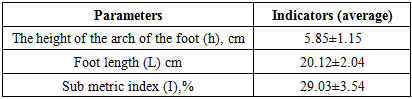
- Studies have revealed the diversity of the clinical condition of the articular syndrome in patients with UCTD.Anthropometric and phenotypic characteristics of the studied patients showed that the average height of the patients is 168.89±7.96 cm, weight - 62.38±12.24 kg, chest circumference - 89.16±8.15 cm, epigastric angle (in degrees0) - 87.46±9.74, arm span depending on height - 1.002±0.07, length of the upper body segment 89.36±9.008 cm, brush length –0.106±0.007 cm, foot length depending on height -0.149±0.08, the height of the arch of the foot -7.95±1.15 cm, respectively.For an objective assessment generalized hypermobility joints (TOS) was used criteria Beighton (P. Beighton). In this case, hypermobility was evaluated in points: 1 point means pathological extension in one joint on one side. The maximum value of the indicator, given the two-way localization, is 9 points. An indicator of 4 to 9 points was regarded as a state of hypermobility. Among the studied patients, the highest were revealed 6 and 8 points (6 points - in 42, 8 points - in 34 patients, respectively).To identify flat feet in patients, the Friedland method was used (Table 1).
|
|

 | Figure 2. The incidence of UCTD in relatives of the first and second line of kinship |
 | Figure 3. Algorithm for early diagnosis and treatment of UCTD |
6. Conclusions
- Thus, diagnostics UCTD is considered odes them from complex branch of medicine s. To him are not only rare monogenic forms, but also a number of genetically heterogeneous, but close in their phenotypic and clinical manifestations of the disease. Based on the principles of the algorithm underlying the diagnosis of various forms of UCTD, it is recommended to check the genetic predisposition in patients with signs of internal and external phenotypes of dysplasia of the disease and determine the titer of autoantibodies to type I collagen. Application of the proposed a method of treatment with magnesium preparations and chondroprotectors, makes it possible to restore impaired collagen synthesis and improve the structure of connective tissue.This, in turn, will make it possible to correctly determine the indications for medical consultation of patients, give recommendations on family planning, optimize early diagnosis, predict the outcome of the disease, see a single systemic defect in connective tissue and conduct dispensary registration.