
-
Paper Information
- Next Paper
- Paper Submission
-
Journal Information
- About This Journal
- Editorial Board
- Current Issue
- Archive
- Author Guidelines
- Contact Us
American Journal of Medicine and Medical Sciences
p-ISSN: 2165-901X e-ISSN: 2165-9036
2020; 10(1): 5-8
doi:10.5923/j.ajmms.20201001.02

Informatively of the Indicators of Blood Allowing to Predict Premature Water Breaking at Prematurely Born Pregnancy
 Abstract
 Reference
 Full-Text PDF
 Full-text HTML
Shavazi Nargiz Nuralievna
Department of Obstetrics and Gynecology of Medical Faculty, Samarkand State Medical Institute, Uzbekistan
Correspondence to: Shavazi Nargiz Nuralievna, Department of Obstetrics and Gynecology of Medical Faculty, Samarkand State Medical Institute, Uzbekistan.
| Email: |  |
Copyright © 2020 The Author(s). Published by Scientific & Academic Publishing.
This work is licensed under the Creative Commons Attribution International License (CC BY).
http://creativecommons.org/licenses/by/4.0/

The study of the relationship in 47 pregnant women with premature outflow of amniotic fluid of coagulation hemostasis, pro-inflammatory cytokines, complement C3, C4 fractions and insulin-like growth factor-1 in blood serum revealed activation of the prothrombinase internal mechanism of formation, which under conditions of premature outflow of water, due to which local outflow occurs and systemic activation of antigen-stimulated macrophages, NK cells, lymphocytes, neutrophils and activation of the complement system. Determination of serum levels of TIF –a, IL-1β, C3-, C4-complement fractions in pregnant women with ROM can be used to predict the development and timely correction of changes in blood coagulation potential, which will expand the possibilities of successfully choosing an adequate treatment tactic and timely warning development of complications during pregnancy.
Keywords: Premature water breaking, Prematurely born pregnancy, Pro-inflammatory cytokines, Complement of C3-, C4 fraction, Insulin-like growth factor-1
Cite this paper: Shavazi Nargiz Nuralievna, Informatively of the Indicators of Blood Allowing to Predict Premature Water Breaking at Prematurely Born Pregnancy, American Journal of Medicine and Medical Sciences, Vol. 10 No. 1, 2020, pp. 5-8. doi: 10.5923/j.ajmms.20201001.02.
Article Outline
1. Relevance
- Currently, the frequency of complications in obstetrics continues to remain at a high level. One of such complications in obstetrics, which make up the difficult obstetric situation and has an undeniable contribution to the formation of the structure of perinatal morbidity and mortality, is the premature discharge of amniotic fluid (ROM) in pregnant women. According to the definition of the World Health Organization, ROM is understood as a violation of the integrity of the fetal membranes and the outflow of amniotic fluid before the start of labor activity, regardless of the term of pregnancy. The frequency of occurrence of ROM has recently increased 1.5-2 times in the structure of all pregnancies is 2-20% [1,2]. To date, the factors provoking ROM are debatable, despite the progress of medicine and a large number of studies in this area [3,4]. Risk factors for the development of ROM in combination with preterm delivery (PR) may include: extra-genital pathology; bad habits of the mother and adverse factors of the labor process in the workplace; low socio-economic status; hereditary causes; PR in the anamnesis; transferred viral diseases; isthmic-cervical insufficiency; overstretching and abnormalities of the uterus; surgical operations during pregnancy. Infection is the most common cause of ROM [5,6]. Also, one of the etiological factors of ROM can be considered the activation of lipid peroxidation (LP). LP is activated by microorganisms with the participation of phagocytes and macrophages. Many of scientists put forward a “collagen” theory of the emergence of ROM, namely, the pathology of collagen of the membranes. In modern foreign literature there is evidence that with ROM, metabolic metabolism in plasminogen metabolism occurs. The processes of the influence of progestin and thrombin on the expression of metalloproteinase-3 in decidual cells with ROM were studied [7,8]. The pathogenesis of ROM is controversial and the existing biochemical aspects of its pathogenesis (clarification or refutation of some of them) will accelerate the solution of a numbesomer of obstetric problems related to tactics of conducting pregnancy and childbirth with ROM in practical obstetrics. Until now, there is no systematic information about the pathogenetic relationship of disorders of the blood coagulation potential in the development of ROM.
2. The Aim of the Work
- The research was conducted to study the relationship of coagulation hemostasis, proinflammatory cytokines, C3-, C4-fractions of complement and insulin-like growth factor-1 in the blood serum of women with premature water breaking.
3. Materials and Methods
- A simultaneous and prospective study of women in 47 patients aged 17 to 26 years with ROM at 22-36 weeks of gestation (main group) was carried out. The comparison group consisted of 12 practically healthy pregnant women, comparable in age with women of the main study group. Assessment of integrative indicators of the state of coagulation hemostasis, fibrinolysis, and cytokine statuses of women of the main group was carried out at the time of their admission to the hospital before treatment against the background of pronounced clinical manifestations of pathology. Coagulation hemostasis and fibrinolysis parameters were studied by coagulometric methods using a Thrombotimer series coagulometer from Behnk-Elektronik (Germany), as well as conventional manual methods using reagents. The cytokine status was evaluated by the content of IL-1β and TNF-α, as well as the study of C-3 and C-4 fractions of complement and insulin-like growth factor-1 in the peripheral blood serum of patients by enzyme-linked immunosorbent assay using test systems from INNOVA on a COBAS-411 analyzer from ROSH. Statistical processing of the research results was carried out using the Statistica 6 package.
4. Research Results and Discussion
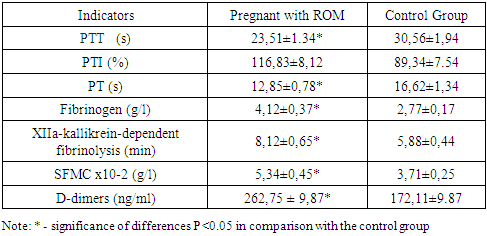
- Studies have shown (Table 1) that in pregnant women with ROM, activation of the internal mechanism of prothrombinase formation occurs. This is indicated by the shortening of activated partial thromboplastin coagulation time (APTT) compared with a group of healthy women. At the same time, an increase in the prothrombin index was established, indicating a decrease in the prothrombin coagulation time of the blood plasma of patients compared with the same indicator in the control group, which indicates excessive activation of the external mechanism of prothrombinase formation, in particular, VII plasma factor in ROM. Along with the violation of the first phase of blood coagulation in pregnant women with ROM, a shortening of the thrombin plasma coagulation time was established, which characterizes the final stage of the coagulation process - the conversion of fibrinogen to fibrin under the action of thrombin. It is known that the indicator of thrombin time is largely interconnected with the concentration of fibrinogen in the plasma and the presence of fibrin degradation products.
|
|
5. Findings
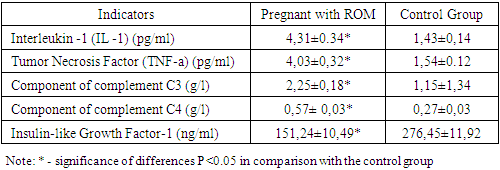
- A pathogenetic relationship between the accumulation of IL-1β, TNF-α, C3-, C4-fractions of the complement system and activation of procoagulant mechanisms in the blood of pregnant women was revealed. The complement system can act as a connecting pathogenetic link between shifts of the cytokine status and activation of coagulation hemostasis mechanisms at the stage of pronounced clinical manifestations of acute inflammatory lesion of the uterine appendages. Determination of serum levels of IL-1β, TNF-α, C3, C4 complement fractions in pregnant women with ROM can be used to predict the development and timely correction of changes in blood coagulation potential, which will expand the possibilities of successfully choosing an adequate treatment tactic and timely prevention of developing complications during pregnancy.