
-
Paper Information
- Paper Submission
-
Journal Information
- About This Journal
- Editorial Board
- Current Issue
- Archive
- Author Guidelines
- Contact Us
American Journal of Medicine and Medical Sciences
p-ISSN: 2165-901X e-ISSN: 2165-9036
2016; 6(3): 92-94
doi:10.5923/j.ajmms.20160603.05

Relation of Polymorphism Gene Urat-1 with Coronary Heart Disease Associated Asymptomatic Hyperuricemia in Uzbek Population
 Abstract
 Reference
 Full-Text PDF
 Full-text HTML
D. H. Togaev 1, E. N. Tashkenbaeva 2, Sh. Kh. Ziyadullaev 2, F. Sh. Kadirova 2
1Samarkand Branch of the Republican Research Centre of Emergency Medicine
2Samarkand State Medical Institute
Copyright © 2016 Scientific & Academic Publishing. All Rights Reserved.
This work is licensed under the Creative Commons Attribution International License (CC BY).
http://creativecommons.org/licenses/by/4.0/

According to the modern conception ischemic heart disease (IHD) is considered as multifactor disease with significant genetic determinant. Today it is well known that hyperuricemy is in the line of the key etiopathogenic factors of IHD. It was interesting to analyze the polymorphic version of the gene of anion transporter of uric acid URAT–1 in IHD associated with asymptomatic hyperuricemy which was not studied in Uzbek population previously. The results of the distribution analyses of the frequencies of alleles and genotypes C/T polymorphic version of the gene URAT1 (rs3825016) in the population of persons of Uzbek nationalities suffered from IHD associated with asymptomatic hyperuricemy in the comparison with healthy parts of population have been presented in the article. The presented statistic calculations have been testified that the certain alleles of URAT1 gene and also their unfavorable combinations have reliable difference between frequencies of the patients’ groups and healthy persons. It is established that in the formation of the genetic structure of IHD associated with asymptomatic hyperuricemy in Uzbek population URAT1Т/Т genotype and URAT1Т allele play the important role.
Keywords: Coronary heart disease, Asymptomatic hyperuricemia, Genetic polymorphism, the Uzbek population
Cite this paper: D. H. Togaev , E. N. Tashkenbaeva , Sh. Kh. Ziyadullaev , F. Sh. Kadirova , Relation of Polymorphism Gene Urat-1 with Coronary Heart Disease Associated Asymptomatic Hyperuricemia in Uzbek Population, American Journal of Medicine and Medical Sciences, Vol. 6 No. 3, 2016, pp. 92-94. doi: 10.5923/j.ajmms.20160603.05.
Article Outline
1. Introduction
- According to modern concepts, CHD is considered as a polietiologic disease with a severe genetic determinant of [4, 5]. Analysis of genetic features that influence the development of the disease state, paid much attention. Today it is well known that hyperuricemia is among the key etiopathogenic factors of CHD [1, 3]. The results of research carried out in some populations [2], suggest a close relationship between the gene polymorphism SLC22A12 (URAT1) with the concentration of uric acid in the blood serum of patients with coronary artery disease. Gene SLC22A12 – anion transporter of uric acid. SLC22A12 is the official symbol of the gene and encode URAT-1 (Uric Acid Anion Transporter 1) - anion transporter of uric acid. Cytogenetic address 11q13.1 gene. The protein encoded by this gene acts as a urate transporter and regulation of their levels in the blood. This protein is an integral membrane protein, it is first found in the epithelial cells of renal proximal tubules [1]. In this regard, it presented an interesting analysis has not previously been studied in the Uzbek population of the polymorphic variant gene anion transporter of uric acid – URAT1 with CHD with asymptomatic hyperuricemia, which will allow not only to identify the risk of developing the disease, but also to adequately influence the choice of tactics of treatment of patients with personalized medicine standpoint.
2. The Purpose of this Study
- The purpose of this study was to examine the distribution of allele frequencies and genotype C/T polymorphic variant gene URAT1 (rs3825016) CHD patients with asymptomatic hyperuricemia and install the "adverse" combination leads to a high probability of developing the disease in the Uzbek population.
3. Material and Methods
- Accordingly, the goal we studied features of the distribution of allele and genotype frequencies of polymorphic variants URAT1 (rs3825016) gene in patients with coronary artery disease and healthy individuals of Uzbek nationality. Verification of CHD diagnosis was performed according to WHO international classification (X revision, ICD-10). The cohort of 106 patients with CHD and 17 healthy people of Uzbek nationality genotyped polymorphic locus C/T gene URAT1 (rs3825016). Genomic DNA was isolated from peripheral blood lymphocytes using a kit of reagents for DNA extraction Diatom ™ DNA Prep 200. The supernatant was further subjected to DNA directly genotyping by PCR amplification. Typing of DNA samples was performed using specific oligonucleotide primers. Oligonucleotides were synthesized by IDT (Integrated DNA Technologies, Iowa, USA). PCR amplification was performed under sterile conditions in a special room. All procedures were performed on ice. PCR analysis was performed using reagents for the PCR amplification of DNA GenePak ™ PCR Core. Programs amplification be strictly specific: pre-denaturation for 5 minutes at 95°C, 5s, 40 cycles; 95°C – 20s, 61°C – 35s, 72°C – 45s; ultimate elongation at 72°C for 7 min. Then, the PCR products were subjected to restriction analysis using a specific restriction enzyme BseLI. The incubation temperature t-65°C 16h. Detection of products and RFLP Genotyping was performed using the horizontal or vertical eletroforez system 8% polyacrylamide gel. For further processing of the electrophoresis data is digitized. The molecular weight of the product was determined by molecular marker, which steps were 100 bp, 100 bp starting mark According URAT1 gene PCR product weight prior to the restriction reaction was 400 bp After the restriction reaction, the following products were obtained: 310 bp, 195 bp and 115 bp Polymorphisms C/C, C/T and T/T determined as follows: if the weight of the two products 195 and 115 bp – Genotype considered homozygous for C/C; at 310 bp – Homozygous mutant T/T; and in the presence of three products 310, 195, 115 bp – Genotype was seen as a heterozygote C/T. The results of electrophoresis of PCR products from the subjects of CAD patients with asymptomatic hyperuricemia by URAT1 gene shown in Fig. 1.
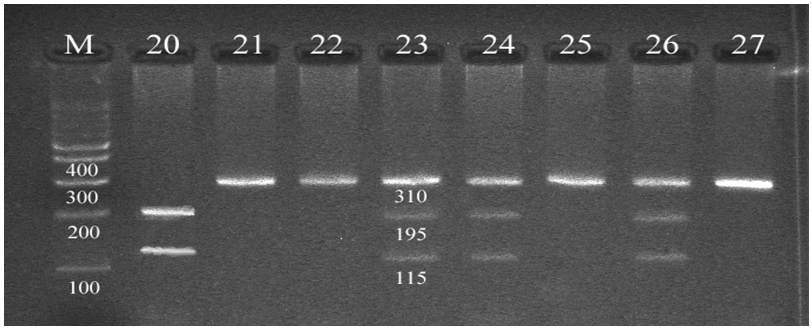 | Figure 1. An example of the results of RFLP analysis electropherograms URAT1 gene (C/T polymorphism) from 20th to 27 th test samples |
4. Results of the Study
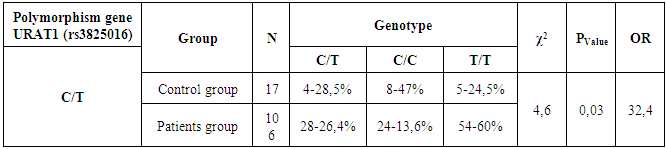
- The analysis of allele frequencies C/T polymorphism URAT1 gene (Table 1) revealed that the allele T in the group of CHD patients with asymptomatic hyperuricemia occurs significantly more frequently than in the group of healthy subjects (64.1% compared to 41.2% respectively, χ2 = 6.4; p = 0.01).
|

|
5. Conclusions
- Thus, the results of molecular genetic studies have shown the importance of the polymorphic variant gene URAT1 (rs3825016), in the formation of the genetic structure of susceptibility to coronary artery disease associated with asymptomatic hyperuricemia in the Uzbek population. The findings suggest that markers of increased risk of CHD with asymptomatic hyperuricemia in patients Uzbek ethnicity are genotype URAT1 – Т/T and allele URAT1 – Т, markers of reduced risk – URAT1 – C/C allele and URAT1 – C.