
-
Paper Information
- Previous Paper
- Paper Submission
-
Journal Information
- About This Journal
- Editorial Board
- Current Issue
- Archive
- Author Guidelines
- Contact Us
American Journal of Medicine and Medical Sciences
p-ISSN: 2165-901X e-ISSN: 2165-9036
2016; 6(1): 23-28
doi:10.5923/j.ajmms.20160601.04

Radical Method of Surgical Treatment of Chronic Recurrent Hematogenous Osteomyelitis in Childhood and Adolescents
 Abstract
 Reference
 Full-Text PDF
 Full-text HTML
Shamsiev Azamat Mukhitdinovich, Zayniev Sukhrob Sabirovich
Samarkand State Medical Institute, Uzbekistan
Correspondence to: Zayniev Sukhrob Sabirovich, Samarkand State Medical Institute, Uzbekistan.
| Email: |  |
Copyright © 2016 Scientific & Academic Publishing. All Rights Reserved.
This work is licensed under the Creative Commons Attribution International License (CC BY).
http://creativecommons.org/licenses/by/4.0/

The results of surgical treatment of 178 patients with chronic recurrent osteomyelitis of the tube bones have been analyzed. The results of clinical – laboratory investigations including immunologic and morphological examinations have been presented and also the role of computer tomography in the diagnostic of intraosteal pathology has been proved. Patients were divided into 2 groups, the first one has got traditional surgical treatment and the second one has got surgical treatment due to elaborated method. The proposed tactic of surgical treatment consists in careful exfoliation of the periosteum from the bone, longitudinal osteotomy, sequesternecroectomy with full restoration of the structure of the bone-marrow canal along the whole length, lavage and ultrasound cavitation with antiseptic solution. The performed surgical tactic secured the most radical sanation of the osteomyelitic foci and improved the treatment results of this severe pathology.
Keywords: Chronic hematogenous osteomyelitis, Children, Surgical treatment
Cite this paper: Shamsiev Azamat Mukhitdinovich, Zayniev Sukhrob Sabirovich, Radical Method of Surgical Treatment of Chronic Recurrent Hematogenous Osteomyelitis in Childhood and Adolescents, American Journal of Medicine and Medical Sciences, Vol. 6 No. 1, 2016, pp. 23-28. doi: 10.5923/j.ajmms.20160601.04.
Article Outline
1. Introduction
- One of the challenging issues of purulent surgery is due to hematogenous osteomyelitis. The disease, which began in childhood, is difficult to treat and rehabilitate. In the process of child growing it often leads to different anatomical and functional disorders of musculoskeletal system and disablement in childhood and in the young working age, thus reducing the quality of life [2, 6]. Transition of the acute hematogenous osteomyelitis to chronic type of the disease remains high and is from 10 to 60% [3, 8]. Frequency of failures in the treatment of chronic hematogenous osteomyelitis (CHO) is not decreasing, and recurrences after surgical treatment make 10-42% [4]. The main causes of recurrences of chronic osteomyelitis are defective sanation of injury focus [1, 5, 7], which make necessary the implementing radical methods of surgical treatment.The aim of investigation was to improve the results of surgical treatment and prevention of recurrences of chronic recurrent hematogenous osteomyelitis by the way of elaboration of new methods of surgical treatment.
2. Materials and Methods of Research
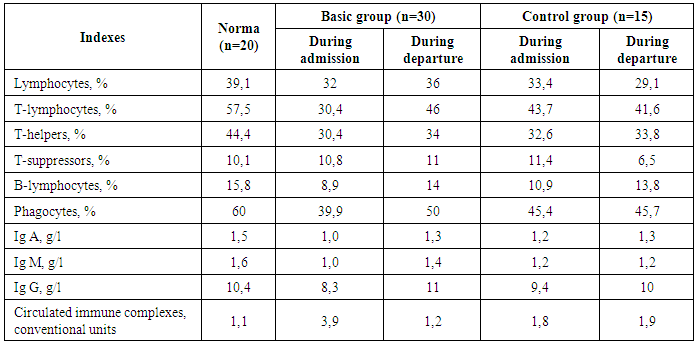
- The present work presents the results of surgical treatment of 178 patients with chronic recurrent hematogenous osteomyelitis (CRHO) of the long tube bones. 50% were patients with the age from 12 to 16 years old, 30% - ones with the age from 16 to 22 years old. Boys made the most off the total - 112 (62.9%) patients.Depending on the methods of surgical treatment all patients were divided into two clinical groups. Control group included 100 children with CHO of long tube bones receiving traditional surgical treatment. Study group comprised 78 patients who had surgical treatment by the elaborated method; earlier all patients of this group were repeatedly operated due to CHO and its recurrences.During the analyses of the disease duration it was determined that the chronic hematogenous osteomyelitis more often lasted 4-7 years (50%) in basic group of patients, and 1-3 years (86%) - in the control group of patients. Predominance of the long period of disease in the basic group was associated with the chronic recurrent hematogenous osteomyelitis; in this occasion it had been carried out sequestrectomy of the injured bone. Examination determined that sequestrectomy was carried once in 144 (80.7%) patients with the chronic osteomyelitis, 34 (19.3%) patients were surgically operated twice. In the both groups osteomyelitic process most often took place in shin bone in 73 (43.7%) patients and in femoral bone in 66 (39.5%) patients.Before the complex of investigation and surgical treatment we agreed on the consent with the parents of all children for the planning diagnostic and treating manipulations. The study of some indexes of the immune system in 45 patients of the investigated groups has been carried out in order to determine immune status of the patients with CRHO in the treatment process. 20 practically healthy investigated persons consisted in the comparison group. The abrupt reduction of the amount of T-lymphosytes (30,4%), T-helpers (30,4%), B-lymphosytes (8,9%) and fagosytes (39,9%) in the comparison with the normal indexes and control group have been noted in the patients of the basic group before surgical operation which testify about chronic reduction of the immune resistance of the organism in CRHO. During the repeated control of the indexes before departure from hospital reliable increasing of all investigated immunologic indexes in the basic group of patients have been noted in the basic group of patients whereas in the control group they were lower than normal indexes (table 1). It is needed to note that in patients it has been determined significant reduction of the immune resistance of the organism, reduction of T-system of immunity and neutrophyl phagositosis. During the investigation of index of blood toxisity (IBT) bebore surgical operation the increase of indexes have been determined not only in the basic group (41,9 units), but also in the control group (43,7 units) in the comparison with normal indexes (28,4 units). Before departure from hospital IBT in the basic group was 29,7 units whereas in the control group it was 33,4 units.
|
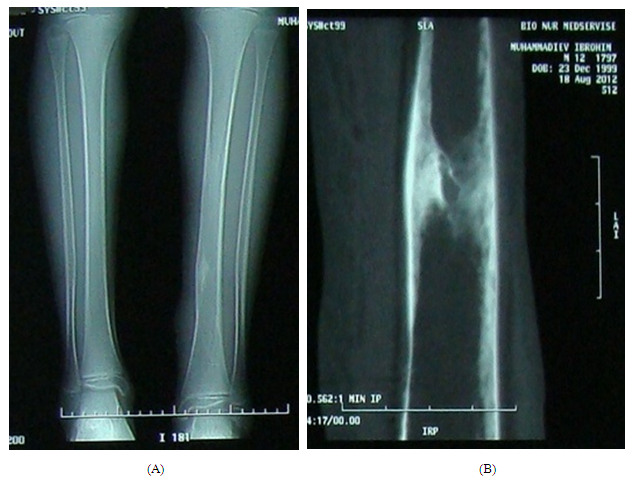 | Figure 1. General X-ray examination (А) And computer tomography (B) Of the right shin bone. It has been determined the presence of intraosseous abscess which clearly visualized on CT |
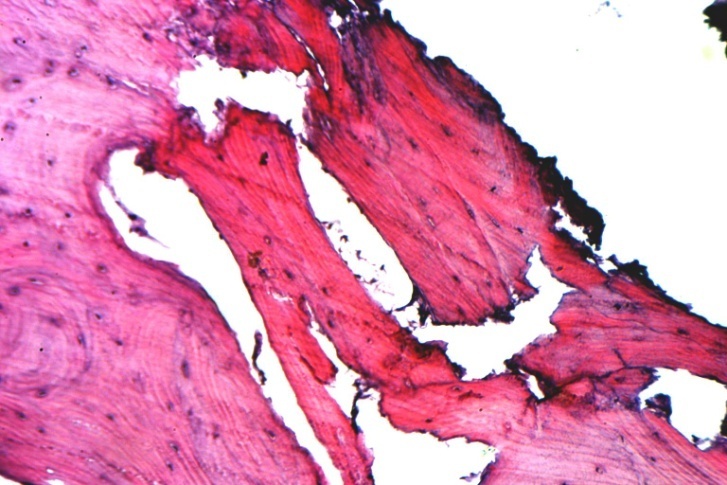 | Figure 2. Formation of sequesters in the necrotic bone |
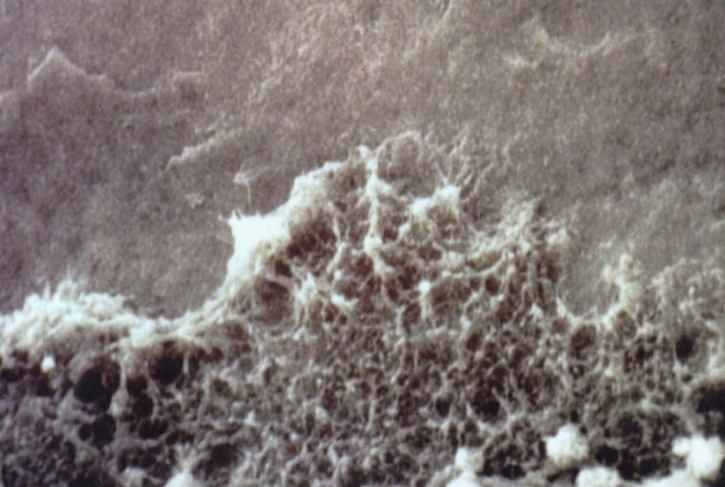 | Figure 3. Necrotic bone tissue of sequesters with the saved viability part of bone. sem Х 4000 |
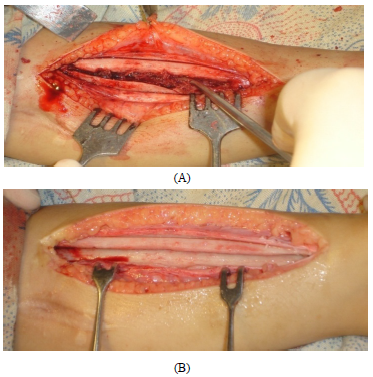 | Figure 4. Longitudinal Osteotomy, Sequestrectomy of the Right Shin Bone (A) - It has been Determined Destructive Injury of the Shin Bone with Central Sequestrums; (B) - Visualization of Medullary Canal Aftermechanical Sanation with the Use of Usc) |
3. Results
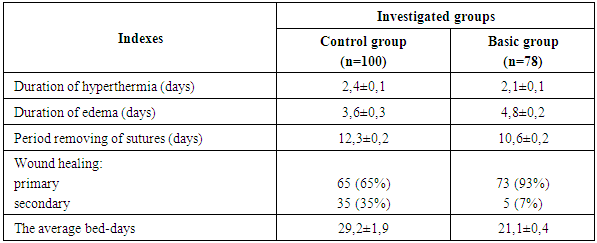
- During the analyses of the direct results of the treatment it was determined that normalization of the body temperature in patients of the control group was occurring on average in 2.4 ± 0.1 days, in the basic group this index was taking place during 2.1 ± 0.1 days. Healing of the wound by primary adhesion during traditional treatment has been obtained in 65 (65%) patients, whereas in the basic group it has been obtained in 73 (93%) patients. Sutures from the wounds in the control group were taken off on average in 12.3 ± 0.2 days, while in the basic group this index made 10.6 ± 0.2 days. Duration of the patient’s hospitalization were linked to the effectiveness of disease treatment in the clinical groups and significantly decreased in the basic group in 21.1 ± 0.4 days against 29.2 ± 1.9 (р < 0.001) days in the control group (table 2).
|
|
4. Discussion
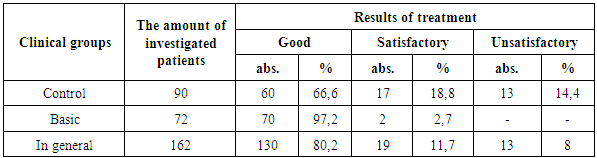
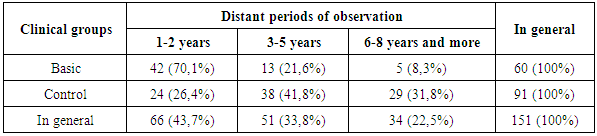
- One of the main manifestations of recurrences of CRHO was the case of the opening of the sinus tract which had been developed only in 3 (3.3%) patients of the control group. During the investigation in the period of 1-2 years after operation, the recurrence of the purulent process with subsequent sequestrectomy was found in 4 (4.4%) patients of the control group, while the recurrence was not noted in the basic group during this period of examination. In the period of 3-5 years after operation, repeated sequestrectomy was carried out in 4 (4.4%) patients of the control group and in 1 (1.2%) patient of the basic group. During the study of the distant results in the period of 6-8 years after operation, the recurrence of the pathological process requiring repeated sequestrectomy was observed in 5 (6.6%) patients of the control group. Analysis of the distant examination periods found that the general amount of recurrences and repeated sequestrectomies took place in 13 (14.3%) patients of control group, whereas in the basic group we noticed the obvious tendency to decrease of the recurrences and repeated sequestrectomies until 1.2%. Good results were fixed in 88.3% of patients of the basic group and only in 75.9% of patients in the control group. Satisfactory results in the basic group were in 8.3% of cases, while in the control group they were noted in 8.8% of cases. The amount of unsatisfactory results in the basic group was significantly less (1.2%) than in the control (15.3%) group (table 4).
|
5. Conclusions
- Thus, the presented data testify that the basic cause of recurrences is nonradical sanation of the inflammation focus. The use of CT allows us with high accuracy identify the character and prevalence of inflammation process. The complex immunologic investigation with determination of interleukins level and pools of lymphocytes is mostly exact reflected the severity of inflammation process in the organism. The distinctive morphological feature for CRHO is the presence of the multiple micro-absences in the compact bone tissue which are not determined by the other methods that is proved the necessity of the use of the most active tactic of surgical treatment. The elaborated method of surgical treatment of CRHO allowed us to prevent the development of disease recurrences in the comparison with traditional methods of treatment.