
-
Paper Information
- Paper Submission
-
Journal Information
- About This Journal
- Editorial Board
- Current Issue
- Archive
- Author Guidelines
- Contact Us
American Journal of Intelligent Systems
p-ISSN: 2165-8978 e-ISSN: 2165-8994
2026; 15(1): 1-6
doi:10.5923/j.ajis.20261501.01
Received: Jun. 14, 2026; Accepted: Jul. 10, 2026; Published: Jul. 15, 2026

AI-Driven Discovery Bot for Manufacturing: Empowering Product and Plant Engineering through Historical Issue Resolution Guidance
 Abstract
 Reference
 Full-Text PDF
 Full-text HTML
Shuvdeep Bhattacharya
IT Director - Seating Engineering, Lear Corporation, 21577 Telegraph Road, Southfield MI 48033
Correspondence to: Shuvdeep Bhattacharya, IT Director - Seating Engineering, Lear Corporation, 21577 Telegraph Road, Southfield MI 48033.
| Email: |  |
Copyright © 2026 The Author(s). Published by Scientific & Academic Publishing.
This work is licensed under the Creative Commons Attribution International License (CC BY).
http://creativecommons.org/licenses/by/4.0/

This paper presents an artificial intelligence–driven Discovery Bot designed to improve manufacturing issue resolution, engineering knowledge reuse, and risk management. The system consolidates historical issue records, engineering change information, quality reports, production data, and collaboration records to support faster root cause analysis and reuse of proven corrective actions. The proposed framework combines natural language processing, machine learning, retrieval-augmented generation, and knowledge graphs to retrieve contextually relevant prior resolutions, identify recurring failure patterns, and support dynamic Failure Modes and Effects Analysis (FMEA). The architecture integrates with product lifecycle management, manufacturing execution, enterprise resource planning, quality, and collaboration systems through modular services and secure APIs. To address practical deployment requirements, the paper distinguishes currently deployed capabilities from planned extensions, defines evaluation metrics, and describes validation against expert-defined baselines. Case-study evidence across manufacturing contexts indicates measurable benefits, including shorter issue-resolution cycles and reduced downtime in selected use cases. The results suggest that an AI-enabled Discovery Bot can convert fragmented engineering knowledge into a scalable decision-support capability, enabling organizations to move from reactive troubleshooting toward predictive quality, reliability, and continuous improvement.
Keywords: Artificial intelligence, Manufacturing knowledge management, FMEA, DFMEA, PFMEA, Knowledge graphs, Retrieval-augmented generation, Natural language processing, Root cause analysis, PLM, MES, ERP
Cite this paper: Shuvdeep Bhattacharya, AI-Driven Discovery Bot for Manufacturing: Empowering Product and Plant Engineering through Historical Issue Resolution Guidance, American Journal of Intelligent Systems, Vol. 15 No. 1, 2026, pp. 1-6. doi: 10.5923/j.ajis.20261501.01.
Article Outline
Managerial Relevance Statement
- Manufacturing organizations often lose time because relevant engineering knowledge is distributed across PLM, MES, ERP, quality systems, email, and local expert memory. This paper provides a practical framework for converting that fragmented knowledge into a governed decision-support capability. The Discovery Bot helps engineers retrieve similar historical issues, understand previous corrective actions, and update FMEA knowledge as new production and field data emerge. For managers, the contribution is threefold. First, the framework reduces dependence on undocumented tribal knowledge by making historical lessons searchable and reusable. Second, AI-enhanced FMEA supports a shift from static risk documentation to continuously updated risk assessment. Third, the modular API-based architecture allows organizations to adopt the capability incrementally without replacing existing enterprise systems.
1. Introduction
- Manufacturing organizations are increasingly leveraging artificial intelligence to tackle complex engineering challenges and improve operational performance. Traditional issue resolution methods—reliant on tribal knowledge and manual searches—are often inefficient and prone to error, leading to delayed decision-making and obscured critical insights.The Discovery Bot transforms this process by automating the retrieval and interpretation of historical data, enabling faster and more informed decisions. Its AI-driven approach to Failure Modes and Effects Analysis (FMEA) enhances risk assessment by identifying potential failure points early in the lifecycle. The system dynamically learns from past issues and corrective actions to generate predictive insights.By integrating natural language processing (NLP), machine learning (ML), and domain-specific knowledge graphs, the bot streamlines root cause analysis and supports continuous improvement. It empowers cross-functional teams with contextual guidance, shifting engineering from reactive to predictive operations, thereby reducing downtime and improving product quality.
2. Literature Review
- A. Manufacturing Knowledge Fragmentation Manufacturing knowledge is often embedded in structured records, unstructured reports, engineering documents, and informal collaboration channels. Prior research on smart manufacturing knowledge management emphasizes that disconnected technical information limits reuse and slows operational decision-making [1], [2]. In issue-resolution contexts, the value of historical knowledge depends not only on storage but also on retrieval, contextualization, and traceability to affected components, processes, and corrective actions. B. AI, NLP, Knowledge Graphs, and RAG in Manufacturing Natural language processing enables systems to interpret engineering descriptions, maintenance notes, quality reports, and operator queries. Large language models have recently been explored for factory knowledge sharing, where retrieval from manuals and issue reports can support faster access to information while still requiring human review [8]. Retrieval-augmented generation (RAG) improves factual grounding by retrieving relevant evidence before generating a response [10]. Knowledge graphs further strengthen retrieval by representing relationships among parts, symptoms, failure modes, processes, suppliers, and corrective actions [7], [12], [13]. C. AI-Enhanced FMEA and Novelty Relative to Prior Work FMEA is a foundational method for identifying failure modes, causes, effects, controls, and risk priorities. However, conventional FMEA can be manual, time-consuming, and difficult to keep current. Prior studies have proposed data-driven FMEA for maintenance planning [3], ontology-based reasoning over FMEA tables [4], and LLM-supported FMEA generation [5], [6]. Reference [5] is particularly relevant because it integrates LLMs into FMEA using data collection, preprocessing, risk identification, and human-in-the-loop validation. The present work differs in scope and contribution. Rather than focusing primarily on generating FMEA content from selected datasets, this paper embeds AI-enhanced FMEA inside an enterprise Discovery Bot that supports historical issue-resolution guidance. The proposed system links FMEA elements to PLM parts, MES processes, ERP supplier data, quality records, and prior corrective actions. Its novelty lies in combining enterprise retrieval, knowledge-graph traceability, AI-assisted root cause guidance, and continuous FMEA update in one deployment-oriented framework. Manufacturing organizations operate in data-rich but knowledge-fragmented environments. Engineering changes, quality defects, maintenance logs, supplier issues, process deviations, and corrective actions are often stored in different systems and described using inconsistent terminology. As a result, engineers may spend substantial time searching for prior resolutions or relying on experienced personnel who may not be available. Traditional issue-resolution workflows are therefore vulnerable to delay, duplicated investigation, repeated failure modes, and loss of institutional knowledge. These challenges are especially visible in complex product and plant engineering environments, where product design, tooling, process parameters, suppliers, and production conditions interact. The Discovery Bot addresses this problem by using AI to retrieve, interpret, and connect historical issue data. It supports engineers through natural-language queries, contextual retrieval, knowledge-graph relationships, and AI-enhanced FMEA updates. Instead of treating FMEA as a static document, the framework treats it as a living risk model that evolves with operational evidence. The paper makes four contributions: 1. It proposes a modular AI architecture for historical issue-resolution guidance across enterprise manufacturing systems. 2. It defines a five-stage methodology for data acquisition, preprocessing, retrieval, validation, and continuous learning. 3. It adds an evaluation approach with explicit baselines, metrics, and validation against expert-defined outputs. 4. It clarifies the novelty of the Discovery Bot relative to prior LLM-FMEA work by extending the focus from automated FMEA generation to enterprise-scale issue-resolution guidance and cross-system traceability.
3. Methodology
- A. Study Design and Evaluation Scope The study uses a multi-case, pre/post evaluation design. Each deployment context compares the Discovery Bot-assisted workflow against the incumbent baseline workflow, defined as manual search across enterprise systems, consultation of prior reports, and escalation to experienced subject-matter experts. The evaluation focuses on three outcome categories: issue-resolution time, downtime, and yield-related quality indicators. Because the deployment contexts involve proprietary manufacturing operations, plant names, product identifiers, and absolute production volumes are anonymized. Results are therefore reported as normalized percentage improvements were supported by available operational records. B. Data Sources The Discovery Bot ingests structured and unstructured data from the following sources: • PLM systems: Part metadata, engineering changes, design specifications, and product history. • MES systems: Production events, machine logs, process deviations, and downtime records. • ERP systems: Supplier, procurement, inventory, and part-availability information. • Quality systems: FMEA records, 8D reports, audit findings, control plans, defect logs, and corrective actions. • Collaboration records: Emails, issue summaries, meeting notes, and informal problem-solving discussions where access is authorized. • Data are normalized through part-number mapping, metadata enrichment, duplicate detection, terminology standardization, and access-control tagging. C. System Architecture and Implementation The Discovery Bot follows a modular architecture consisting of five layers: • User interaction layer: natural-language interface for engineers, quality teams, and plant users. • NLP and intent layer: query parsing, entity extraction, intent classification, and terminology normalization. • Retrieval and knowledge layer: hybrid retrieval across indexed documents, structured records, and knowledge-graph relationships. • Recommendation and FMEA layer: retrieval of similar issues, corrective-action ranking, failure-mode mapping, and risk-score update support. • Integration and governance layer: REST APIs, role-based access control, audit logging, and enterprise-system connectors.
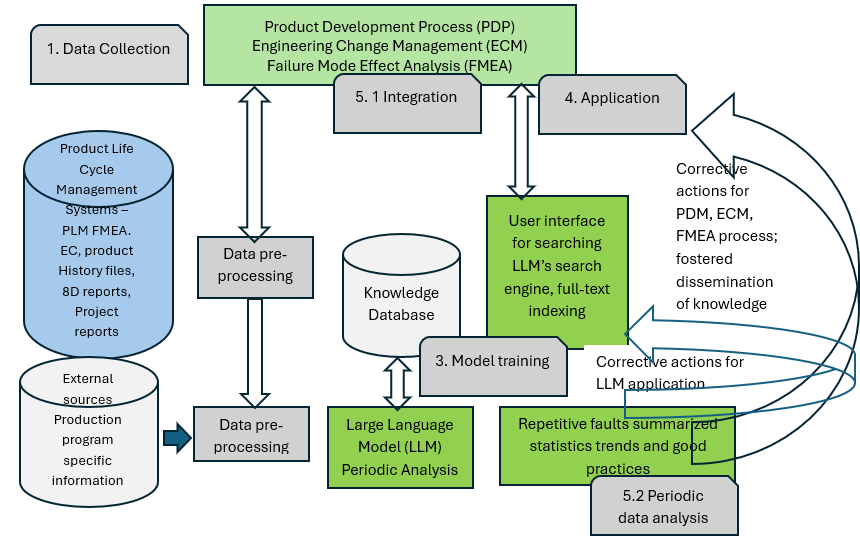 | Figure 1. Information system model for LLM application in FMEA |
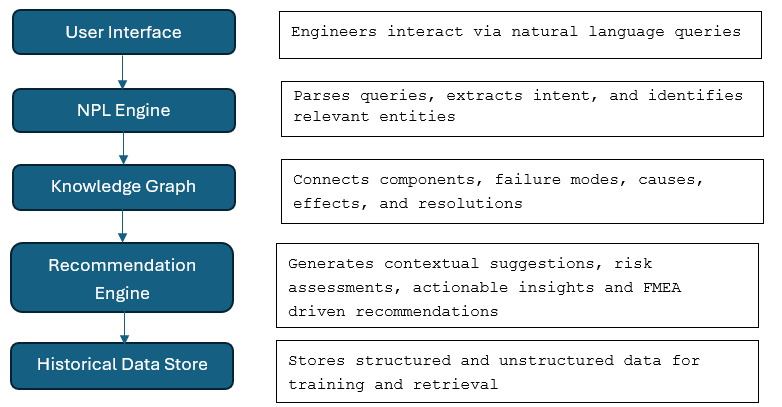 | Figure 2. Discovery Bot reference architecture |
|
|
4. Results
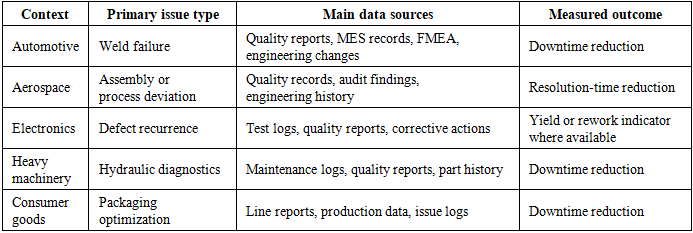
- A. Cross-Industry Evaluation Contexts
|
|
5. Discussion
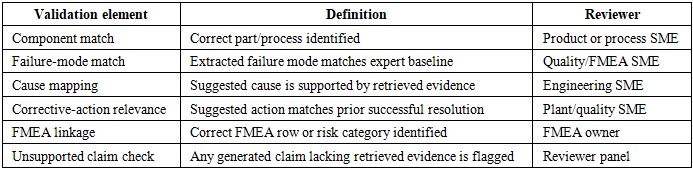
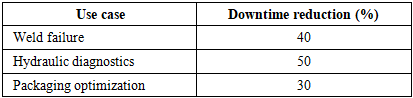
- The results support the practical value of combining historical issue retrieval with AI-enhanced FMEA. The primary benefit is not simply faster search; it is the transformation of fragmented records into contextual engineering guidance. By linking symptoms, components, root causes, corrective actions, and FMEA entries, the Discovery Bot helps engineers identify whether an issue is new, recurring, or related to a previously mitigated risk. The framework also addresses a limitation of static FMEA practice. Traditional FMEA documents may become outdated when new field or production evidence is not systematically incorporated. The proposed approach creates a feedback loop in which validated issue-resolution outcomes can trigger FMEA review. This improves organizational learning while preserving human accountability. The system’s value depends on data quality, terminology consistency, access governance, and expert validation. AI recommendations should not be treated as final engineering decisions. Instead, they should accelerate evidence gathering, highlight relevant prior experience, and support structured review by qualified personnel.
6. Conclusions
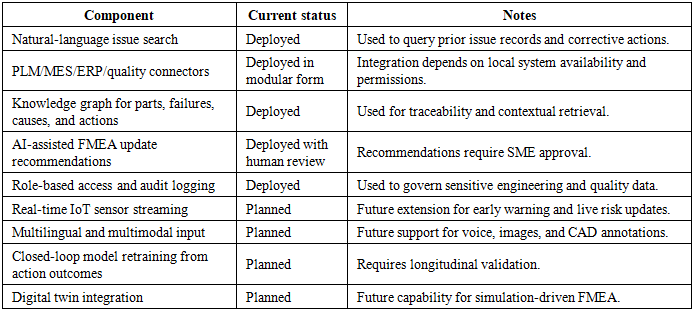
- The AI-driven Discovery Bot provides a practical framework for improving manufacturing issue resolution and FMEA currency. The key conclusions are: • Historical knowledge can be operationalized. The system converts fragmented issue records, quality reports, engineering changes, and production data into searchable guidance. • AI-enhanced FMEA improves risk visibility. Failure modes, causes, corrective actions, and risk assumptions can be reviewed as new evidence emerges. • Measured outcomes are encouraging. Reported cases show 30–50% reduction in issue-resolution time and downtime reductions of 40%, 50%, and 30% in selected use cases. • Human validation remains essential. The Discovery Bot supports engineers but does not replace expert judgment, especially for safety, quality, and design decisions. • Enterprise integration is central to• scalability. Secure APIs, access control, knowledge graphs, and modular services allow deployment across plants and product lines.
7. Limitations and Future Directions
- The study has several limitations. First, deployment contexts are anonymized, and absolute counts are not disclosed. Second, yield metrics are not uniformly reported because definitions differ across systems and industries. Third, the validation approach relies on expert-defined baselines, which improves safety but requires SME availability. Fourth, real-time IoT integration, multilingual and multimodal input, closed-loop retraining, and digital twin linkage remain planned extensions. Future work should expand validation sample sizes, report precision/recall/F1 values for LLM extraction, test the system longitudinally in live production settings, and evaluate whether closed-loop FMEA updates reduce recurrence over time. Additional research should also examine governance, privacy, and explainability requirements for AI-enabled manufacturing decision support.
ACKNOWLEDGEMENT
- The author thanks colleagues and industry partners who supported the development, evaluation, and refinement of the Discovery Bot across manufacturing environments.