Olumurewa O. K.
Department of Mathematical Science, Federal University of Technology, Akure, Ondo State, Nigeria
Correspondence to: Olumurewa O. K., Department of Mathematical Science, Federal University of Technology, Akure, Ondo State, Nigeria.
| Email: |  |
Copyright © 2026 The Author(s). Published by Scientific & Academic Publishing.
This work is licensed under the Creative Commons Attribution International License (CC BY).
http://creativecommons.org/licenses/by/4.0/

Abstract
This study developed, investigated and implemented a novel Implicit Two – step Third derivative method of order six for direct solution of initial value problems of third order ordinary differential equations. The method was developed through Taylors series expansion, incorporating third derivatives (l=3) to enhance higher accuracy while maintaining computational efficiency through a two – step (k=2) formulation thus eliminating the need to reducing the third order ordinary differential equation into a system of first order equations. Key properties of the method which include accuracy, consistency, stability and convergence were investigated. Numerical implementation demonstrated the method’s efficiency and effectiveness across diverse test problems with error analysis revealing high order accuracy when compared with exact solution and some existing block methods of same and higher order of accuracy thus establishing the method as an efficient and accurate tool for solving third order ordinary differential equations in scientific and engineering applications.
Keywords:
Third order, Differential equation, Implicit, Two – step, Multiderivative, Direct, Integration, Non – linear
Cite this paper: Olumurewa O. K., A Sixth Order Multiderivative Method for Direct Integration of Non – linear Third Order Ordinary Differential Equations, American Journal of Computational and Applied Mathematics , Vol. 16 No. 1, 2026, pp. 1-6. doi: 10.5923/j.ajcam.20261601.01.
1. Introduction
Due to the limitations of analytical methods particularly when solving nonlinear and higher order systems in modern science, numerical methods are found to be indispensable option and tool for theoretical exploration and simulation. Rigorous and extensive research are devoted to the development of effective and efficient numerical schemes which are aimed at obtaining reliable approximate solutions where exact solutions are impractical or unavailable. It is note – worthy that ordinary differential equations serve as crucial tools for modelling phenomena across diverse domains such as Biology, Economics, Physics, Chemistry and Engineering. These models give rise to various forms of Initial Value Problems (IVPs) of Ordinary Differential Equations (ODEs) of different orders that have the general form: | (1.1) |
where  is the order of the problem,
  and
and  is a continuous function of
  and the derivatives of
  This study considered the solution to (1.1) when
  that is
 | (1.2) |
IVPs of higher order ODEs are conventionally reduced to a system of first order ODEs for solution but literature revealed that several researchers have developed direct approaches for the solution. [1] developed a three – step implicit block method for direct solution of IVPs of second order ODEs using interpolation and collocation techniques with Chebyshev polynomials as basis function, the scheme enabled the simultaneous evaluation of solutions at step and off – step points with numerical results that demonstrated better performance over some existing methods. [2] developed an efficient numerical method for solving IVPs of second order ODEs using the method of interpolation of the combination of Chebyshev and Legendre polynomials approximate solution and collocation of differential system which was found to give a better approximation when compared with some existing methods. [3] developed a one - step block hybrid method based on third derivative for direct solution of IVPs of second order ODEs using power series approximation function, the method was interpolated at two points and collocated using both second and third derivatives at five strategically chosen off – step points. The derived method was found to be effective and efficient for solving stiff and non – stiff equations. [4] developed an efficient implicit two - step second derivative method for direct solution of second order ODEs by making an extension to the implicit second derivative methods for the solution of first order ODEs in [5] and [6], to mention a few. [7] listed some researchers that developed different block methods using the approach of interpolation and collocation for solving (1.2). Improving on the studies in [7] and advancing the field, this study developed an efficient and effective Implicit two – step third derivative (k=2, l=3) method tailored towards direct solution of IVPs of third order ODEs, using predictor - corrector approach that utilized Taylor’s series expansion as the basis function. The development of the method was found to be easier than block method and processed better accuracy than those in [7].
2. Methodology
2.1. Derivation of the Method
According to [8], Obrechkoff’s Multiderivative Linear Multistep Method of the form; | (2.1) |
has local truncation error: | (2.2) |
(where l is the order of derivative and k is the step - number), Taylor series expansion of the dependent variable, that is; given as;
 | (2.3) |
was adopted. Accuracy of order P was imposed on the local truncation error  and the resulting equations were solved for parameters
  and
and  to generate the required scheme. Order of accuracy and error constant of the scheme was determined by substituting the results of parameters
  and
and  into the original equation. The scheme was implemented by using it to solve some sampled non - linear IVPs of third order ODEs.Setting k=2, l=3 in (2.1) gives
  | (2.4) |
that is | (2.5) |
with local truncation error | (2.6) |
adopting Taylor’s series expansion of  and
and  in (2.6) and combining terms in equal powers of h gives
  | (2.7) |
where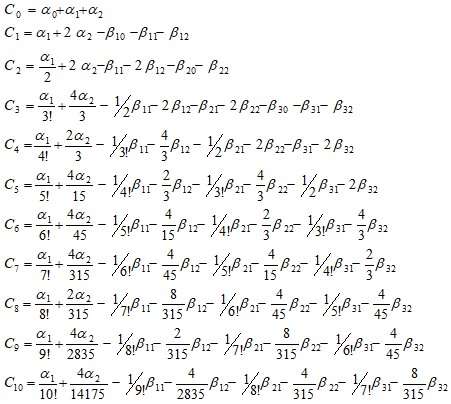 | (2.8) |
imposing accuracy of order 10 on  to have
 and
and  solving gives;
 putting these values into equation (2.5) gives two – step, third derivative method of the form:
  | (2.9) |
which resolves into: | (2.10) |
2.2. Verification of Basic Properties
2.2.1. Accuracy
According to [9], a numerical method is accurate if and only if its result tends to the exact solution and order P of the method is greater than or equal to one  A linear multistep method (L.M.M) is said to be of order P, if the order of the local truncation error
  is P, that is, the method is of order P if
  and
and  .For this two – step, third derivative method
  with
with
 . Substituting the values of these parameters in equation (2.8) gives
  Since the method is a two - step method i.e. (k=2) then
 thus
thus  with error constant
  .
.
2.2.2. Consistency
According to [10], a linear two - step method is consistent if the parameters  and
and  satisfy the following conditions:
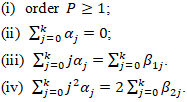 For the two - step third derivative method
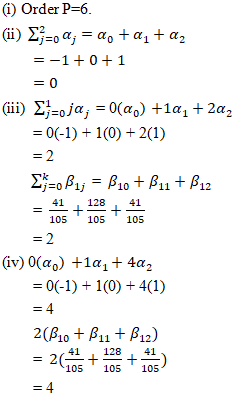 Having satisfied the given conditions, the method is consistent.
2.2.3. Zero-stability
According to [11], a L.M.M of the form: with first characteristic polynomial
  is said to be zero-stable if the root of the first characteristic polynomial
  has modulus less than or equal to 1;
  and must be simple.For the two – step, third derivative method
  of the form:
 whose first characteristic polynomial
  is
is 
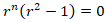 and its roots are
  [roots are within a unit circle and simple] Hence, the method is zero-stable.
2.2.4. Convergence
According to [12], a necessary and sufficient condition for a L.M.M to be convergent is that it must be consistent and zero-stable.Since this method is consistent and zero-stable, then it is convergent.
3. Implementation
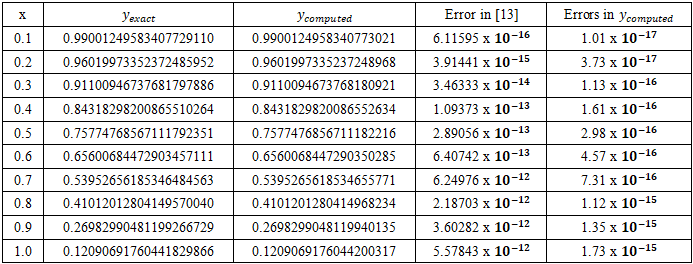
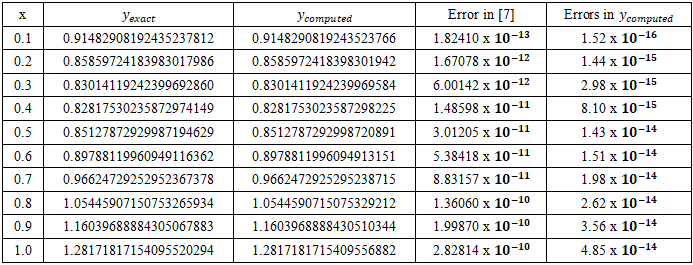
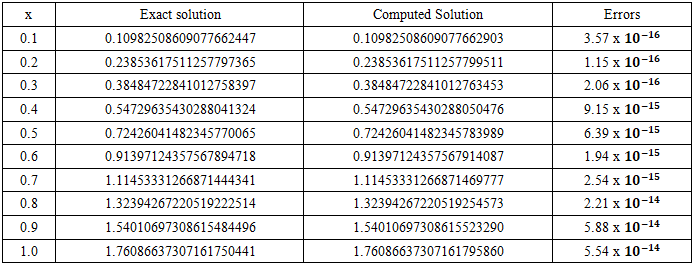
The developed method was used to solve three non - linear IVPs of third order ODEs with exact solutions to test its effectiveness and accuracy. Numerical result of Problems 1 was compared with the result of 4PHBM in [13] while the result of Problem 2 was compared with S2S4PHM in [7]. The results are as presented in Tables 1 - 3.Problem 1 Exact solution:
 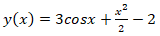 Source: [13] and [14]Problem 2
 Exact solution:
  Source: [7]Problem 3
 Exact solution:
Table 1. Numerical result for Problem 1 using the new method in relation with the method in [13]
 |
| |
|
Table 2. Numerical result for Problem 2 using the new method in relation with the method in [7]
 |
| |
|
Table 3. Numerical solution for Problem 3 using the new method
 |
| |
|
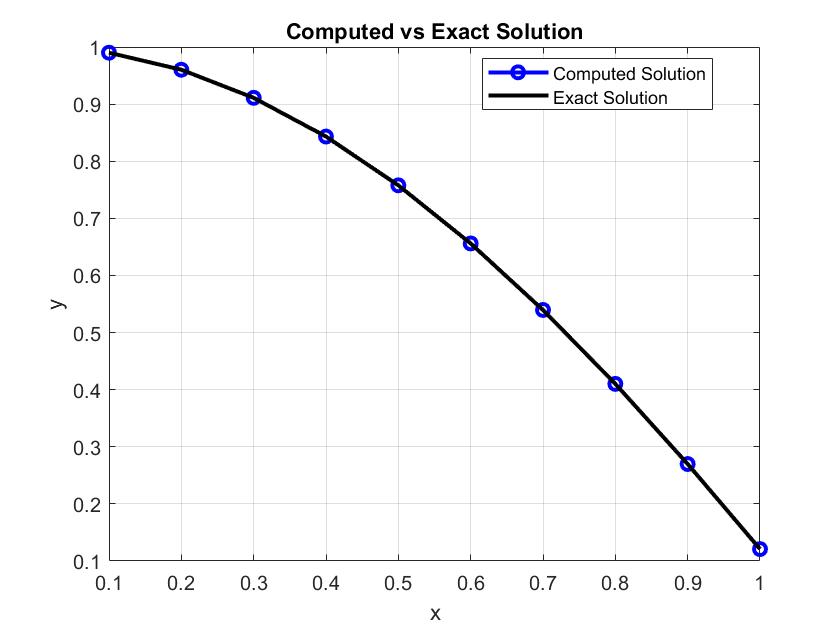
 | Figure 1. Graph of Numerical result and Exact solution for Problem 1 |
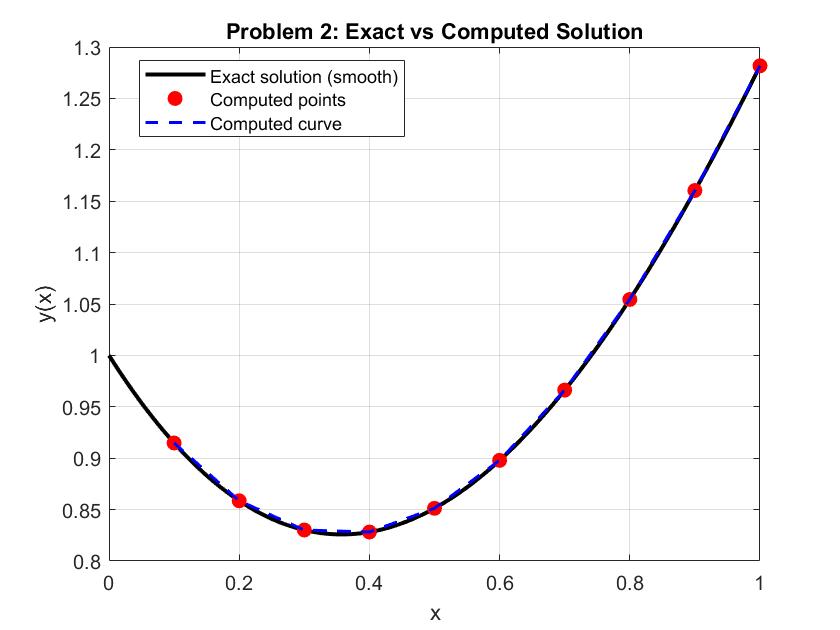
 | Figure 2. Graph of Numerical result and Exact solution for Problem 2 |
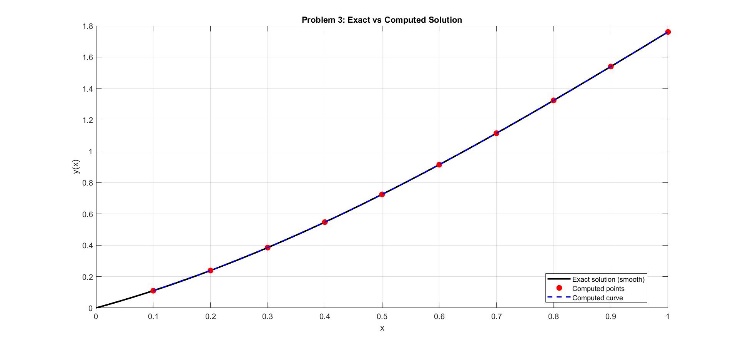
 | Figure 3. Graph of Numerical result and Exact solution for Problem 3 |
4. Discussion of Results
Analysis of the basic properties showed that the derived method has accuracy of order 6 with error constant of  The method was verified to be consistent, zero – stable and convergent. The results obtained in Tables 1 – 3 and the graphical representation in Figures 1 – 3 confirmed that the two – step third derivative method has high accuracy when compared with exact solution. The table of results also showed that the new method performed better in terms of accuracy and convergence than the methods in [7], [13] and [14] which are of order 6, 6 and 7 respectively.
5. Conclusions
This study has produced an accurate, consistent, zero – stable and convergent implicit two – step third derivative method which is capable of direct solution of IVPs of third order ODEs. Taylors series expansion was used as the basis function for the approximate solution to the given problems. The method was implemented on some sampled non – linear test problems whose numerical results when compared with exact solution and numerical results from some existing block methods revealed that the developed method performed more favorably in terms of accuracy, stability and convergence hence, this method is recommended for direct solution of IVPs of third order ODEs.
References
| [1] | Adeyefa, E.O., Joseph, F.L. and Ogwumu O.D. (2014). Three step implicit block method for direct solution of second order ODEs. International Journal of Engr. Sc. Invent. Vol. 3, pp. 34 – 38. |
| [2] | Kayode S.J., Ige O.S. and Obarhua F.O. (2018). An order six Stormer – Cowell -type method for solving directly higher order ODEs. Asian Research Journal of Mathematics 11(3) pp. 1 – 12. |
| [3] | Alkasassbeh, M. and Omar, Z. (2017). A one – step block hybrid method on third derivatives for the direct solution of second order IVPs. Applied Mathematics and Computation, 314, 321 - 335. |
| [4] | Olumurewa O.K., Orunko O.E. and Olaleye J.T. (2025). An extension to implicit second derivative method with variable step – number for direct solution of second order ODEs. Asian Research Journal of Mathematics 21(7) 1 – 10. https://doi.org/10.9734/arjom/2025/v21i7953. |
| [5] | Famurewa O.K., Ademiluyi R.A. and Awoyemi D. O (2011). A comparative study of a class of implicit multiderivative methods for numerical solution of non – stiff and stiff ODEs. African Journal of Mathematics and Computer Science Research. Vol. 4(2) pp. 120 – 135. |
| [6] | Famurewa O.K. and Olorunsola S.A. (2013). The effect of involving more derivative properties on the accuracy of an implicit one – step method. Asian Journal of Natural and Applied Sciences. Vol 2(3) pp. 42 – 57. |
| [7] | Kayode S.J. and Obarhua F.O. (2017). Symmetric 2 – step 4 – point hybrid method for the solution of general third order differential equations. International Journal of Scientific and Engineering Research. Vol. 8(7) pp. 1 - 12. |
| [8] | Lambert J.D. (2000). Numerical method for ordinary differential systems of initial value problems. John Willey and Sons, New York. |
| [9] | Butcher J. (2008). Numerical Methods for ODEs (2nd ed.). John Wiley and Sons Ltd. West Sussex. |
| [10] | Awoyemi D.O. and Idowu O.M. (2005). A class of hybrid collocation method for third order ODEs. International Journal of Computational Mathematics 82(10): 1287 - 1293. |
| [11] | Babatola P.O., Ademiluyi R.A. and Areo E.A. (2007). K – Step rational R – K method for solution of stiff system of ODEs. Journal of Mathematics and Statistics 4(3)130 – 137. |
| [12] | Palencia C. (1994). On the stability of variable step size rational problems. BIT, 18, 475 – 489. |
| [13] | Obarhua F.O., Kayode S.J. and Areo E. A. (2018). An accurate four – point hybrid block method for the solution of third order ODEs. Journal of the Nigerian Association of Mathematical Physics. Vol 48 (Sept. & Nov. issue) pp. 47 - 56. |
| [14] | Adesanya A.O., Udoh D.M. and Ajileye A.M. (2013). A new hybrid block method for the solution of general third order IVPs of ODEs. International Journal of Pure and Applied Mathematics. 86(2): 365 - 375. |


 Abstract
 Reference
 Full-Text PDF
 Full-text HTML