
-
Paper Information
- Paper Submission
-
Journal Information
- About This Journal
- Editorial Board
- Current Issue
- Archive
- Author Guidelines
- Contact Us
American Journal of Computational and Applied Mathematics
p-ISSN: 2165-8935 e-ISSN: 2165-8943
2015; 5(6): 178-181
doi:10.5923/j.ajcam.20150506.04

A Generalized EOQ Model for Time Dependent Deteriorating Items under Inflation, Exponentially Increasing Demand and Partial Backlogging
 Abstract
 Reference
 Full-Text PDF
 Full-text HTML
Sanjay Sharma
Department of Mathematics, Roorkee Engineering & Management Technology Institute Shamli (UP), India
Correspondence to: Sanjay Sharma, Department of Mathematics, Roorkee Engineering & Management Technology Institute Shamli (UP), India.
| Email: |  |
Copyright © 2015 Scientific & Academic Publishing. All Rights Reserved.
This work is licensed under the Creative Commons Attribution International License (CC BY).
http://creativecommons.org/licenses/by/4.0/

In this paper, an –order level deterministic inventory model is developed for deterioration. Where demand is exponentially increasing and shortages are allowed which is taking to be partially backlogged. The sensitive analysis is carried out to study the effect of inflation and method is solved by minimizing the total cost. Method is also discussed with a numerical example.
Keywords: Time dependent deterioration, Exponentially increasing demand, Partially backlogging
Cite this paper: Sanjay Sharma, A Generalized EOQ Model for Time Dependent Deteriorating Items under Inflation, Exponentially Increasing Demand and Partial Backlogging, American Journal of Computational and Applied Mathematics , Vol. 5 No. 6, 2015, pp. 178-181. doi: 10.5923/j.ajcam.20150506.04.
Article Outline
1. Introduction
- Inflation is defined as the rate at which the general level of price for goods and services is rising and subsequently, purchasing power is falling. effect of Inflation on an economy are various and can be simultaneously positive and negative effects of influence include a decrease in the real value of money and other monitory items over time. The high inflation may lead to shortages of goods if consumers being hoarding out of concern that pries’ will increase in the future positive effects include ensuring central banks can adjust normal interest rates. Also shortage is the fraction of those customers whose demand is not satisfied in the current time period mean to this that they are not returning to the next period of time. Deterioration is defined as the decay, spoilage, damage loss of utility of the product meaning that item cannot be used for its original purpose for example Food items, Pharmaceuticals and radioactive substances etc. Therefore the loss due to deterioration cannot be avoided also deterioration is the measure reason if the shortages. Very firstly Within (1957) studied the effects of deterioration by taking deteriorating items such that fashion goods, fruits and vegetables etc and give a mathematical inventory model for such type of items then Ghare and Schrader (1963) extend the model of within by including exponentially decay of inventory due to deterioration after that Cover and Philip (1973), Hartley (1976) study an EOQ model for items with Weibull distribution deterioration and Pierskalla and Roach (1972), Nahmias (1982) give a review on perishable inventory theory he give a literature on ordering polices for both fixed life perishable inventory and for continuous exponential decay and Murdeshwar and Sathe (1985), Sarma (1987) and Rafat (1991) extend and present their model by considered the effects of deterioration, as the fraction of on hand inventory – level. Goswami and Chaudhari (1993) discussed an economic order quantity model for items with two levels of storage for a linear Trend in demand and Pakkala and Achary (1994) study two level storage inventory model for deteriorating items with bulk release rule, Abad (1996) present a literature of optimal pricing and lot – sizing inventory model under the condition of perishable and partial back ordering where the back order rate depends upon the waiting time till the next replenishment but in this literature stock – out cost was not study Chang and Dye (1999) considered that if the back logging rate would be the fraction of the customer who like to accept back-logging at time t is decreasing with the waiting time for the next –replenishment and developed an inventory model with time varying demand and partial back logging in which the back – logging rate is defined by
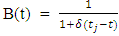 , Where
  is the time at which the
  replenishment is making and
  is the backlogging parameters. V.N. Mishra (2007) developed some Problems on Approximations of Functions in Banach Spaces.Nitashah, Acharya and Ankit (2008) present a model for a time dependent deteriorating Order level inventory model for exponentially Declining demand and Tripathi and Misra(2011) present the model for an inventory model with shortage, time-dependent demand rate and quantity dependent Permissible delay in payment. Deepmala (2014) present A Study on Fixed Point Theorems for Nonlinear Contractions and its Applications. Vandana and B.K. Sharma (2015) developed an EPQ inventory model for non-instantaneous deteriorating item sunder trade credit policy also Vandana and B.K. Sharma (2015) present an inventory model for Non-Instantaneous deteriorating items with quadratic demand rate and shortages under trade credit policy. S. Gupta, U. Dalal and V.N. Mishra (2015) developed performance on ICI self cancellation in FFT-OFDM and DCT-OFDM system.In the proposed study demand is taking exponentially increasing an attempt is made to develop a EOQ model for deteriorating items where shortages are allowed and assuming it partially – backlogged.Here the object is to minimize the total cost per time unit of an inventory system numerical example is illustrated the theoretical result.
 2. Assumptions and Notations
- To develop the mathematical model for inventory model the following assumptions are adopted in this paper.(i) The system deals with the single item.(ii) Rate of replenishment is infinite and lead time is zero.(iii) The time horizon of the inventory system is infinite.(iv) Total initial inventory = I(v) Purchasing cost per unit = P(vi) Inventory holding cost per unit per unit time = h(vii) Inventory ordering cost = O(viii) Shortage cost per unit = C(ix) Demand
 where
where  is any constant and b denote the rate of change of demand.(x) The deterioration of units
  where 0 < Q < 1 and t > 0 (xi) Unsatisfied demand is backlogged and backlogging rate is
 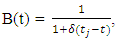 Where
Where  is the time at which the
  replenishment is making and
  is the backlogging parameters.(xii)
  Time point of positive inventory
  (xiii)
  Cycle – Time (xiv)
  Rate of deterioration at any instant of time t.(xv) Deteriorated units cannot be repaired or replaced during a period.(xvi) Shortages are allowed and completely backlogged
3. Mathematical Formulation
- Using above assumptions, the inventory level follows the pattern depicted in Fig.1. To establish the total relevant profit function, we consider the following time intervals separately, we know that the on hand inventory depletes due to the combined effect of demand and deterioration at any instant of time the inventory level I(t) is represent by the deferential equations
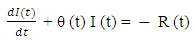 | (1) |
 and with the conditions that
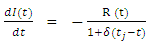 | (2) |
 and with the conditions that I
  Solution of equation (1) is given by
  | (3) |
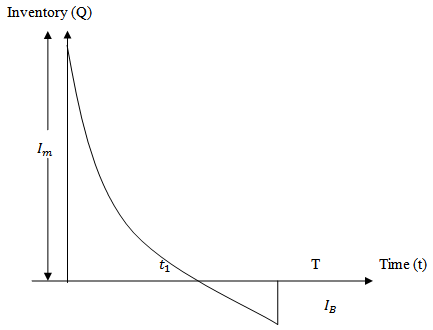 | Figure 1. Graphical representation of the model |
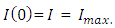 then from (3)
 | (4) |
 Its solution is given by
  | (5) |
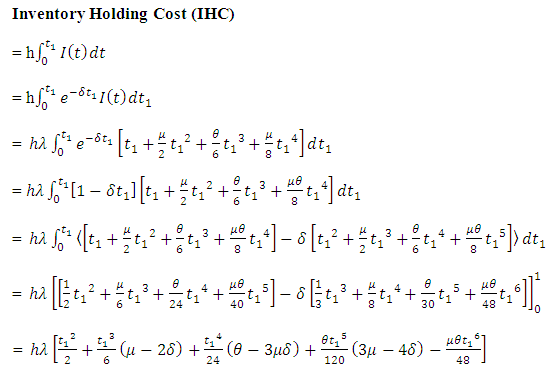 | (6) |
 therefore
 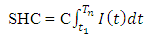 | (7) |

 | (8) |
 | (9) |
 = IHC+SC+CD+LS and Total cost
  per time unit of an inventory system is
  (IHC+SC+CD+LS)The necessary condition for total cost
  to be minimum is that
  and
and  Provided that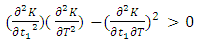
4. Numerical Illustrations
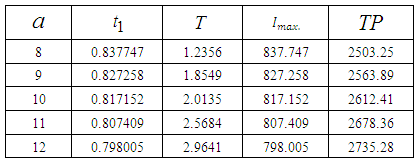
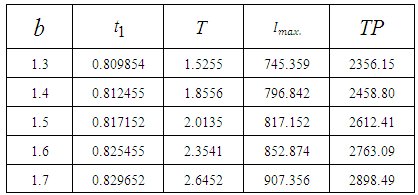
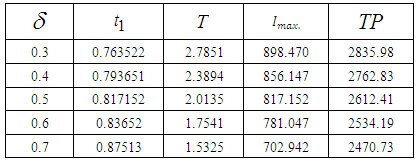
- To illustrate the proposed model we have considered the following input parameters in appropriate units
 On the basis of the above parametric values, we derive the optimal solution and results are
|
|
|
5. Conclusions
- In this paper we have developed an inventory control model for the deteriorating items with timely dependent demand and partial backlogging. The goal of this research is to study the optimal polices for the retailer when the demand is decline. Here we give analytical solution of the model for the main purpose that we have to minimize the total cost. The model is very useful when over demand is depend upon the time. The model is also explained by taking numerical examples.