
-
Paper Information
- Next Paper
- Paper Submission
-
Journal Information
- About This Journal
- Editorial Board
- Current Issue
- Archive
- Author Guidelines
- Contact Us
American Journal of Computational and Applied Mathematics
p-ISSN: 2165-8935 e-ISSN: 2165-8943
2013; 3(5): 251-258
doi:10.5923/j.ajcam.20130305.01
Stopping Criteria of the Extended Iterative Refinement Algorithm Used to Solve an Ill Conditioned Linear System
 Abstract
 Reference
 Full-Text PDF
 Full-text HTML
Abdramane Sermé
Department of Mathematics, the City University of New York, New York, NY, 10007, USA
Correspondence to: Abdramane Sermé, Department of Mathematics, the City University of New York, New York, NY, 10007, USA.
| Email: |  |
Copyright © 2012 Scientific & Academic Publishing. All Rights Reserved.
We proved in[1] that our extended iterative refinement or improvement algorithm to solve accurately an ill conditioned linear system converges by providing a theorem that we called the convergence theorem. To compute an accurate solution to an ill conditioned linear system we first use the additive preconditioning to decrease the condition number of the input ill conditioned matrix  . Then we use the technique of Schur aggregation to reduce the computation of
  to the computation of the Schur aggregate
  . This second step is done using the Sherman-Morrison-Woodbury (SMW) formula. The extended iterative refinement or improvement algorithm should stop when
  and the Schur aggregate
  are computed with higher precision. We provide in this paper the condition for the extended iterative refinement or improvement algorithm to stop in a proposition.
Keywords: Stopping criteria, Condition number, Ill conditioned linear system, Sherman-Morrison-Woodbury (SMW) formula, Preconditioning, Schur aggregation, Iterative refinement or improvement, Algorithm, Rounding errors, Singular value decomposition
Cite this paper: Abdramane Sermé, Stopping Criteria of the Extended Iterative Refinement Algorithm Used to Solve an Ill Conditioned Linear System, American Journal of Computational and Applied Mathematics , Vol. 3 No. 5, 2013, pp. 251-258. doi: 10.5923/j.ajcam.20130305.01.
Article Outline
1. Introduction
- The following extended iterative refinement or improvement algorithm helps us solve the matrix linear system
 with higher precision.



 for
for  Using this algorithm the residuals dynamically decrease, which is a must for us. We represent the output value as the sum of matrices with fixed-precision numbers. The extended iterative refinement or improvement algorithm should stop when
  and the Schur aggregate
  are computed with higher precision. We use
  to compute the Schur aggregate
  . An accurate solution
  of an ill conditioned linear system
  is achieved by transforming it using the additive preconditioning
  for preconditioner
  of smaller rank
  and the Schur aggregation. We use the Sherman-Morrison-Woodbury (SMW) formula
 where
where  is an invertible square matrix to get new linear systems of smaller sizes with well conditioned coefficients matrices
  ,
,  , and
, and  . The technique of iterative refinement or improvement for computing the Schur aggregate[15] and its application for solving linear system of equations has been studied in a number of papers[3, 15, 18].This paper is divided into three sections. The first section covers the concept of rounding errors, floating-point summation, matrix norms and convergence. The second section is devoted to the additive preconditioning, the Schur aggregation and how the iterative refinement or improvement technique is used with the SMW formula to transform the original linear system
  into better conditioned linear systems. In the third section of this paper we show in a proposition the stopping criteria of the extended iterative refinement or improvement algorithm.
2. Rounding Errors, Floating-point Summation, Matrix Norms and Convergence
2.1. Rounding Errors
- Definition 2.1.1 Let
 be an approximation of the scalar x. The absolute error in
  approximating
  is the number
  .Definition 2.1.2 Let
  be an approximation of a scalar
 . The absolute and relative errors of this approximation are the numbers
  and
and  , respectively. If
  is an approximation to
  with relative error
  , then there is a number
  such that 1)
  and 2)
  .Remark 2.1.1 The relative error
  is independent of scaling, that is the scaling
  and
and  leave
leave  unchanged.Theorem 2.1[6] Assume that
  approximates
  with relative error
  < 1. Then
  is nonzero and
  .Remark 2.1.2 If the relative error of
  with respect to
  is
is  , then
  and
and  agree to roughly
  correct significant digits. For binary system, if
  and
and  have relative error of approximately
  , then
  and
and  agree to about
  bits.Definition 2.1.3 The componentwise relative error is defined as:
  for
for  and is widely used in the error analysis and perturbation theory.Remark 2.1.3 In numerical computation, one has three main sources of errors.1. Rounding errors, which are unavoidable consequences of working in finite precision arithmetic.2. Uncertainty in the input data, which is always a possibility when we are solving practical problems.3. Truncation errors, which are constituted and introduced by omitted terms.Rounding errors and Truncation errors are closely related to forward errors.Definition 2.1.4 Precision is the number of digits in the representation of a real number. It defines the accuracy with which the computations and in particular the basic arithmetic operations
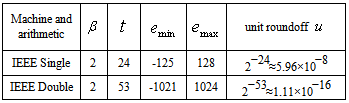
  are performed. For floating point arithmetic, precision is measured by the unit roundoff or machine precision, which we denote u in single precision and
  in double precision. The values of the unit roundoff are given in Table 1.1 in Section 2.3.Remark 2.1.4 Accuracy refers to the absolute or relative error of an approximation.Definition 2.1.5 Let
  be an approximation of
  computed with a precision
  where
where  is a real function of a real scalar variable.
  is called the (absolute) backward error, whereas the absolute or relative errors of
  are called forward errors.Theorem 2.2[8] (Rigal and Gaches). The normwise backward error
 is given by
  , where
  Definition 2.1.6 For an approximation
  to a solution of a linear system
  with
with  and
and  , the forward error is the ratio
  .The process of bounding the forward error of a computed solution in terms of
  is called forward error analysis.
  is the perturbation of
  .Definition 2.1.7 An algorithm is called forward stable if it produces answers with forward errors of similar magnitude to those produced by backward stable method.Definition 2.1.8 A mixed forward-backward error is defined by the equation
  where
where  ,
,  with
with  and
and  are small constants.Remark 2.1.5 This definition implies that the computed value ŷ differs just a little from the value
  that would have been produced by an input
  which is a little bit different from the actual input
  . This means that
  is almost the right answer for almost the right data.Definition 2.1.9 An algorithm is called numerically stable if it is stable in the mixed forward and backward error sense.Remark 2.1.6 A backward stability implies a forward stability but the converse is not true.Remark 2.1.7 One may use the following rule of thumb;Forward error
  condition number
 backward error, with approximate equality possible. Therefore the computed solution to an ill conditioned problem can have a large forward error even if the computed solution has a small backward error. This error can be amplified by the condition number in the transition to forward error. This is one of our motivations for reducing the condition number of the matrix A using the additive preconditioning method.Definition 2.1.10 For a system of linear equations
  ,
,  is called the relative residual. The relative residual gives us an indication on how closely
  represents
  and is scale independent.
2.2. Floating-point Number System
- Definition 2.2.1[6] A floating-point number system
 is a subset of the real numbers whose elements have the form
 . The range of the nonzero floating-point numbers in
  is given by
  . Any floating-point number
  can be written in the form
  where each digit
  satisfies
  and
and  for normalized numbers.
  is called the most significant digit and
  the least significant digit.
2.3. Error-free Floating-point Summation
- Here is a summation algorithm due to D.E. Knuth[7]. Algorithm 1. Error-free transformation of the sum of two floating point numbers
 The algorithm transforms two input-floating point numbers
  and
and  into two output floating-point numbers
  and
and  such that
  and
and  . The same solution is achieved using the Kahan-Babušhka’s[11] and Dekker’s[12] classical algorithm provided that
  . It uses fewer ops but includes branches, which slows down the code optimization outputs.Definition 2.3.1[8] The unit roundoff error
  is the quantity
  . We write
  and
and  to denote the operations performed in single precision and in double precision, respectively.
|
 lying in
  can be approximated by an element of
  with a relative error no larger than
  Theorem 2.3 If
  lies in
  then
then  with
with  <
<  Theorem 2.3 says that
  is equal to
  multiplied by a factor very close to 1.Definition 2.3.2 From now on
  , for an argument that is an arithmetic expression, denotes the computed value of that expression. op represents floating-point operation in
  .
.2.4. Matrix Norms
2.4.1. The Singular Value Decomposition (SVD)[3, 15]
- Definition 2.4.1 The compact singular value decomposition or SVD of an
 matrix
  of a rank
  is the decomposition:
 where
where  and
and  are unitary matrices, that is,
  ,
, ,
, is a diagonal matrix,
  and
and  are m- and n-dimensional vectors, respectively, and
  > 0.
> 0.  or
or  for
for  is the
  largest singular value of the matrix
  .Definition 2.4.2 The condition number,
  of a matrix
 of a rank
  is
is  . A matrix is said to be ill conditioned if its condition number is large, that is if
  , and is called well conditioned otherwise.Definition 2.4.3[6] The matrix 2-norm
  =
=  =
=  , is also called the spectral norm.
  denotes the largest singular value of the matrix
  .Remark 2.4.1 The matrix 2-norm satisfies the relation1.
  where
where  ,
,  for
for  and
and .2.
.2.  .Lemma 2.4 For a vector norm
  , suppose that
  < 1 . Then
  .
.2.5. Numerical Nullity
- Definition 2.5.1 The nullity of
 ,
,  , is the smallest integer
  for which a rank
  APC
APC  can define a nonsingular A-modification
  . The nullity of
  , which is defined as the dimension of the null space can also be defined as the large integer r for which we have
  or
or  , provided
 is a nonsingular matrix. In this case,
  and
and  are the right and left null matrix bases for the matrix A.
2.6. Convergence
- There is a natural way to extend the notion of limit from
 to
to  .Definition 2.6.1 Let
  be a sequence of vectors in
  and let

 . The sequence
  converges componentwise to
  and we write
  if
if  for
for  .Here is another way to define convergence in
  .Definition 2.6.2 Let
  be a sequence of vectors in
  and let

 . The sequence
  converges normwise to
  , that is
  if and only if
  There is no compelling reason to expect the two notions of convergence to be equivalent. In fact for infinite dimensional vector space, they are not.Theorem 2.5[6] Let

 and suppose that
  . Then
  is nonsingular and
  (this sum is called Neumann sum). A sufficient condition for
  is that
  < 1 in some consistent norm, in which case
  .Corollary 2.6 If
  , then
 is nonnegative and
  .Theorem 2.7[6] Let
  be a matrix norm on
  consistent with a vector norm (also denoted
  ) and let a matrix

 . Let
. Let  be a square matrix such that
  < 1. Then(i) the matrix
  is nonsingular,(ii)
  , and (iii)
  . The following corollary extends Theorem 2.7. Corollary 2.8[6] If
  , then
  Moreover,
  , so that
  .The corollary remains valid if all occurrences of
  are replaced by
  .Theorem 2.9[8, 17] Let
  denote a matrix norm and a consistent vector norm. If the matrix
  is nonsingular and
  and (i)
  , where
  is an approximated value of x, then(ii)
  . In addition if
  < 1, then
  is nonsingular and(iii)
  .
.3. The Additive Preconditioning Method, the Schur Aggregation and the Extended Iterative Refinement or Improvement Algorithm
3.1. The Additive Preconditioning Method
- Definition 3.1.1 For a pair of matrices
 of size
  and
and  of size
  , both having full rank
  > 0, the matrix
  of rank
  is an additive preprocessor (APP) of rank
  for any
  matrix
  . The matrix
  is the A-modification. The matrices
  and
and  are the generators of the APP, and the transition
  is an A-preprocessing of rank
  for the matrix
  . An APP
  for a matrix A is an additive preconditioning (APC) and an A-preprocessing is an A-preconditioning if
  . An APP is an additive compressor (AC) and an A-preprocessing is an A-complementation if the matrix A is rank deficient, whereas the A-modification C has full rank. An APP
  is unitary if the matrices
  and
and  are unitary.Remark 3.1.1 Suppose
  has rank r. Then[3, 18], we expect
  to be to the order of
  , therefore small if the additive preconditioner
  isi) random ii) well conditioned, andiii) properly scaled, that is
  is not large and not small.The additive preconditioning consists in adding a matrix
  of a small rank to the input matrix
  , to decrease its condition number. The A-modification is supposed to generate a well conditioned matrix
  . In practice, to compute the A-modification
  error-free, we fill the generators
  and
and  with short binary numbers.
3.2. The Schur Aggregation
- The aggregation method consists of transforming an original linear system
 into linear systems of smaller sizes with well conditioned coefficients matrices
  ,
,  , and
, and  . The aggregation method is a well known technique[3, 14, 15, 18], but the aggregation used here both decreases the size of the input matrix and improves its conditioning. One may remark that the aggregation can be applied recursively until no ill conditioned matrix appears in the computation.Definition 3.2.1 The Schur aggregation is the process of reducing the linear system
  by using the SMW (Sherman-Morrison-Woodbury) formula
 The matrix
 , which is the Schur complement (Gauss transform) of the block
  in the block matrix
  , is called the Schur aggregate. The A-modification
  and the Schur aggregate
  are well conditioned, therefore the numerical problems in the inversion of the matrix A are confined to the computation of the Schur aggregate
  .
.3.3. The Iterative Refinement or Improvement Algorithm
- Let
 . Then, we apply the SMW formula to the original linear system
  and transform it into better conditioned linear systems of smaller sizes, with well conditioned matrices
  ,
, and
and  . We solve the original linear system
  by post-multiplying
  by the vector b. We consider the case where the matrices C and S are well conditioned, whereas the matrices
  and
and  have small rank r, so that we can solve the above linear systems with the matrices
  and
and  faster and more accurately than the system with the matrix
  . In this case the original conditioning problems for a linear system
  are restricted to the computation of the Schur aggregate
  .To compute the Schur aggregate
  with precision, we begin with computing
  using the iterative refinement or improvement algorithm. We prove that we can get very close to the solution
  of the linear system
  . We closely approximate it by working with numbers rounded to the IEEE standard double precision and using error-free summation. All norms used in this section are the 2-norm. The iterative refinement or improvement algorithm is a technique for improving the computed approximate solution
  of a linear system
  . The iterative refinement or improvement for the Gaussian Elimination (GE) was used in the 1940s on desk calculators, but the first thorough analysis of the method was given by Wilkinson in 1963. The process consists of three steps ([6],[7],[15]).Algorithm 2. Basic iterative refinement or improvement algorithmInput: An
  matrix
  , a computed solution
  to
to  and a vector b.Output: A solution vector
  approximating
  in
in  and an error bound
  .Initialize:
  Computations:1) Compute the residual
  in double precision (
 )2) Solve
  in single precision (
 ) using the GEPP3) Update
  in double precision (
 )
) Repeat stages 1-3 until
  is accurate enough.Output
  and an error bound. The iterative refinement or improvement algorithm can be rewritten as follows[6].
  is the error in the computation of
  ,
,  is the error in the computation of
  and
and  , where
  is the perturbation to the matrix A.
  is a computed solution of the linear system
  . 1)
. 1)  2)
2)  3)
3)  Repeat stages 1-3.The algorithm yields a sequence of approximate solutions
  which converge to
  .We use an extension of Wilkinson’s iterative refinement or improvement to compute the matrix
  with extended precision. In its classical form above the algorithm is applied to a single system
  , where
  and are
  vectors. We applied it to the matrix equation
  , where the solution we are seeking is the matrix
  . In its classical version also the refinement stops when the matrix
  is computed with at most double precision. In order to achieve the high precision in computing
  , we apply a variant of the extended iterative refinement or improvement where the residuals dynamically decrease, which is a must for us. We represent the output value as the sum of matrices with fixed-precision numbers.
3.4. The Extended Iterative Refinement or Improvement Algorithm
- Suppose
 is an ill conditioned non-singular
  matrix with
  where
where  is the numerical nullity of the matrix
  ,
,  is a random, well conditioned and properly scaled APC of rank r < n, and the well conditioned A-modification
  . We use the matrices
  and
and  whose entries can be rounded to a fixed (small) number of bits to control or avoid rounding errors in computing the matrix
  .Surely, small norm perturbations of the generators
  and
and  , caused by truncation of their entries, keep the matrix
  well conditioned. We write the extended iterative refinement or improvement algorithm to solve the linear system
  with
with  and
and  as follows.Algorithm 3.
 | (0.1) |
 | (0.2) |
 | (0.3) |
 , derived from the ill conditioned linear system
  , by applying the following extended iterative refinement or improvement algorithm.
 | (0.4) |
 | (0.5) |
 | (0.6) |
 We have the following theorem.Theorem 3.1[1] If
  < 1 and
  for
for  then
then In other words,
  is bounded by
  for a certain integer
  .
.4. Stopping Criteria of the Extended Iterative Refinement or Improvement
4.1. Analysing the Errors in Algorithm 4
- The solution
 of the linear system
  is computed by means of Gaussian Elimination with Partial Pivoting (hereafter GEPP), which is a backward stable process. It is corrupted by rounding errors of the computation of
  in (0.4), so that the computed matrix
  (computed in single precision arithmetic
  ) turns into
  .
.  is the perturbation to the matrix
  . We can also say equivalently that there exists an error matrix
  such that
  where
where  That is,
  is an exact solution for the approximated problem.
  is a constant function of order
  We recall that the summation (0.6) is done error free[7].Proposition 4.1. (Stopping criteria of the extended iterative refinement or improvement algorithm)If Algorithm 4. is the linear equation solver of the linear system
  derived from the ill conditioned linear system
  then, the extended iterative refinement or improvement should stop when the error
  of the residual
  is bounded by
  In another word the extended iterative refinement or improvement should stop when
 ProofThe backward error and the condition number of the matrix help determine when to stop an iterative refinement or improvement algorithm. Stopping an iterative method is related to the backward (or forward) error in the order of the machine round off
  or
or  If
If  where
where  is a constant of order
  and
and  is the perturbation to the matrix
 , then the extended iterative refinement or improvement algorithm cannot distinguish between
  and
and  There is no need at that point to get a smaller backward error and the extended iterative refinement or improvement shall stop.From theorem 2.2 and
  | (0.5) |
 since (0.5) is computed in double precision
  and (0.6) is computed error free[7] . Dividing both side by
  yields
  Using theorem 2.2 we conclude that
  is a bound of the normwise backward error. Therefore we have,
  is equivalent to
 ,
,  That is the extended iterative refinement or improvement algorithm should stop when
 .Which means when
  is in the order of
5. Example
- In the following example ones can see that the iterations shall stop when
 at which point the Schur aggregate
  and
and  are computed with higher precision. The error
  of the residual
  which dynamically decreases is such that
  where
where 

















 With
With  and
and  computed in higher precision we generate a more accurately solution
 of the linear system
6. Conclusions
- To find an accurate solution
 to an ill conditioned linear system
  we used a variant of Wilkinson iterative refinement or improvement algorithm called the extended iterative refinement or improvement algorithm. We reduced the computation of
  to the computation of the Schur aggregate
  which needed to be computed with higher precision. We used the technique of the additive preconditioning for preconditioner
  of smaller rank
 to decrease the condition number of the input matrix
  . The Schur aggregation method was also used to transform the original linear system
  into linear systems of smaller sizes with well conditioned coefficients matrices. Our extended iterative refinement or improvement algorithm makes the residual decrease dynamically. We showed using the residual and the backward error that our extended iterative solver should stop when
  That is
ACKNOWLEDGEMENTS
- The author would like to thank Professor Victor Pan, Distinguished professor of The City University of New York for his support and advice. The author would also like to thank his wife Lisa C. Serme for her support.