Nilufar Tursunova, Luqmon Kamolov, Meyliyeva Muxlisa, Zarina Zogitova, Kamolova Fayozabonu
Karshi State University, 17 Ko‘chabog‘ Street, Karshi, Uzbekistan
Correspondence to: Nilufar Tursunova, Karshi State University, 17 Ko‘chabog‘ Street, Karshi, Uzbekistan.
| Email: |  |
Copyright © 2026 The Author(s). Published by Scientific & Academic Publishing.
This work is licensed under the Creative Commons Attribution International License (CC BY).
http://creativecommons.org/licenses/by/4.0/

Abstract
In this study, the chemical composition and bioactive compounds present in the extract of Agaricus bisporus were investigated using GC–MS, HPLC, UV–Vis, and FTIR analytical techniques. The GC–MS analysis revealed the presence of various bioactive constituents, including trans-caryophyllene, farnesene, phytol, fatty acids, squalene, and tocopherol derivatives. Among these, α-tocopherol (vitamin E) was identified as the predominant component, accounting for 63.61% of the total composition. HPLC analysis demonstrated that the extract possesses a complex multi-component profile with numerous detectable peaks. UV–Vis and FTIR spectral analyses confirmed the presence of functional groups characteristic of tocopherol-type antioxidant compounds. The obtained results indicate that Agaricus bisporus is a rich source of biologically active secondary metabolites with significant antioxidant potential. The identification of major compounds was performed based on chromatographic and spectroscopic data.
Keywords:
Agaricus bisporus, Secondary metabolites, GC–MS, HPLC, α-tocopherol, Antioxidants
Cite this paper: Nilufar Tursunova, Luqmon Kamolov, Meyliyeva Muxlisa, Zarina Zogitova, Kamolova Fayozabonu, Chemical Profiling and Characterization of Bioactive Compounds in Agaricus Bisporus Extract Using GC–MS, HPLC and Spectroscopic Techniques, American Journal of Biochemistry, Vol. 16 No. 1, 2026, pp. 11-16. doi: 10.5923/j.ajb.20261601.03.
1. Introduction
The isolation of biologically active compounds from natural sources and the study of their chemical properties represent one of the key directions in modern biochemistry and pharmaceutical sciences. Secondary metabolites found in plants and fungi exhibit a wide range of biological activities, including antioxidant, antimicrobial, anti-inflammatory, and other pharmacological effects. Mushrooms of the genus Agaricus have been recognized as promising natural sources of bioactive compounds with antioxidant and antimicrobial properties, as well as inhibitory effects against bacterial activity [19]. In particular, extracts of Agaricus bisporus are known for their strong antifungal activity [17]. Among biologically active compounds, α-tocopherol (vitamin E) is of particular importance as a lipophilic compound with strong antioxidant properties. It protects cell membranes from oxidative stress, neutralizes free radicals, and ensures the stability of essential physiological processes in the human body. Due to these properties, tocopherols are widely used in the food, pharmaceutical, and nutraceutical industries. Previous studies have shown that normal-phase high-performance liquid chromatography (NP-HPLC) is an effective method for the determination of tocopherols in Agaricus species. Chromatographic separation using a hexane and ethyl acetate mixture enables rapid and accurate identification of tocopherol components, demonstrating high sensitivity and precision [1–3]. Furthermore, differences have been observed between the tocopherol content and antioxidant activity of mushroom fruiting bodies and mycelium cultivated under laboratory conditions. Specifically, fruiting bodies generally exhibit higher antioxidant activity, whereas mycelium may contain relatively higher levels of γ-tocopherol [4]. The antioxidant activity of mushrooms varies depending on their developmental stage, which is directly related to their chemical composition [18]. In addition, wild mushrooms contain phenolic compounds, tocopherols, and other bioactive constituents that contribute to antioxidant activity by scavenging free radicals and inhibiting lipid peroxidation [5,6]. However, processing and storage conditions can negatively affect the biological value of mushrooms. In particular, technological treatments may lead to a reduction in the content of tocopherols and other bioactive compounds [7,8]. At the same time, Agaricus bisporus is an important source of B-group vitamins, especially niacin and riboflavin. Overall, Agaricus bisporus is rich in antioxidants and essential minerals, with its fruiting body representing a valuable source of bioactive compounds, while the mycelium is considered a relatively safe and clean alternative source [20]. Various biologically active compounds, including sterols, fatty acids, terpenoids, and vitamins, have been identified in this species. Modern analytical techniques play a crucial role in the identification of bioactive compounds. Gas chromatography–mass spectrometry (GC–MS) is widely used for compound identification, while high-performance liquid chromatography (HPLC) is employed for quantitative analysis. UV–Vis and FTIR spectroscopy provide valuable information on chemical structure and functional groups. The aim of this study is to isolate α-tocopherol from Agaricus bisporus extract and to determine its chemical composition using modern analytical methods.
2. Materials and Methods
Extraction and Column Chromatography. The ethanol extract of Agaricus bisporus was obtained, and the solvent was removed by evaporation to yield a dry extract. The obtained dry extract was subjected to fractionation using column chromatography on silica gel as the stationary phase. A mixture of hexane and chloroform (9:1, v/v) was used as the eluent system.The collected fractions were monitored by thin-layer chromatography (TLC). One of the fractions exhibited a spot with an Rf value characteristic of tocopherols. The isolated compound was further analyzed using UV–Vis and FTIR spectroscopic methods to determine its chemical structure. Based on the obtained spectral data, the compound was identified as α-tocopherol (vitamin E).
3. Results and Discussion
Quantitative Analysis of Secondary Metabolites in Agaricus bisporus Extract by HPLC. High-performance liquid chromatography with photodiode array detection (HPLC–PDA) was employed to identify and quantify biologically active compounds present in the extract of Agaricus bisporus. According to the obtained chromatographic results, a total of 40 distinct peaks were detected in the extract, with a cumulative retention time of 34.891 min. These findings indicate that the extract possesses a complex and multi-component chemical composition.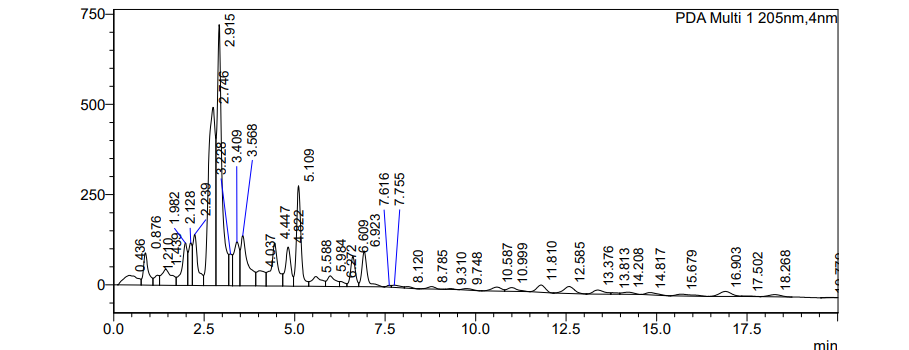 | Figure 1. HPLC–PDA chromatogram of Agaricus bisporus extract |
Further analysis of the chromatographic data revealed that the major component of the extract was detected at a retention time of 2.915 min, accounting for 19.614% of the total peak area. The second predominant component was observed at 2.746 min with a relative abundance of 18.860%. In addition, several other components were identified at retention times of 2.239 min (3.783%), 1.982 min (3.456%), 1.410 min (2.468%), 0.876 min (2.441%), 6.693 min (2.234%), and 7.616 min (2.893%). Moreover, minor constituents were detected at retention times of 5.188 min (1.936%), 3.568 min (1.593%), 4.437 min (1.981%), 12.585 min (1.110%), and 16.903 min (0.945%). The remaining peaks exhibited relative abundances in the range of 0.03–1.0%, corresponding to trace-level metabolites present in the extract. These results indicate that the Agaricus bisporus extract contains a diverse range of biologically active secondary metabolites, including sterols, terpenoids, phenolic compounds, and other bioactive substances. The chromatographic profile confirms that the extract represents a complex, multi-component chemical system. The results show that the large number of peaks detected in the extract indicates that the mushroom has a complex secondary metabolite system. The high percentage of major components indicates that these substances play an important role in biological activity. Minor constituents are by-products of metabolism or trace compounds formed during the extraction process, which enrich the overall chemical profile.Identification of Secondary Metabolites by GC–MS Analysis. The GC–MS analysis of the extract obtained from the biomass of Agaricus bisporus revealed the presence of various biologically active compounds, including lipids, terpenoids, and vitamins. A total of 10 major peaks were observed in the chromatogram, which were identified based on their retention times and relative peak areas.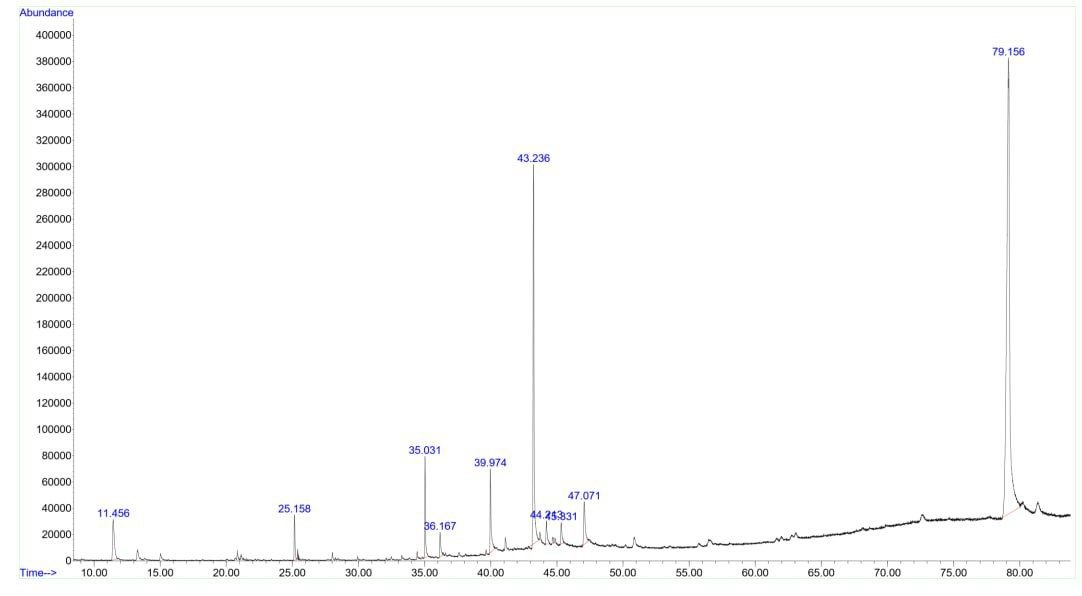 | Figure 2. GC–MS spectrum of Agaricus bisporus extract |
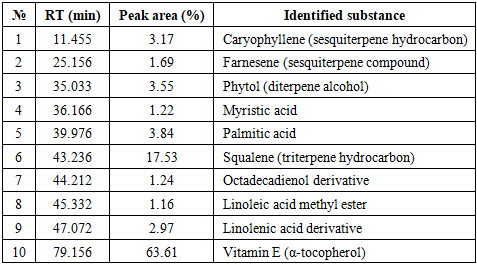
The GC–MS analysis revealed that the most intense peak was observed at a retention time (RT) of 79.156 min, with a relative abundance of 63.61%. Comparison with the NIST mass spectral library identified this compound as vitamin E (α-tocopherol). This result indicates that tocopherols represent the major components of the extract. The second most abundant peak was detected at RT = 43.236 min, accounting for 17.53% of the total composition, and was identified as squalene, an important precursor in sterol biosynthesis. Additionally, a peak observed at RT = 35.033 min with a relative abundance of 3.55% was assigned to phytol, a diterpene alcohol known for its antioxidant and biological activity. Several fatty acids were also identified in the extract, including palmitic acid (RT = 39.976 min, 3.84%), linolenic acid (RT = 47.072 min, 2.97%), myristic acid (RT = 36.166 min, 1.22%), and linolenic acid ester (RT = 45.332 min, 1.16%). Among the detected terpenoids, caryophyllene (3.17%) and farnesene (1.69%) were also identified. The high concentration of α-tocopherol is explained by its lipophilic nature and good release during ethanol extraction. In addition, this compound is one of the main antioxidants that protect fungal cells from oxidation. The identified sesquiterpenoids, such as caryophyllene and farnesene, are naturally occurring biologically active compounds in mushrooms that possess antioxidant, anti-inflammatory, and antimicrobial properties. Their presence indicates the presence of active terpenoid biosynthesis processes in the mushroom.Table 1. GC–MS analysis results of the extract obtained from the biomass of Agaricus bisporus
 |
| |
|
UV–Vis Spectral AnalysisThe extract sample was fractionated using column chromatography, and the obtained fractions were subsequently analyzed by UV–Vis spectroscopy. This method is considered one of the important analytical techniques for the identification of biologically active compounds in complex mixtures. According to the UV–Vis spectral analysis results, distinct absorption maxima were observed at approximately 220 nm and 290 nm in the spectra of the isolated fractions. The absorption band around 220 nm is mainly associated with π → π* electronic transitions in organic molecules, indicating the presence of compounds containing aromatic ring systems in the extract.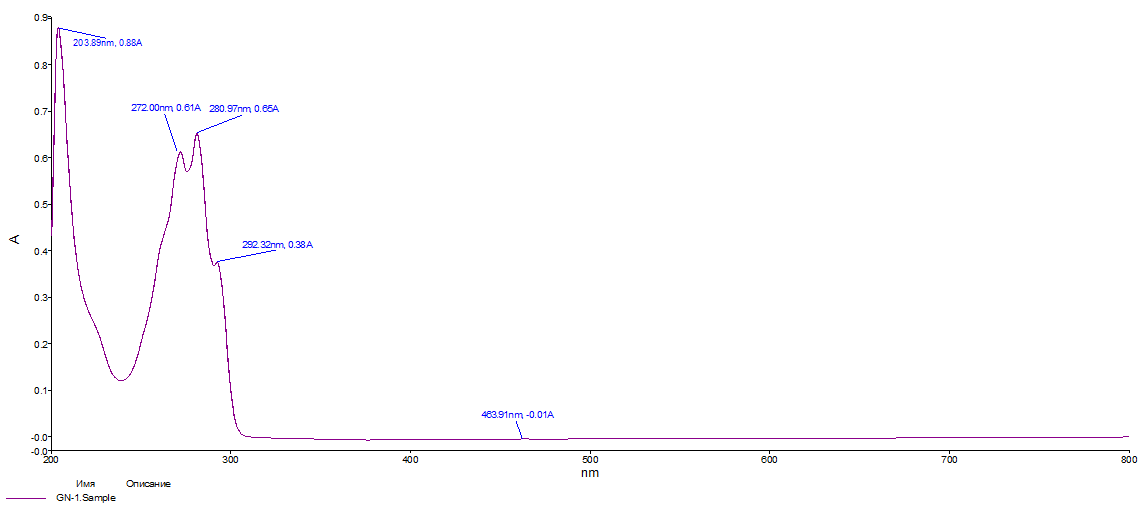 | Figure 3. UV–Vis spectrum of α-tocopherol |
In addition, the absorption maximum observed around 290 nm is a characteristic spectral feature of compounds belonging to the tocopherol group. In particular, the chromanol ring present in the α-tocopherol (vitamin E) molecule is responsible for strong absorption at this wavelength. The obtained spectral data indicate the presence of α-tocopherol (vitamin E) in the extract. This compound is a biologically active antioxidant of significant importance, known for its ability to neutralize free radicals, inhibit lipid peroxidation, and protect cell membranes from oxidative damage. Furthermore, the results obtained from UV–Vis spectroscopy are consistent with those obtained from other analytical techniques, particularly chromatographic analysis. The presence of vitamin E (α-tocopherol) in the extract was also confirmed by chromatographic methods, thereby supporting the UV–Vis spectral findings. The maximum around 290 nm is characteristic of tocopherols, which confirms the presence of a chromanol ring and is fully consistent with the GC-MS results. Overall, the results demonstrate that the studied extract contains tocopherol-type biologically active antioxidant compounds. This confirms the biological and pharmacological significance of the mushroom extract and highlights its potential applications in the nutraceutical and pharmaceutical industries.FTIR Spectral AnalysisFourier Transform Infrared (FTIR) spectroscopy was employed to determine the chemical structure of the isolated fraction. The obtained spectral data revealed the presence of various functional groups in the sample.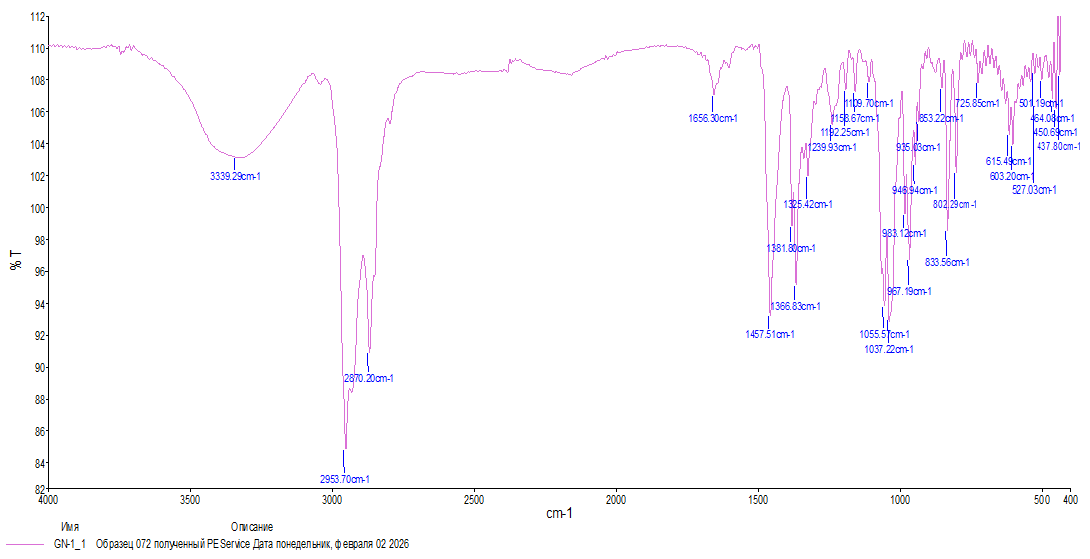 | Figure 4. FTIR spectrum of α-tocopherol |
The FTIR spectrum exhibited a broad absorption band around 3400 cm⁻¹, corresponding to the stretching vibrations of the phenolic O–H group. This band indicates the presence of a hydroxyl group attached to an aromatic ring, which is characteristic of the tocopherol structure. Additionally, absorption bands observed at approximately 2920 cm⁻¹ and 2850 cm⁻¹ were attributed to the asymmetric and symmetric stretching vibrations of aliphatic –CH₂– groups, indicating the presence of long hydrocarbon chains. This is consistent with the structure of tocopherols, which contain a long isoprenoid side chain. Furthermore, absorption bands in the range of 1460–1370 cm⁻¹ were assigned to the bending vibrations of –CH₂– and –CH₃ groups. Peaks detected in the region of 1260–1050 cm⁻¹ correspond to C–O stretching vibrations, confirming the presence of phenolic and ether functional groups. The obtained spectral data confirm that the isolated fraction contains functional groups characteristic of α-tocopherol (vitamin E). These findings are in good agreement with the results of UV–Vis spectroscopy and chromatographic analyses, further confirming the presence of tocopherol-type biologically active antioxidant compounds in the extract and supporting the proposed structure of the compound. The absorption lines in the range of 1460–1370 cm⁻¹ correspond to the deformation vibrations of the –CH₂ and –CH₃ groups in aliphatic chains. These functional groups are widely found in fatty acids, terpenoids, and tocopherols, which confirms the presence of this class of compounds in the extract.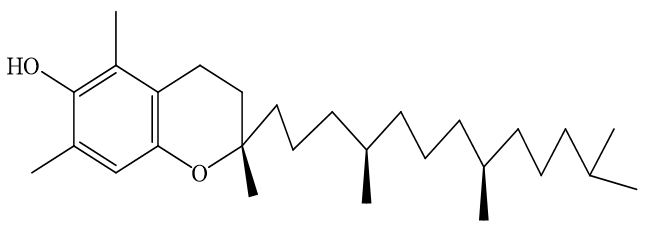 | Figure 5. Chemical structure of α-tocopherol (vitamin E) |
4. Conclusions
In the present study, the profile of biologically active secondary metabolites in the extract of Agaricus bisporus was comprehensively investigated using GC–MS analysis. The results revealed a chemically diverse composition, including terpenoids, fatty acids, and fat-soluble vitamins. Among the identified compounds, α-tocopherol (vitamin E) was determined to be the dominant constituent, with a relative abundance of 63.61%, indicating its major contribution to the overall bioactivity of the extract.The high content of α-tocopherol suggests a strong antioxidant potential of the mushroom extract, likely associated with its ability to inhibit lipid peroxidation and protect biological membranes from oxidative damage. Compared to previously reported data on mushroom-derived metabolites, the relatively elevated proportion of α-tocopherol highlights the significance of Agaricus bisporus as a valuable and accessible natural source of vitamin E–like compounds.Despite these promising findings, the study is limited by the use of a single analytical approach (GC–MS) and the absence of in vitro or in vivo biological activity assays. Therefore, further studies are required to validate the antioxidant capacity and to elucidate the pharmacological mechanisms of action of the identified compounds.Overall, the results provide important insights into the chemical composition and functional properties of Agaricus bisporus extracts and support their potential application in the development of natural antioxidant formulations for food, pharmaceutical, and nutraceutical industries. Future research should focus on bioactivity-guided fractionation, quantitative validation, and formulation development to fully realize the applied potential of these mushroom-derived compounds.
References
| [1] | Zhang, M.; et al. Chemical structures, biological activities, and biosynthetic analysis of secondary metabolites from Agaricus mushrooms: A review. J. Agric. Food Chem. 2024, 72, 12387–12397. |
| [2] | Nzekoue, F.K.; et al. Effect of the ultrasound-assisted extraction parameters on the determination of ergosterol and vitamin D₂ in Agaricus bisporus, A. bisporus Portobello, and Pleurotus ostreatus mushrooms. J. Food Compos. Anal. 2022, 109, 104476. https://doi.org/10.1016/j.jfca.2022.104476. |
| [3] | Barros, L.; et al. Optimization of the determination of tocopherols in Agaricus sp. edible mushrooms by a normal phase liquid chromatographic method. Food Chem. 2008, 110, 1046–1050. https://doi.org/10.1016/j.foodchem.2008.03.016. |
| [4] | Reis, F.S.; et al. A comparative study of tocopherols composition and antioxidant properties of in vivo and in vitro ectomycorrhizal fungi. LWT Food Sci. Technol. 2011, 44, 820–824. https://doi.org/10.1016/j.lwt.2010.11.033. |
| [5] | Heleno, S.A.; et al. Tocopherols composition of Portuguese wild mushrooms with antioxidant capacity. Food Chem. 2010, 119, 1443–1450. https://doi.org/10.1016/j.foodchem.2009.09.025. |
| [6] | Elmastas, M.; et al. Determination of antioxidant activity and antioxidant compounds in wild edible mushrooms. J. Food Compos. Anal. 2007, 20, 337–345. https://doi.org/10.1016/j.jfca.2006.07.003. |
| [7] | Jaworska, G.; et al. Vitamins, phenolics and antioxidant activity of culinary prepared Suillus luteus mushroom. LWT Food Sci. Technol. 2014, 59, 701–706. https://doi.org/10.1016/j.lwt.2014.07.040. |
| [8] | Bernaś, E.; Jaworska, G. Vitamins profile as an indicator of the quality of frozen Agaricus bisporus mushrooms. J. Food Compos. Anal. 2016, 49, 1–8. https://doi.org/10.1016/j.jfca.2016.03.002. |
| [9] | Muszyńska, B.; et al. Composition and biological properties of Agaricus bisporus fruiting bodies: A review. 2017. |
| [10] | Öztürk, M.; et al. In vitro antioxidant, anticholinesterase and antimicrobial activity studies on three Agaricus species with fatty acid compositions and iron contents. Food Chem. Toxicol. 2011, 49, 1353–1360. |
| [11] | Atila, F.; Owaid, M.N.; Shariati, M.A. The nutritional and medical benefits of Agaricus bisporus: A review. J. Microbiol. Biotechnol. Food Sci. 2017, 7, 281–286. |
| [12] | Beelman, R.B.; Royse, D.J.; Chikthimmah, N. Bioactive components in button mushroom Agaricus bisporus of nutritional, medicinal, and biological importance. Int. J. Med. Mushrooms 2003, 5. |
| [13] | Shu, L.; et al. Morphological and metabolic changes in an aged strain of Agaricus bisporus As2796. Appl. Microbiol. Biotechnol. 2021, 105, 7997–8007. |
| [14] | Chen, H.P.; Liu, J.K. Secondary metabolites from higher fungi. Prog. Chem. Org. Nat. Prod. 2017, 106, 1–201. |
| [15] | Jiang, N.; Xu, S.; Li, C. Research progress on pharmacological activity of Agaricus bisporus: A review. Food Biosci. 2025, 107763. |
| [16] | Jaworska, G.; et al. Nutraceuticals and antioxidant activity of prepared commercial mushrooms Agaricus bisporus and Pleurotus ostreatus. J. Food Qual. 2015, 38, 111–122. https://doi.org/10.1111/jfq.12132. |
| [17] | Stojković, D.; et al. Cultivated strains of Agaricus bisporus and A. brasiliensis: Chemical characterization and evaluation of antioxidant and antimicrobial properties. Food Funct. 2014, 5, 1602–1612. |
| [18] | Tsai, S.-Y.; et al. Antioxidant properties of ethanolic extracts from culinary-medicinal button mushroom Agaricus bisporus harvested at different stages of maturity. Int. J. Med. Mushrooms 2008, 10, 127–137. https://doi.org/10.1615/IntJMedMushr.v10.i2.30. |
| [19] | Glamočlija, J.; et al. A comparative study on edible Agaricus mushrooms as functional foods. Food Funct. 2015, 6, 1900–1910. |
| [20] | Ghahremani-Majd, H.; Dashti, F. Chemical composition and antioxidant properties of cultivated button mushrooms (Agaricus bisporus). Hortic. Environ. Biotechnol. 2015, 56, 376–382. |
| [21] | Zhang M. et al. Chemical structures, biological activities, and biosynthetic analysis of secondary metabolites from Agaricus mushrooms: A review // Journal of Agricultural and Food Chemistry. – 2024. – Т. 72. – №. 22. – С. 12387-12397. |
| [22] | Agnihotri C. et al. Ultrasonication-Assisted Extraction and Exploration of Untargeted Metabolomics in Agaricus bisporus Fruiting Body and Stipe using LC/MS Q-TOF // Journal of Pharmaceutical and Biomedical Analysis. – 2025. – С. 117257. https://doi.org/10.1016/j.jpba.2025.117257. |
| [23] | Hola B., Murshed R., Jbour M. Chemical composition and antioxidant activity of some Syrian wild mushroom (Agaricus spp) strains // Scientific Reports. – 2023. – Т. 13. – №. 1. – С. 15896. |
| [24] | Krishnamoorthi R. et al. Dietary nutrients in edible mushroom, Agaricus bisporus and their radical scavenging, antibacterial, and antifungal effects // Process Biochemistry. – 2022. – Т. 121. – С. 10-17. https://doi.org/10.1016/j.procbio.2022.06.021. |
| [25] | Kang L. et al. Characterization and antioxidant activity of polysaccharides from Agaricus bisporus by gradient ethanol precipitation // Chemistry & Biodiversity. – 2025. – Т. 22. – №. 8. – С. e202500120. https://doi.org/10.1002/cbdv.202500120. |


 Abstract
 Reference
 Full-Text PDF
 Full-text HTML