
-
Paper Information
- Paper Submission
-
Journal Information
- About This Journal
- Editorial Board
- Current Issue
- Archive
- Author Guidelines
- Contact Us
American Journal of Biochemistry
p-ISSN: 2163-3010 e-ISSN: 2163-3029
2026; 16(1): 6-10
doi:10.5923/j.ajb.20261601.02
Received: Mar. 2, 2026; Accepted: Mar. 25, 2026; Published: Mar. 28, 2026

Analysis of the Composition of Macro and Micro Elements of Certain Proportions of Carrot, Turnip and Radish Leaves
 Abstract
 Reference
 Full-Text PDF
 Full-text HTML
Ibragim Askarov Rakhmanovich1, Nargiza Atakulova Bakhtiyorjon kizi2, Guzaloy Madaminova Anvarjon kizi3, Sarvinoz Odilova Burkhonjon kizi3
1Doctor of Chemical Sciences, Professor of Chemistry Department, Andijan State University, Andijan, Uzbekistan
2Teacher of the Department of Chemistry, Doctor of Philosophy in Chemistry, Andijan State University, Andijan, Uzbekistan
3Master’s Student of the Department of Chemistry, Uzbekistan
Correspondence to: Nargiza Atakulova Bakhtiyorjon kizi, Teacher of the Department of Chemistry, Doctor of Philosophy in Chemistry, Andijan State University, Andijan, Uzbekistan.
| Email: |  |
Copyright © 2026 The Author(s). Published by Scientific & Academic Publishing.
This work is licensed under the Creative Commons Attribution International License (CC BY).
http://creativecommons.org/licenses/by/4.0/

This carrot in the article (Daucus carota L), turnip (Brassica rapa L) and radish (Raphanus sativus L.) plants of leaves mutual some of the proportions macro and micro elements composition analysis In particular, this plant of leaves botanist classification, chemical composition and human health for benefits studied. Sample in the content chemical elements amount induction connected plasma optical emission spectrometry in the way was found. Research during turnip leaf macro and micro elements according to the most wealth known It was. Especially turnip The leaves contain the highest levels of K (400-550mg/100gr), Ca (200-300mg/100gr) many occurs on a carrot leaf and micronutrients include iron (2-3.5mg/100gr) and there is (0-.3-0.5mg/100gr) presence because of blood harvest to be support Radish leaf and mineral and biological active substances with detoxification and liver in the activity This is useful. positive results through village farm waste as carrot, turnip and radish from the leaves in the future ecological clean to products convert opportunity gives. With this one in line this from waste healer food - food additives, pharmaceuticals in the field, and cosmetics tools also wide in taking use possible. These through and waste reduce according to wide extensive efforts are also achieved and green chemistry principles, and ecological stability obligations Research results in low impact has plant based on ingredients turnover bioeconomy and prevention health storage approaches input the necessity emphasizes.
Keywords: Carrot, Turnip, Radish leaves, Macro and micro elements, Green chemistry, Potassium, Calcium, IBP-OES method
Cite this paper: Ibragim Askarov Rakhmanovich, Nargiza Atakulova Bakhtiyorjon kizi, Guzaloy Madaminova Anvarjon kizi, Sarvinoz Odilova Burkhonjon kizi, Analysis of the Composition of Macro and Micro Elements of Certain Proportions of Carrot, Turnip and Radish Leaves, American Journal of Biochemistry, Vol. 16 No. 1, 2026, pp. 6-10. doi: 10.5923/j.ajb.20261601.02.
Article Outline
1. Introduction
- Today on the day whole in the world big to the problem rotating healthy food and human health for necessary was natural food products to multiply big importance being given to everyone known. In particular, the population healthy to eat was need increasing progressing, natural plants and natural food to their products and from them removable vitamins, minerals, biological active from compounds organization found food to the additions was demand to increase take is coming [1].Plants not only root vegetables, maybe often consumption undoable leaf parts are also valuable chemical to the content has are, they are human health for necessary was many substances source is considered [2].In particular, in Uzbekistan wide cultivated carrot (Daucus carota L.) turnip (Brassica rapa L.) and radish (Raphanus sativus L.) folk farm and food in the industry important place catcher from plants is considered. In practice this of plants mainly root vegetable consumption is done, but their leaves and still enough at the level unrated without waste as However, scientific research this It shows that carrots, turnips and radish leaves in the composition big in quantity human organism for necessary macro and micro elements in water solvent vitamins (vitamin C, group B) vitamins), minerals, antioxidants to the feature has phytochemical compounds high in quantity occurs (Table 1) [3].Carrot (daucus carrot) - very ancient from the times our people between healer vegetable as applied bride to everyone known and famous. This useful of the plant not only root vegetable maybe his/her The leaves are also popular. in medicine very many diseases in treatment and prevent in receiving Carrots are used. annual or two annual plant cultural type and, that is consumption for sowable type two annual Carrots are ethereal. oily plants in a row Up to 1.9% in fruits, plant on the leaf and up to 0.13% ether oil, as well as geraniol, dautsene, bisaboden, sesquiterpene caratol alcohol, daukol, azaron and other compounds Available in carrot root and one row carotenoids, vitamins K, B1, B2, PP, C, pantothenate acid and inositol and phytosterols, phosphatides, enzymes, sugars, flavonoids, microelements, fiber, potassium, calcium, iron and other many biological active rich in nutrients. Their combination human skin restore, see improve immunity reinforcement and heart and blood vein system in support important role plays [1,4].Radish (Raphanus sativus L.) cabbages to the family belonging two annual plant. 5 thousand of them year before Egypt, Greece and In Rome planted. Current at the time in the world all in countries cultivated is coming. Contains average 1.92% protein, 1.58% sugar, 1.55% fiber, 8–29 mg vitamin C and other vitamins available. Article exchange and food digestion improves. Radish Uzbekistan central in the regions July end August at the beginning, south in the regions is cultivated in Uzbekistan. radish Margilan and Andijan quick-cooking varieties state to the list included. Productivity Margilan grade 350 - 360 s/ up, Andijan variety and up to 480 - 500 s/ harvest giving is coming. Radish of the tree leaves usually waste as throw away sent, but they biological active rich in nutrients valuable raw material The leaves are green colorful, sharp tasty is, the plant high photosynthesis to the activity has part is considered. People in medicine radish leaves organism cleanser, anti- inflammatory antibacterial and immunity reinforcing tool as Radish is used. leaves own in the composition organic acids, vitamins, minerals and phytochemical compounds gathered. Radish Vitamin C (ascorbic acid) in the leaves acid) 80– 100 mg/%, strong antioxidant, immunity increases inflammation Vitamin A (carotene) in the form of) – 3–5 mg/100 g boron, see ability and skin health improves [5].Vitamin K – blood coagulation process Vitamin B group (B1, B2, B6, folate) – substances exchange Calcium (Ca) – bone and tooth strength Iron (Fe) – hemoglobin synthesis for Important. Potassium (K) – heart activity supports, swelling Flavonoids (quercetin, kaempferol) – antioxidant, anti - inflammatory against impact Glucosinolates (sinigrin, raphanin) – antibacterial and antitumor properties has. Humidity amount – 85–90%, proteins – 2.5–3.0%, carbohydrates – 3–5%, fibers – up to 1.5–2% occurs [6,7,8].
2. Page Layout
- Sample worker solution preparation. In advance dried, ground, 0.001 g accuracy on the scales pull taken (Navigator tm, OHAUS ®) 1 g sample porcelain in the crucible dry ash to take in the method muffle in the oven (Nabertherm, Germany) 500°C until to heat with ash was taken. In this initially 95°C up to 30 minutes, 120°C up to 60 minutes, 300°C up to 120 minutes and 550°C up to 60 minutes heated and 5 hours 550°C at temperature hold stood up. Harvest was Add 3 ml of 70% HNO3 (Sigma Aldrich, USA) of ICP-MS grade to the ash and 2 ml of 60% H2O2. pouring, white smoke harvest to be until it's over chimney in the closet to heat on the plate heated. Cooled 100 ml solution polypropylene measurement to the flask transferred, ultra clean water with to the line delivered. This worker from the solution syringe using a filter (0.45 μ m) filtered analysis for used [9].
3. Page Style
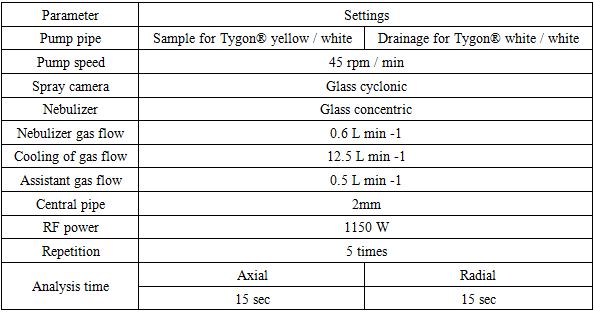
- Standard solutions Preparation of 2% HNO3 of 68 elements at a concentration of 10 mg/l standard solution (Highpuritystandards, USA), 2% HNO3 of 4 elements at a concentration of 1000 mg/l standard solution (CPAchem, Sweden), 70% HNO3 (Sigma Aldrich, USA), 5% HNO3 of 20 elements at a concentration of 1000 mg/l standard solution (CPAchem, Sweden), 70% HNO3 (Sigma AccuStandard, USA) solutions 2% of 69 elements using HNO3 in standard worker solution prepared and dilution way with 6 more types standard worker solutions prepared. Empty sample from a 2% HNO3 solution as used. Above standard worker from solutions used for 69 elements without calibrator line harvest Calibrator R 2 of the lines values above 0.995 in case analysis continue was carried out.Analysis performed by Thermo Fisher Scientific (USA) working issued iCAP PRO X Duo ICP-OES induction connected plasma in an optical emission spectrometer done The method was increased. creation, analysis the results analysis to do QTegra in the ISDS program done. Analysis The parameters are listed in Table 1 [10].
|
4. Results and Discussion
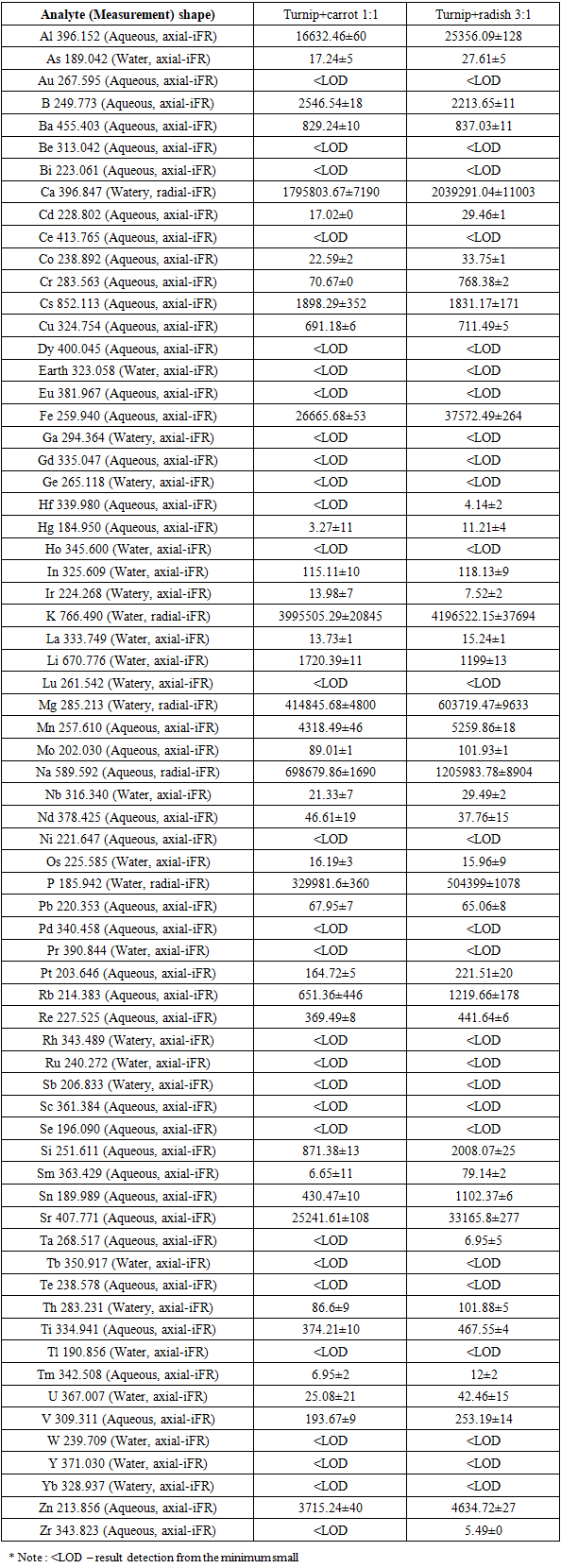
- Turnip leaf in the content macro and microelements Amount is g/100g.
|
5. Conclusions
- This in the article In Uzbekistan cultivated carrots from plants (Daucus carota L), turnip (Brassica rapa L) and radish (Raphanus sativus L.) leaves botanist classification, distribution, chemical composition, macro and micro elements discussion was done. Turnip on the leaf macro and microelements amount YuSSX in the way identified and analysis was done. In this Macronutrients: 2010 mg/100g K (Potassium) and 965 mg/100g Ca (Calcium), 67 mg/100g vitamin B1 (Thiamine), 21 mg/100g vitamin PP and 532 mg/100g quercetin flavonoid and 231 mg/100g salicyl acid phenol compounds many in quantity that was identified.Food as plants parts consumption because of health storage ministry by state standard requirements working was released. According to this ash amount, humidity to the amount their vital nutritional (minerals, fiber, vitamins, phenolic compounds and antioxidants) are great attention In particular, various kind useful to the features has phytochemical substances existence because of turnip leaves consumption to do natural medicinal value with health to save provides. First annual on the leaves calcium and potassium the most many a mineral that occurs was detected. On the leaves at total flavonoid levels quercetin and high in apigenin was. In vitamins in the water solvent vitamins amount many that from outside accessible vitamins encourages and daily need satisfies. Currently food natural accordingly storage, artificial from additions escape and this with new products working to release to optimize contribution add for turnip leaf functional products to the ranks add for enough is considered rich.
ACKNOWLEDGEMENT
- The authors express their sincere gratitude to the staff of the Department of Chemistry, Andijan State University, for their continuous support and assistance in conducting this research. Special thanks are extended to the laboratory personnel for their technical support during the ICP-OES analysis. The authors also acknowledge the valuable contributions of colleagues who provided guidance and encouragement throughout this study. This research was supported by the internal research grants of Andijan State University, and the authors are thankful for the financial and infrastructural support provided.
DISCLOSURE
- The authors confirm that there are no conflicts of interest associated with this publication. The manuscript has not been previously published, nor is it under consideration by another journal. All authors have reviewed and approved the final version of the manuscript. No external expert reviews were purchased or disclosed for this work. The findings presented are based solely on the independent research conducted by the authors.