
-
Paper Information
- Paper Submission
-
Journal Information
- About This Journal
- Editorial Board
- Current Issue
- Archive
- Author Guidelines
- Contact Us
Advances in Computing
p-ISSN: 2163-2944 e-ISSN: 2163-2979
2013; 3(2): 22-29
doi:10.5923/j.ac.20130302.02
Task Scheduling for Computational Grids Using NSGA II with Fuzzy Variance Based Crossover
 Abstract
 Reference
 Full-Text PDF
 Full-text HTML
Reza Salimi , Navid Bazrkar , Mostafa Nemati
College of Computer Science, Tabari Institute of Higher Education, Babol, Iran
Correspondence to: Reza Salimi , College of Computer Science, Tabari Institute of Higher Education, Babol, Iran.
| Email: |  |
Copyright © 2012 Scientific & Academic Publishing. All Rights Reserved.
Scheduling algorithms have essential role in computational grids for managing jobs, and assigning them to appropriate resources. An efficient task scheduling algorithm can reduce the total Time and Price for jobs execution and improve the Load balancing between resources in the grid. In this paper, we address scheduling problem of independent tasks in the market-based grid environment. We use NSGA-II to optimize task scheduling problem in grid. For decreasing computation, we considered Load balancing problem and improved it in task scheduling indirectly using fuzzy system without implementing third objective function. For the first time, we proposed Variance based Fuzzy Crossover operator for this purpose and more variety in Pareto-optimal solutions. Two functions are defined to generate two inputs for fuzzy system. Variance of Costs and presence of resources in scheduling are used to specify probability of crossover intelligently. Second fuzzy function with cooperation of Makespan objective satisfies load balancing objective indirectly. Our method conducts the algorithm toward best and most appropriate solutions with load balancing in less iteration. Results obtained proved that our innovative algorithm converges to Pareto-optimal solutions faster and with more quality.
Keywords: Task Scheduling, Load Balancing, Grid Computing, Non-Dominated Sorting Genetic Algorithm II,Fuzzy Variance Based Crossover Operator, Multi Objectives Optimization
Cite this paper: Reza Salimi , Navid Bazrkar , Mostafa Nemati , Task Scheduling for Computational Grids Using NSGA II with Fuzzy Variance Based Crossover, Advances in Computing, Vol. 3 No. 2, 2013, pp. 22-29. doi: 10.5923/j.ac.20130302.02.
Article Outline
1. Introduction
- Grid Computing has originated from a new computing environment that has emerged as a main- stream technology for scientific research and cooperation using large-scale computing resources sharing and distributed system integration. In fact, computational resources in grid are geographically distributed computers or clusters, which are aggregated to serve as a single computing resource logically[1][2]. On the other hand, the goal of load balancing algorithms is essentially to fairly spread the load on computational resources for maximizing their utilization while minimizing the total task execution time[3][4][5]. In distributed computational systems, load balancing has important role in reducing response time and avoiding overload. Load balancing is applied in grid computing system, using some scheduling algorithm to ensure that the ratio of performance of entire resource node computing as an equal, therefore by improving the utilization of resources based on nodes, the overall task completion time can be reduced[6]. Computational grids enabling resource sharingand coordination are now one of the common and acceptable technologies used for solving computational intensive applications rising in scientific and industrial problems. Nevertheless, due to the heterogeneity, dynamicity and autonomy of the grid resources, task scheduling within these systems has become a challenging research area[7]. Therefore, many research works have been done to overcome these challenges by proposing new algorithms and mechanisms. Applying the market model to the grids is a good approach which can easily take the dynamic characteristics of the grid resources into account and simplify the scheduling problem considering user-centric trends. Also performance and quality of scheduling algorithms are very important in grid computing because of variable conditions in resources and communications. Proposed method enhances the intelligence of Genetic Algorithms in adapting to the environment using intelligent rate for genetic operators and so causes the better performance and quality. In this paper, we made use of a multi-objective heuristic genetic algorithm, NSGA II for optimizing two objectives: Cost and Makespan in scheduling problem in grid computing. We considered Load balancing problem and improved it in task scheduling indirectly using fuzzy system instead of implementing third objective function. We implemented Variance based Fuzzy Crossover operator for this algorithm. In the experiments, we have used the standard mutation with mutating bits of a solution based on bit mutation probability (The likelihood of mutating each bit of a solution in mutation). Some algorithms are used and then are compared together. The rest of paper is organized as follows. We begin with an overview of related works in section 2. NSGA II and our approach are presented in section 3. Experimental results and discussion are represented in sections 4 and 5. Finally the paper is concluded in section 6.
2. Related Works
- Previously proposed approaches for scheduling problem in traditional grids are limitative for users. Those don’t provide different solutions with different qualities for users to select one based on their requirements and capabilities optionally. For example, approaches[1, 2] mostly consider system and grid factors like Maximum load balance and Makespan of the system as main objective in scheduling, ignoring the interests and requirements of users or[8] considers cost and Makespan as objectives in scheduling without load balancing using Genetic Algorithm and variable neighbourhood search. Buyya et al. in reference[9] proposed only an economics model for Grid resource management and scheduling, using marketing concepts such as commodity market, posted price modeling, bargaining modeling, contract net modeling, auction modeling and other. It is represented in[10] two types of GA for improving the performance. These only minimize the total execution time and satisfy the load balance. In[11] has been proposed a job grouping method using Particle Swarm Optimization (PSO) to reduce the communication overhead and consequently reduce the completion time of the processes in computational grid and improve resource utilization. The objective of that paper is to dynamically assemble the individual fine-grained jobs of an application into a group of jobs and then transfer these coarse-grained jobs to the grid resources, so that optimizes the utilization of grid resources and reduces the overall completion time for processing user jobs. In[12] is represented a pure load balancing in computational grid using genetic algorithm without considering Makespan or cost for grid resources. In[13] has been studied the various load balancing strategies based on a tree representation of a grid. This study enables transforming any grid architecture into a unique tree with at most four levels. Task scheduling in[13] and[14] only considers the load balancing without Makespan or cost for users. A hierarchical layered architecture for grid computing services in[15] has been offered. It proposed an adaptive two levels algorithm, which attempts to minimize the overall completion time or Makespan and maximize the system throughput. Use of multi-objectives optimization algorithms such as NSGA II in[16] is observed. It uses NSGA II for optimizing Tasks scheduling problem in heterogeneous distributed computing system considering two objectives, Makespan and flow time without load balancing.We studied the effect of mutation rate on diversity and quality of Pareto front and proposed fuzzy adaptive mutation ratein[17] for the first time for NSGA IIto solve tasks scheduling problem in market based grid computing. In that work three objectives: Price, Makespan and Load balancing were optimized using three- dimensional optimization.
3. NSGA II and Proposed Method
- The NSGA-II algorithm[18] is the first and one of the commonly used evolutionary multi-objective optimization (EMO) algorithms which search solution space to find Pareto-optimal solutions in a multi objective optimization problem. NSGA-II uses the elitist principle and an explicit diversity preserving mechanism. In addition to, it emphasizes non-dominated solutions and forms the Pareto front as Pareto-optimal solutions[19]. The NSGA-II algorithm uses two effective strategies including an elite-preserving and an explicit diversity-preserving. NSGA-II uses an explicit diversity-preservation or niching strategy to assign a diversity rank to all the individuals that are in the same non-dominated front and thus have the same non-dominated rank in the population[18]. The members within each non-dominated front that are in the least crowded region in that front are assigned a higher rank. For calculating the density of solutions surrounding a particular solution in the population, a crowding distance metric is used that is achieved from the average distance of the two solutions on either side of the solution along each of the objectives. As respects this particular niching strategy does not require any external parameters, so it was chosen for NSGA II. Details can be found elsewhere[19][20]. Because of the nature of the models of the multi-objective optimization problems, non-dominated sorting genetic algorithm (NSGA) can be used to find the non-dominant optimal solutions. In the absence of any additional information about multi-objective optimization problem, one of these Pareto-optimal solutions cannot be considered as better solution than the others[21]. Superiority and Suitability of one solution over the others depends on several factors including user’s choice and problem environment. Therefore, the NSGA II determines a set of dominant solution and so Pareto front is obtained[22]. In this paper, NSGA II with Variance based Fuzzy Crossover Operator is used to address independent task assignment problems in parallel distributed computing systems. Tasks scheduling in grid is done with two objectives, Price and Makespan, with NSGA II without fuzzy logic and with fuzzy logic; besides our method considers load balancing using fuzzy function indirectly. In NSGA II with Variance based fuzzy Crossover, inputs for fuzzy function are Variance between Costs of individuals and percentage of presence of available resources in scheduling. In next section we solve the problem with proposed approach.
3.1. Encoding Mechanism
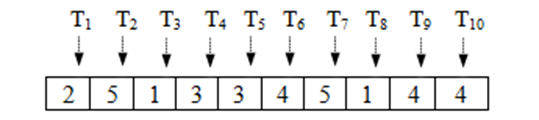
- In the coding scheme we have developed for our problem, each solution is encoded as a vector of integers. For a problem with n tasks and m resources, the length of the vector which can be considered as a chromosome is n. As well as, the content of each cell of vector which shows a gene value in chromosome can take a number between 1 and m that representing the resource allocated to that task. An example of a chromosome as a schedule with 10 tasks and 5 resources is shown in Fig.1.
 | Figure 1. An example of a chromosome in coding Scheme |
3.2. Objectives and Fitness Functions
- Our main objective here is to get task assignments that will achieve minimum completion time and minimum Price for users. Therefore, our fuzzy NSGA II algorithm is a two dimensions optimization. In this problem two objectives Price and Makespan are in conflict with each other naturally so that when Price is reduced then Makespan is increased.
3.2.1. Makespan
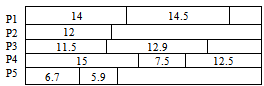
- The first objective function of our algorithm is the Makespan or latest completion time of the task schedule. Makespan means the longest completion time among all the processors in the system[1][3]. Consider Ti and Cj denote the size of the task i and processing speed of the resource j, respectively. Then, the execution time of the task i on the resource j can be formulated as follow:
 | (1) |
|
|
 | (2) |
 | (3) |
 | Figure 2. Example of Makespan |

3.2.2. Minimum Price
- As mentioned, resource providers in market-based grids can request price from users based on the amount of resource that requested by them. Therefore, scheduling algorithms in market-based grid should consider users' willingness to complete their applications in the most economical way possible[8]. So, second objective function is total price that must be minimized. Suppose wjdenotes to unit price for resource j. therefore, the execution cost of the task i on the resource j can be computed using following equal:
 | (4) |
 | (5) |
3.2.3. Maximum Load Balance
- For proving with reason about improvement the load balancing using proposed method, we define load balancing function to evaluate and compare load balancing on results of algorithms.The load balancing mechanism is distributing the load on each computing node equitably, and maximizes the utilization and minimizes the total task execution time. In order to get these goals, the load balancing mechanism should be 'fair' in distributing the load across the resources; it implies that the load difference between the "heaviest-loaded" node and the "lightest-loaded" node should be minimized. We first specify the average node utilization. Note that high average node utilization almost means that the distributed load is well balanced across all nodes in the system[1]. We obtain the average node utilization through dividing the sum of all the nodes’ utilization by the total number of nodes[1]. So, we calculate the expected utilization of each node based on the given tasks assignment. We calculate it by dividing the task completion time of each node by the Makespan. Thus, utilization of each node is:
 | (6) |
 | (7) |
 | (8) |
3.3. Variance based Fuzzy Crossover Operator
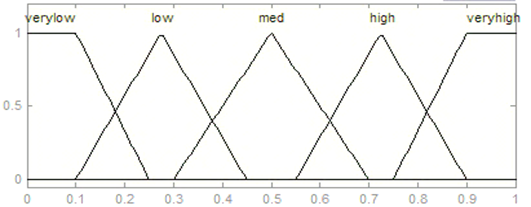
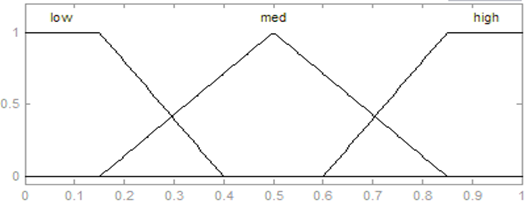
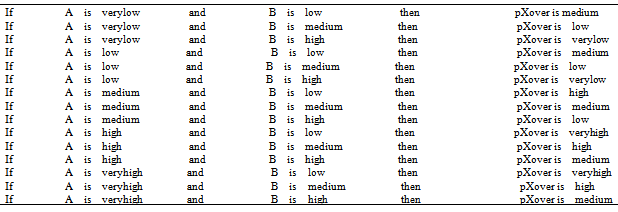
- In this paper, innovative Variance based Fuzzy Crossover operator is developed and compared with standard Crossover operator and demonstrated superior to that. Two functions are made and used for calculating the Costs Variance and percentage of involved resources in scheduling using Variance. First calculates the percentage of presence of available resourcesin scheduling (9). This function takes individuals existing in Pareto front as input and calculates the Variance of frequency of any resource in scheduling. This function first calculates the average of frequency of resources that equals number of tasks divided by number of resource that in (9) is α. Then it calculates frequency of any resources in current scheduling. Percentage of involved resources in one scheduling is calculated from these frequencies. This function will generate for any individual in Pareto front a value that denotes how much percent of all resources attend in one scheduling (10); max of these values is approximately a large value and depends on the number of tasks and resources. So, we used (11) for normalizing these values to certain values in the interval[0, 1]. Output of this function is average of these values. For Instance, a low Variance of frequency of involved resources indicates that the presence of any resource tends to be very close to the mean or in other words, tasks have been assigned to any resource equally.Therefore, this function must have a direct effect on making decision for output in the fuzzy system. We use this function with contribution of Makespan to enhance Load Balancing in task scheduling problem.
 | (9) |
 | (10) |
 | (11) |
 | (12) |
 | (13) |
 | Figure 3. Input membership function: A |
 | Figure 4. Input membership function: B |
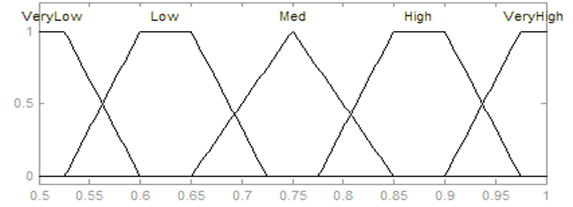 | Figure 5. Output membership function: pXover |
4. Experimental Results
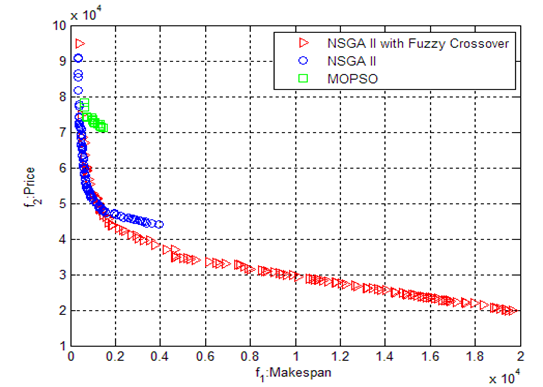
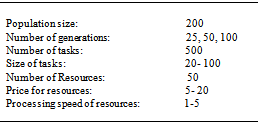
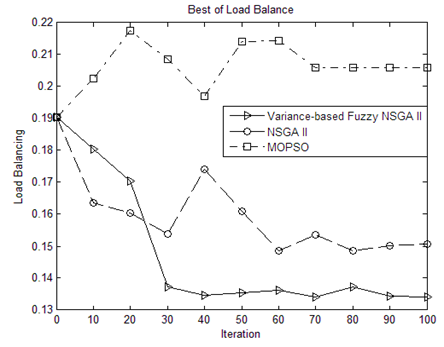
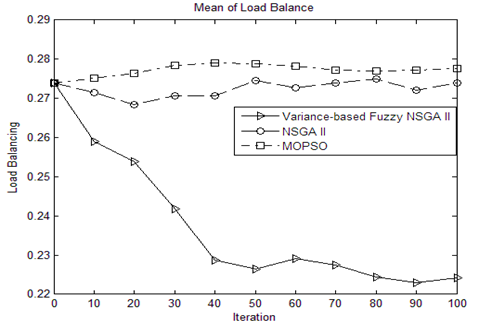
- In this section, for the experiments we optimize tasks scheduling with three algorithms MOPSO, NSGA II and variance based fuzzy NSGA II with two objectives, Price and Makespan. The algorithms are implemented according to their description in the literature[18][19][23]. We observe that our algorithm is better to others so that, our proposed method converges to Pareto-optimal solutions faster and almost with higher quality; besides it improves load balancing indirectly while other methods do not consider load balancing. Experimental results show that our algorithmcreates the Pareto front with all individuals existing in population in less iteration and also created Pareto front has wide-spread and higher quality. Furthermore during the experiments, we found that non-dominated sorting genetic algorithms perform better than the multi-objective particle swarm optimization for this scheduling problem. The results are shown in Figures 6, 7 and 8. All performance analyses are carried out at different numbers of generations, 25, 50 and 100. Tables 4 and 5 are used for the specific parameters. Size of tasks, price and speed of resources are generated randomly.As mentioned, in the market-based grid environment, two factors Price and Makespan is very important, besides load balancing also is important for every grid. For decreasing computation, we optimize tasks scheduling problem only in terms of two factors Price and Makespan. But we improve load balancing using fuzzy function without optimizing load balancing objective function. Tests were performed in 25 and 50 and 100 iterations. In any case, tests were done ten times and there exists the average of obtained results in figures 6, 7 and 8. As can be seen from the figures the performance of our proposed method is better. So that in the experiment with 50 iterations, NSGA II with fuzzy variance based crossover on average in iteration 8 totalof individuals i.e. 200 members entered into Pareto-optimal Front, while in NSGA II in iteration 40, 200 members and in MOPSO in iteration 50 only 16 members are entered into Pareto front. Also in the experiment with 100 iterations, our algorithm on average in iteration 9 total of individuals i.e. 200 members entered into Pareto- optimal Front, while in NSGA II in iteration 42, 200 members and in MOPSO in iteration 100 only 38 members are entered into Pareto front. In all experiments, Pareto Front in our proposed method was created faster and with more quality. Table 6 shows best solutions in terms of only one factor for all three algorithms. As be seen, our algorithm performs better about price and load balancing objectives functions compared to other. In the analysis, for instance, the points A in Figure 8 are the best solutions in terms of Makespan but not for Price while the points B are the best member of Pareto optimal front only in terms of Price. Most appropriate solutions in terms of both objectives are in the middle of Pareto front. Nonetheless, all of solutions in Pareto optimal front that are obtained from our method have been optimized in terms of load balancing. After optimizing task scheduling problem by all algorithms, we evaluated and compared them in terms of load balancing criterion. Figure 9 and figure 10 shows measure of load balancing in Pareto-optimal fronts that have been obtained from all. These results have been obtained from average of ten times run of algorithms. As be seen in figures 9 and 10 our method is superior to other.
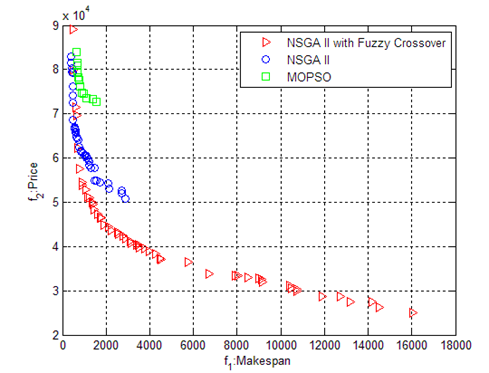 | Figure 6. Obtained Pareto-Optimal Fronts in 25 iterations |
|
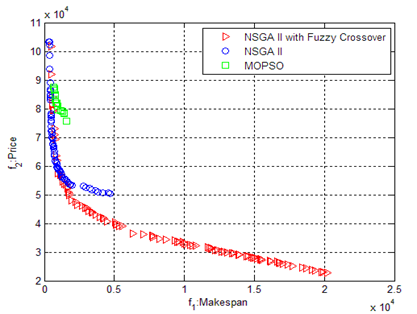 | Figure 7. Obtained Pareto-Optimal Fronts in 50 iterations |
 | Figure 8. Obtained Pareto-Optimal Fronts in 100 iterations |
|
|

|

 | Figure 9. Best Individuals in Pareto Front in terms of Load Balancing |
 | Figure 10. Average of Load Balancing objective values for Pareto Front |
5. Discussion
- In this work, applying defined Variance for fuzzy system causes to conduct the algorithm towards variety of solutions and subsequently better exploration the solution space. Variable and adaptive rate of crossover in our method increases exploration in solution space when variety of solutions is low. More variety in genes of solutions causes more variety in fitness of solutions. This is why the Pareto front can be created much faster and requires less iteration than others. For more details, Cost Variance function tries to increase variety of solutions in terms of their fitness. When value of costs variance is low, it means that many solutions are similar. So the fuzzy system increases the crossover rate in population to explore the solutions space of problem more for creating more various solutions. These various solutions form pareto-optimal front in less iteration. On the other hand, the first function that calculates percentage of involved resources, tries to make number of assigned tasks to resources close to the mean. In other words, when output of this function is high, some resources are idle and others have many tasks. So the algorithm increases the crossover rate to create more new offspring solutions. Moreover, the algorithm also optimises Makespan, result of these, will be the better load balancing. It means that decreasing Makespan and distributing the tasks to resources relatively equally, cause that resources with less computational power receive tasks with less completion time and resources with more computational power receive tasks with longer completion time. So it satisfies the load balancing implicitly and indirectly. Defined fuzzy rate for crossover is adaptive and when Variance of frequency of any resource in scheduling is high, then probability of crossover is also increased and subsequently variety of solutions is increased, and when Variance of frequency of any resource in scheduling is low, it is desired, so probability of crossover is reduced and good solutions remain more in population. We enhance the load balancing without using Pareto front or three objectives optimization but using Makespan and percentage of involved resources functions together. In fig.8 is seen that variance-based fuzzy NSGA-II performs equivalent to NSGA-II in terms of Makespan, but since price has a higher magnitude over Makespan and also proposed method tries to explore solution space with more preciseness, therefor in Table.6 is observed that price has been reduced by proposed method more than other algorithms. The points B in our method have high Makespan but corresponding price of these points are very lower than others. While in all cases, optimization using our method includes load balancing. Fig.9 and fig.10 show that obtained pareto-optimal front from proposed method has better and more Load-Balancing in terms of both best and average. This shows all generated schedules using our method have balanced the loads on resources very better to other methods. Infig.9 all three methods only optimize two objectives Price and Makespan,so obtained results in fig.9 related to NSGA II and MOPSO are stochastic and these have no method for satisfying or optimizing the Load balancing. In our method Makespan and first fuzzy function try to improve load balancing and second fuzzy function tries to increase variety of solutions. Spread and span of solutions in proposed method is more than other method because variance based fuzzy crossover rate is flexible, therefor it explores the solution space better and finds solutions in more extensive areas. Furthermore the Pareto-optimal front is created by our method much faster and with higher quality.Especial property of Pareto front is offering diverse and various solutions which trade-off between conflicted objectives. In general algorithm optimizes objectives Price and Makespan, but these objectives are in conflict with each other so that when Makespan is reduced (higher QoS); Price is increased and vice versa. Therefore algorithm offers to users all various and divers solutions. Users according to their financial ability will choose appropriate solution through offered Pareto optimal solutions and will pay its cost. In fact multiobjective optimization mechanisms obtain various possible optimum QoS levels for every user’s QoS satisfaction levels [24]. Proposed method tries to increase spread and span of Pareto front and subsequently offer users more diverse solutions which have more various QoS.Besides we could optimize three objective functions using two objective functions. This method reduces computation measure, so that if number of iterations and population are p and q, respectively, we could reduce complexity of computation p×q times through removing third objective function i.e. load balancing while it was satisfied by fuzzy system and Makespan indirectly.
6. Conclusions
- In this paper NSGA II with variance based fuzzy crossover was implemented for task scheduling in market-based grid environment and compared with general NSGA II and MOPSO. It is clear that the quality of schedules achieved by proposed method is better. In comparing the performance of the algorithms it is seen that NSGA-II with variance based fuzzy crossover maintains a uniform spread of solutions in the obtained pareto-optimal front. Spread and span of solutions in proposed method is more than others. Our method enhances the intelligence of Genetic Algorithms in adapting to environment using intelligent rate for genetic operators and so causes the better performance and quality.